Jon Batiste has a gift for transforming even the most recognizable music into something unmistakably his own.
When the New Orleans-reared pianist performed in Davies Symphony Hall last May, he sauntered through Beethoven’s canon like it was a set of American Songbook standards, taking the familiar themes down new paths defined by his command of blues and soul phrasing. The sold-out recital was an early stop on his international Maestro Tour exploring material from his hit 2024 album Beethoven Blues.
For his return to the San Francisco venue on Friday, Dec. 12, Batiste will not be alone. He’s collaborating with the San Francisco Symphony and conductor Jonathan Taylor Rush, “envisioning a really beautiful blend of music that is both my own original compositions and movements from the American Symphony,” Batiste told SF Classical Voice on a recent phone call.
In February, Batiste earned the two most recent of his seven Grammy Awards for American Symphony, the acclaimed 2023 Netflix documentary about the creation of his first symphony of the same name. Commissioned by Carnegie Hall, the embracing, celebratory work was created in counterpoint to the cancer diagnosis of his wife, Emmy Award-winning writer and health activist Suleika Jaouad.
For his forthcoming show in San Francisco, Batiste said the evening will include a sextet featuring his longtime collaborators, bassist Phil Kuehn and drummer Joe Saylor — members of his Stay Human band during Batiste’s seven-year stint on “The Late Show With Stephen Colbert.” It’s a rhythm section that gives him full access to Stay Human pieces “expanded into orchestral arrangements, as well as reworkings of pieces from Beethoven, Mozart, Ellington and Jelly Roll Morton,” he explained.
Part of what makes Batiste’s Beethoven-and-beyond repertoire so engaging is the joyful charisma he brings to the stage. Like a Mardi Gras procession that expands with every block, the 39-year-old’s live performances are a rolling party with space for everyone to harmonize. On the piano, he revels in switching up the instrumentation, placing his solos “back-to-back with the symphony, and everything in between.”
“Every section gets to be featured in more chamber-like music orchestration,” he went on. “I really enjoy telling the story of the night through all these different ensembles within the orchestra.”
Batiste describes his on-stage elaborations of Beethoven as “spontaneous composition,” a process that involves dozens of hours mapping possible forms as scaffolding for impromptu performance. In reclaiming baroque and classical music’s largely lost tradition of improvisation Batiste is in-part drawing on his Juilliard training, when he devoted an entire year to dissecting Brahms’s First Ballade.
Growing up in Louisiana, Batiste felt his various musical pursuits lived in disparate realms — “I had classical piano lessons on Saturday morning,” he recalled. “Saturday nights I was playing in the ballrooms and nightclubs of New Orleans.” It took years before he started searching for ways to methodically bridge European standards with jazz and kindred keyboard idioms.
He credits mentors from across the musical spectrum with encouraging him to follow his muse, a path that has turned him into the embodiment of New Orleans cultural polyphony.
“Both my classical mentors and my mentors from all other music traditions were all about finding your voice within the context of the repertoire and lineage,” Batiste said. “So there was a common thread across all the different pedagogy. In hindsight, it seems inevitable I would wind up here.”
He’s hardly the first artist steeped in jazz to walk this road. Duke Ellington and Billy Strayhorn vividly reimagined Tchaikovsky's Nutcracker Suite. French pianist Jacques Loussier reached a wide audience with Vivaldi’s Four Seasons. And pianist Uri Caine brilliantly expanded on the works of Mahler on his album Urlicht / Primal Light.
The documentary American Symphony captured Batiste’s process of accretion, as he found musical solutions to add new voices to the piece. He recorded a reworked version of the symphony in June for release next year, and continues to hone it so the work can become “something other orchestras could play without me being there,” he said.
His symphony is a small step in a larger vision. Batiste describes his dream scenario as gathering musicians together for impromptu invention, “playing and creating without planning.”
“We don’t just create music that’s repetitive, or based on this idea of experimental improvisation. We actually compose spontaneously together this work of great structure, intelligence and rigor, and excitement and soul,” he said. “We separately become one.”
It might sound utopian, but for Batiste the creative process has become sustaining as he and Jaouad contend with her third diagnosis of acute myeloid leukemia in 15 years.
“She’s phenomenal in her ability to, as she puts it, alchemize all of the hardships of life, to take something we’re going through and to make it something beautiful to share through our art and community,” he said. “Physically she’s doing great. We’re seeing so many miracles with this treatment, and I’m so grateful for her. As everyone in the world can see, she’s a shining star.”
Contending with the unexpected is the essence of Batiste’s art. He’s not worried about taking the symphony’s musicians off the written page. At those moments, “it’s not based on something we all know. It’s something we have yet to imagine.
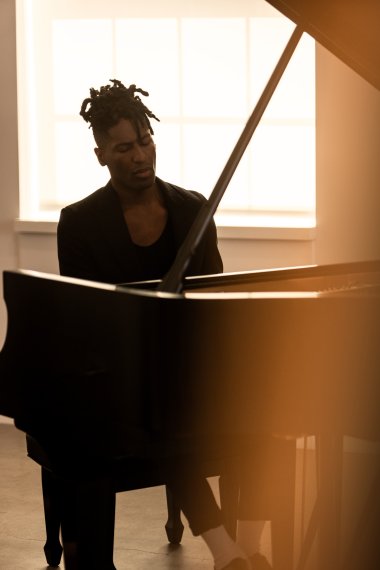
“What we’re going to do is not something we’re going to mess up, it’s meant to be expressed in this moment,” he continued. “It’s up to us to be invested in the moment, to be open and trusting to let it happen.”
Andrew Gilbert is a freelance writer. This article has been provided in partnership with San Francisco Chronicle.