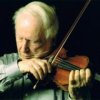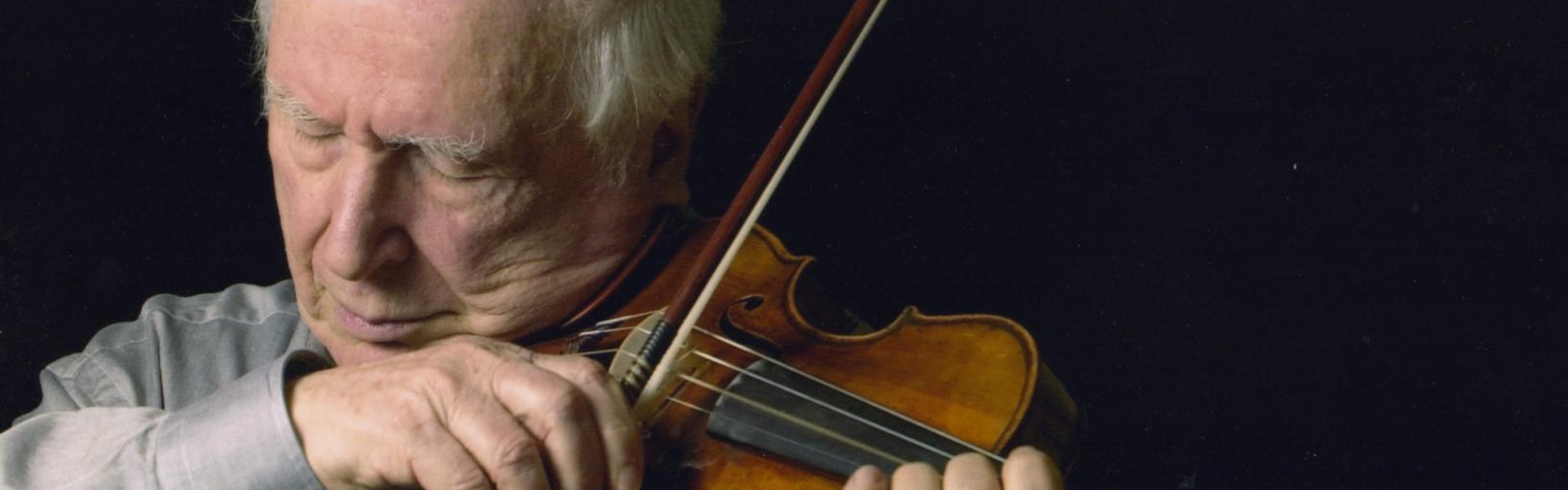
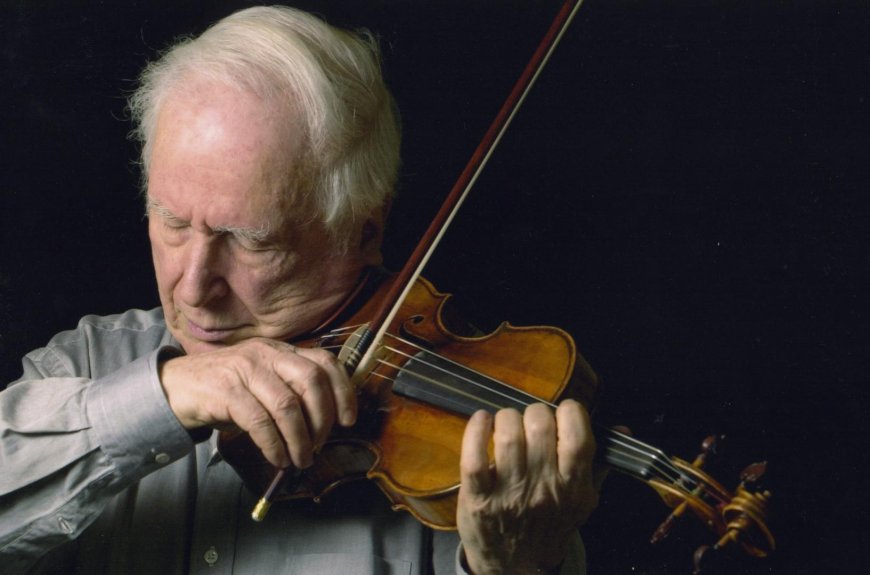
Violinist Stuart Canin will turn 100 on April 5, but even a century seems too short to contain the richness, diversity, and accomplishments of his life story.
He was a longtime concertmaster of the orchestra that used to serve San Francisco’s Symphony, Opera, and Ballet. He was also the concertmaster of the New Japan Philharmonic (under SF Symphony Music Director Seiji Ozawa), Los Angeles Opera and numerous Hollywood studio orchestras. In an interview with SF Classical Voice, the violinist proudly named nearly a dozen famous films in which he played solos — Jurassic Park, Schindler's List, Forrest Gump, Toy Story, Avalon, Death Becomes Her, among others — and almost neglected to mention the Paganini International Competition and Handel Medal he won.
Millions of moviegoers and DVD owners heard Canin play during the on-deck scenes of Titanic. In Robert Altman's Short Cuts, the violinist even got an on-camera scene. The usually humble violinist often mentions that event.
Canin served as founding music director of the New Century Chamber Orchestra, headed the Cincinnati May Festival Orchestra, and has been a faculty member at the SF Conservatory of Music and the University of Iowa, among several others.
With all this and so much more, when you ask Canin for what he is most proud of, he reels off about his children — his younger son, Ethan Canin, wrote the bestseller The Palace Thief, which has been translated into foreign languages; his elder son, Dr. Aram Canin, is an oncology specialist with Kaiser Hospitals.
Born in 1926 in New York City of Russian-Lithuanian-Jewish parents, Canin’s family lived in Far Rockaway. His father, Monroe Canin, was a cigar salesman, and one of the founders of the Tobacco and Warehouse Union in New York. Stuart’s brother, Martin, would later become a piano professor at Juilliard.
He picked up a little fiddle at age 5. Canin developed “an incredible love for the violin,” and his father was moved to purchase a real violin for him during the Depression. It was a “luxury” that “turned out to be a good investment,” Canin said.
At age 10, he appeared on the Jack Benny and Fred Allen shows — two of the pre-TV era’s biggest blockbusters. Canin played Schubert's “The Bee,” and Allen said the child “already plays better than Jack Benny.” Benny, in response, panned Allen mercilessly to fuel the on-air feud. Canin and Benny remained good friends, and three decades later, Canin returned to what was by then Benny’s TV show.
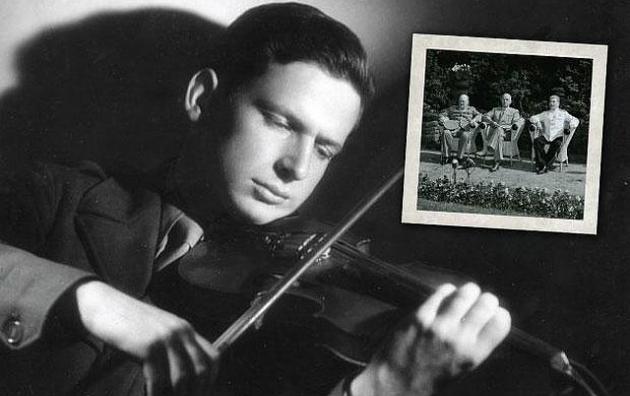
At age 19, as an Army rifleman and member of the 6817 Special Service Battalion, Canin played for Truman, Churchill, and Stalin at the Potsdam Conference. “Somebody from the Russian secret service leaped across the room to watch as I opened the case, smiled when saw the violin,” Canin recalled. He and Eugene List played the music of Wieniawsky for the heads of state after dinner on the back porch of the one remaining building in the area.
According to Canin, Mickey Rooney served in the same battalion and intended to join the performance, but dropped out. Officers realized that “Mickey doesn’t translate into Russian that easily, and Churchill was about to lose his position as prime minister of Great Britain. That didn't bode well for Mickey’s appearance, so he just got to stay in the tent for a week.”
The violinist then attended Juilliard on the GI bill as Ivan Gallamian’s student, but did not graduate because he ran out of money.
At age 26, Canin was named professor of music at the University of Iowa, and in 1956, he won a Fulbright. He spent a year in Freiburg “getting to know ISCM [International Society for Contemporary Music], [Luciano] Berio,[Bruno] Maderna, and [Leon] Kirschner.”
While Canin was teaching at the Oberlin Conservatory in 1961, he joined the Chamber Symphony of Philadelphia and participated in recordings and a national tour, “playing the Mendelssohn 19 times in 20 days.”
It was in Philadelphia that the call came from San Francisco, followed by a meeting with Seiji Ozawa in 1969, that brought Canin to the city for good.
When Davies Hall opened in 1980, enabling full seasons for the city's separate symphonic, opera and ballet orchestras (as the three no longer needed to share the Opera House), SF Symphony Music Director Edo de Waart replaced Canin because “as any music director, he wanted to have ‘his own’ concertmaster,'' Canin recollected kindly.
At that point, a new door opened for Canin in Hollywood when he took on the role of concertmaster at LA Opera from 2001 to 2010. The chair is now endowed in Canin’s name, and last week, the company appointed violinist Alyssa Park as the orchestra’s “Stuart Canin concertmaster.”
When Canin returned to the Bay Area, he taught at the SF Conservatory of Music, played solo engagements, and took the first chair in various area orchestras, including the Berkeley Symphony.
When Canin joined the founding members of the conductorless New Century Chamber Orchestra in 1992, he brought a “mature presence” to a group of very talented and very young musicians.
One of them, violist and composer Kurt Rohde, was in awe of Canin’s “youthful attitude” that ranged from the music director’s support for new composers (Canin had an important role in the realization of Rohde's Occulus and other works) to his insistence on standing during rehearsals when musicians four decades younger would prefer to make themselves comfortable.
New Century’s current music director, Daniel Hope, speaks of his predecessor as a “legend,” with admiration and affection.
Parker Monroe, who took on the role of NCCO’s Executive Director in 1996, recalls working with Canin during the ensemble’s early years:
“We planned subscription seasons together and did several tours in the United States. We travelled to New York together for the Grammy Awards ceremony when the New Century recording of Shostakovich’s music, titled Written With the Heart’s Blood, was a Grammy Award finalist.
“Of all the music directors I ever worked with and for, he was my favorite. He was authoritative, focused, and occasionally stern and dismissive of my sometimes bad ideas. But he also had a fabulous and ever-present sense of humor, finely honed from all those years as a kid on the radio in New York.
“I remember once nervously introducing him at an after-concert function at the Osher Marin JCC, saying he played a Stradivarius from 1699, to which he immediately rejoined, ‘Marked down from $17.99!’ The audience loved it because it was funny all by itself and also played so effectively off the nervous young executive director’s earnestness.”
When Canin left New Century, board president Paula Gambs said that “Stuart's contribution to NCCO cannot be exaggerated. He will be leaving us with such a strong legacy that it will allow us to move forward into the next century with confidence and zeal.”