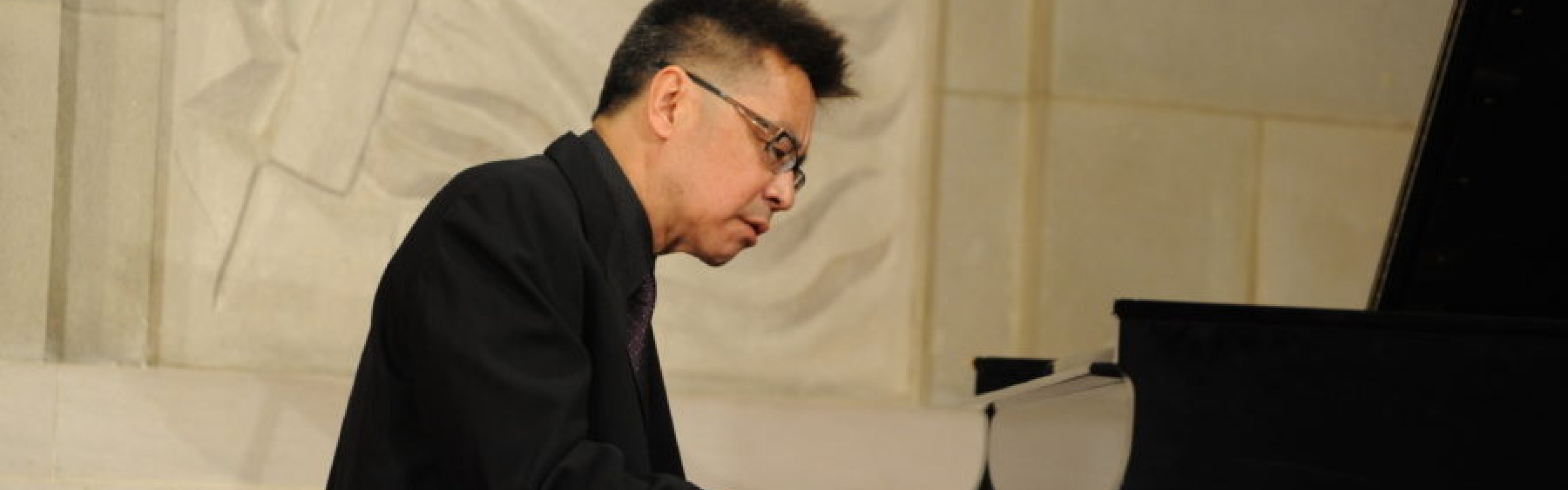
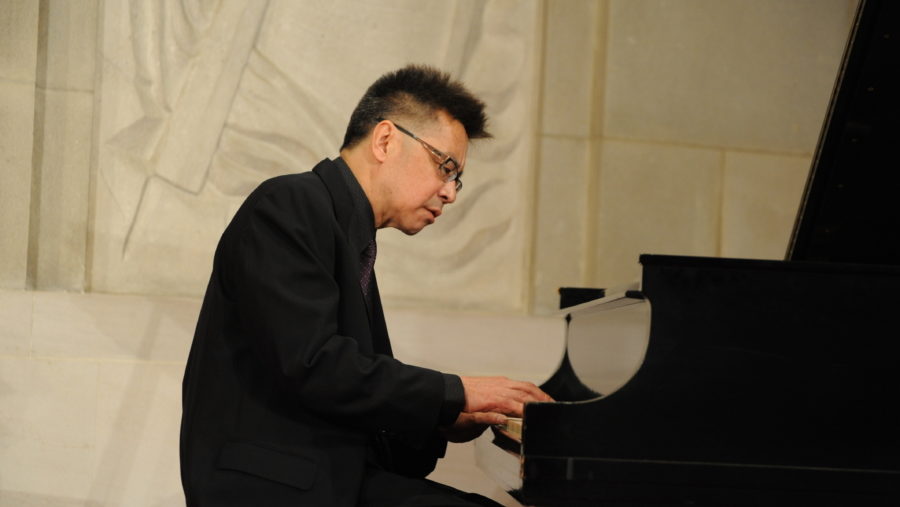
“My practice has been directing without directing,” says jazz pianist Jon Jang, who has composed for and led ensembles of various sizes for over four decades. “And this practice has been based on ‘fighting without fighting’, which is from a 1973 Bruce Lee film, Enter the Dragon. I never micro-manage unless I have to.”,
Over breakfast near the Russian Hill home he inherited from his immigrant grandparents, Jang talked about an August 13 retrospective of his music at the Community Music Center (CMC) where he won’t have to manage at all. That task will fall to Chris Trinidad, a Filipino-Canadian bassist and educator who’ll lead the event’s ensemble, most of them gleaned from the new generation of Asian-American jazz progressives. Jang, aged 72, and saxophonist Francis Wong, the veteran in Trinidad’s ensemble, were among the founders of that progressive Bay Area movement in the late 1980s.
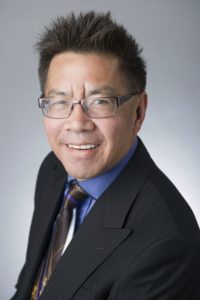
“Jang Journeys: The Music of Jon Jang in the Making of Asian America” is the final part of a series which has earlier honored Wong and Glenn Horiuchi. It channels Jang’s democratic approach to his art. It will also showcase Jang’s lifelong compositional intention of “looking back at people who’ve made our lives more meaningful, honoring people who’ve stood for good causes.” Dedicatees on the program include Frederick Douglass, Malcolm X, Greg Morozumi, and Mabel Teng, as well as jazz idols Thelonious Monk, Charlie Mingus, Cannonball Adderley, and John Coltrane. And there’s a tribute to Jang’s mother, Etta Jang, and his wife, Joyce Nakamura.
In high school in a white middle-class area of Palo Alto in the 1960s, Jang explored rock, jazz, and sports. He commenced classical piano study after dropping out of UC Berkeley and then enrolled at Oberlin. He made pocket money playing at a nearby Black church. Jang felt more drawn toward the college’s then-new jazz program, created by Wendell Logan, than to classical music, but he sought a means of melding the genres.
Jang returned to the Bay Area as an eager participant in an era of political activism, and he was thrilled when a Watsonville farmworker addressed him as “a people’s artist.” He participated in the first Asian-American Jazz Festival, held at Fort Mason in 1981. The next year, in collaboration with the United Front ensemble, he recorded his eponymous debut album on RPM Records, which included one work by Olivier Messiaen.
In 1990, Jang engaged Max Roach, one of his high school inspirations, and percussionist John Santos in SenseUs, a project reimagining national anthems. “Jon’s democratic spirit is very different from the other collaborations I’ve worked in,” Roach commented to this writer at the time. “Jon has sketched it out, but he’s given everyone an opportunity to deal with it organically.”
In performance over the next decades and on a dozen recordings — most of them on Asian Improv Records, the label he co-founded in 1987 —, Jang foregrounded the musical forms, cultures, and political concerns of Asians, Blacks, and other ethnicities. In 1994, he was commissioned by the Kronos Quartets to write Immigrant Suite No. 2, commemorating the Chinese internees of Angel Island and featuring a Cantonese opera singer
This approach also involved Asian instruments, including the Chinese erhu and pipa, with which Jang positioned delicate traditional Chinese traditional pentatonic modes within Western jazz and classical settings. In the CMC show, Kevin Amos will perform on a wok, as well as on steel drums.
The retrospective will conclude with the world premiere of Talk With Your Hands, dedicated in part to Jang’s high school wrestling coach Len Doster, to cultural critic Jeff Chang, and to inspirational martial artist Bruce Lee. Jang himself is scheduled for a cameo in the politically themed last part of the piece, titled “When We Enter the Dragon to Break the Mirror.” It’s been two-and-a-half years since Jang suffered a stroke which disabled the right side of his body and put him in a wheelchair. Nakamura remembers his asking for a piano after he was taken to St. Francis Hospital.
During rehab from his stroke, Jang discovered he could begin playing again with his left hand., “I can now play a Bach prelude,” he said.
Favoring his left hand, Jang has performed at benefits for the Chinese Progressive Association and at the Oakland Museum. He’s also on the teaching faculty at the CMC and expresses gratitude for the recent renovations to its performance space.
Among the audience at Jang’s retrospective will be his daughter Mika Yeung, the mother of toddler Ella. “She’s beautiful and very curious,” he reports. “And when I try to interact with her, she’s always pointing at the piano.