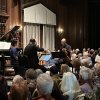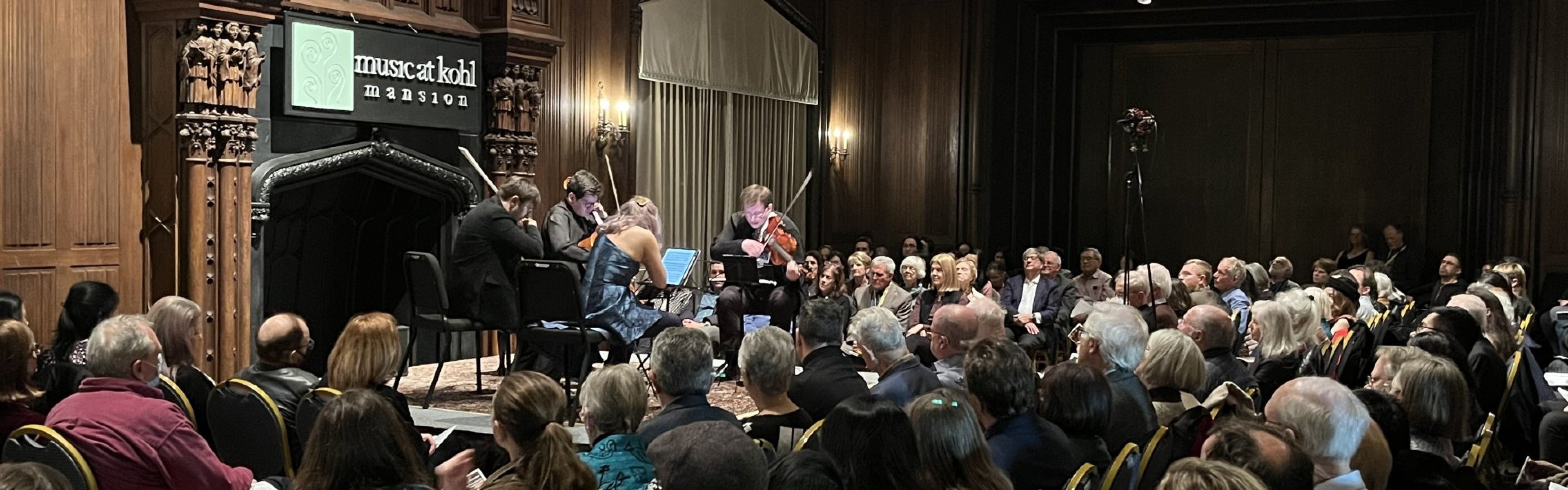
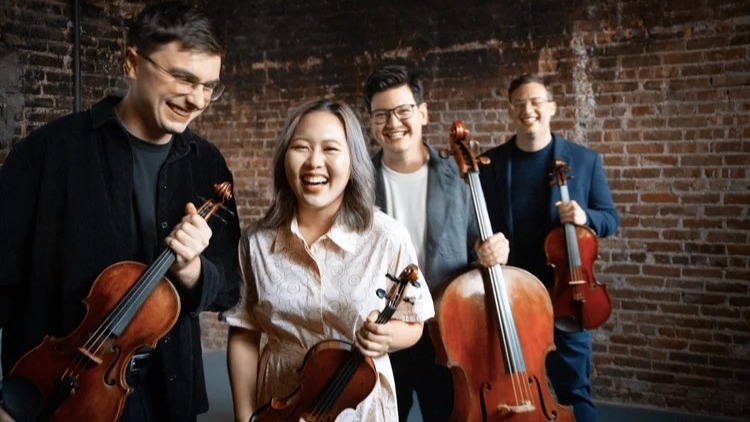
The Balourdet Quartet’s touring program of mostly 20th-century works is called Wildest Dreams — and on January 18, the concert lived up to its “wild” billing.
The four musicians (Angela Bae and Justin DeFilippis, violin; Benjamin Zannoni, viola; and Russell Houston, cello) were students when they became an ensemble in 2018. They began winning competitions soon after. It’s easy to see why. Their Music at Kohl Mansion performance pressed forward with astonishing intensity. Where other groups might take a breath at the end of a phrase, Balourdet barreled on. The playing was all-out, in-your-face. Too much so? Not necessarily. Certainly nothing in this program of backward-looking works felt sedate — least of all the oldest work on the program, by Johannes Brahms.
If Brahms’s String Quartet No. 3 captures the composer at his sunniest, that’s partly because the he channeled hunting music by Mozart in the opening strains, which on Sunday were raucous. In other moments the performance was delicate. Seamless bowing — almost sul ponticello (near the bridge) — made the first movement’s ghostly lines shimmer like cobwebs. Brahms revisits this motif and others in the finale, a reposed theme-and-variations movement that never breaks its structure. In this performance, though, past and present swirled in a pleasant haze.
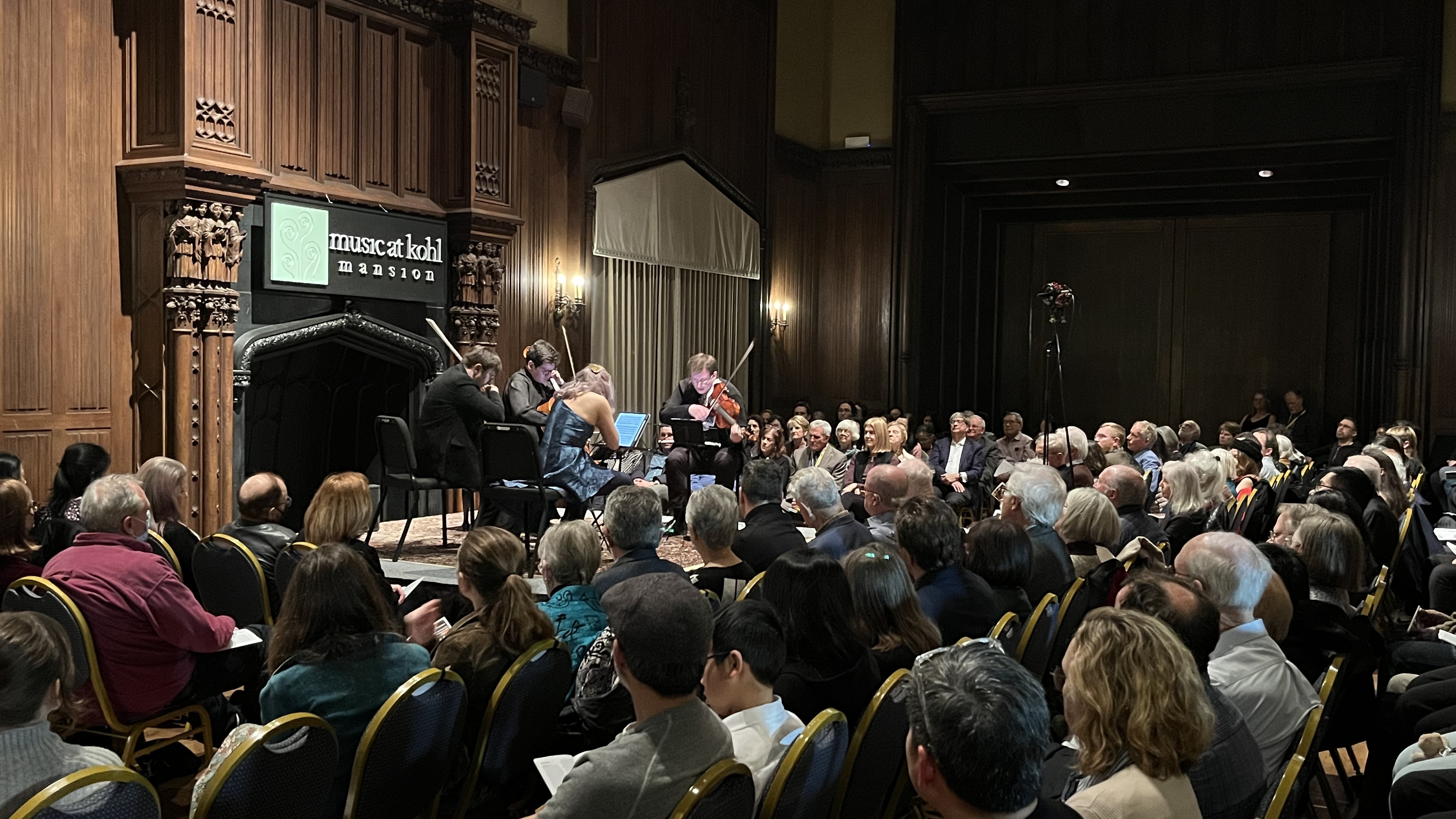
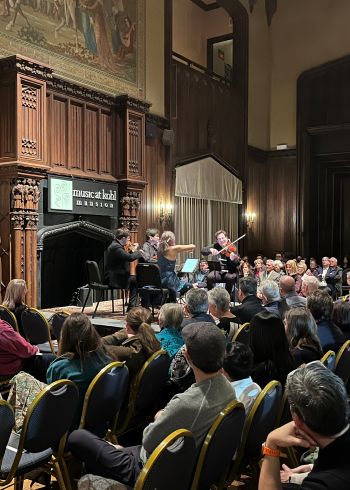
Two quartets from the 1920s, played side by side, revealed an artistic kinship between composers who are rarely mentioned in the same sentence: Béla Bartók and Amy Beach. Their music sounds nothing alike, yet the pieces on the Wildest Dreams program — Bartók’s Quartet No. 3 and Beach’s String Quartet in One Movement, Op. 89 — draw on many of the same techniques. There are arching structures, folk melodies, and not a little indebtedness to Beethoven. (If not for his “Harp” Quartet, Bartók’s wild codas couldn’t exist.)
Beach’s movement, her only work for string quartet, at first sounds rather like Beethoven’s Symphony No. 1. A chord finds its resolution — easy. But then a third chord comes, and a fourth, in an endless sequence of oozing chromaticism. And yet Beach’s dissonances are so Romantic-sounding, you hardly notice that the music hasn’t yet found a key.
From there, the piece’s there-and-back journey covers a lot of ground. There are Inuit melodies, first a lone call in the viola and later set off by grand, symphonic-sounding transitions (including some “Eroica”-like chords). There’s a march, then a wicked fughetta, a highlight of this taut and highly lyrical Balourdet performance.
Throughout, the music feels almost jumpy, as if the motifs are afraid to take up too much space. Beach had been a piano prodigy, but at her husband’s request, she limited her public appearances. (After he died, she performed her own music on tours, including in San Francisco.) She lived well into the 20th century and yet spent almost half of her adult life working under restrictions similar to those Clara Schumann and Fanny Mendelssohn had experienced a hundred years before. Performances of Beach’s music are still uncommon.
In the realm of quartets, Bartók, on the other hand, is practically as celebrated as Beethoven. On Sunday, Bartók’s String Quartet No. 3 — an earthy, rigorously structured single movement — opened with wonderful rubato, a gratifying touch of romanticism. Then it was off to the races. The performance was thrilling one moment, borderline the next. When the slower music returned, I realized I had been clenching my entire body.
Among this music’s descendants is Eleanor Alberga’s String Quartet No. 2 (1994), a single movement that springs from only a few motifs, almost obsessively developed. Once the music gets going, though, you can only think to dance.
Physical movement was formative for the Jamaican British composer, who began writing music while working as a piano accompanist for a contemporary dance troupe. Long before that, she had fallen in love with the music of Bartók, whose influence — quintal harmonies, lurching dance rhythms, contrapuntal skirmishes — is undeniable here. (Violinist DeFilippis ventured that Alberga modeled her work after the same Bartók piece they’d played earlier in the program). But this music has more glamour.
The Balourdet Quartet was born to play these rhapsodic chords, these crooning unisons. The short strokes popped; the double-stops rang.
Midway through the piece, there’s an odd, beautiful passage where the upper voices pluck uneven rhythms against the cello’s sing-song ostinato. It sounds like raindrops hitting a metal roof. Actually, DeFilippis likened the larger section to floating in outer space. “And then,” he said, “We go back to the party at home.”