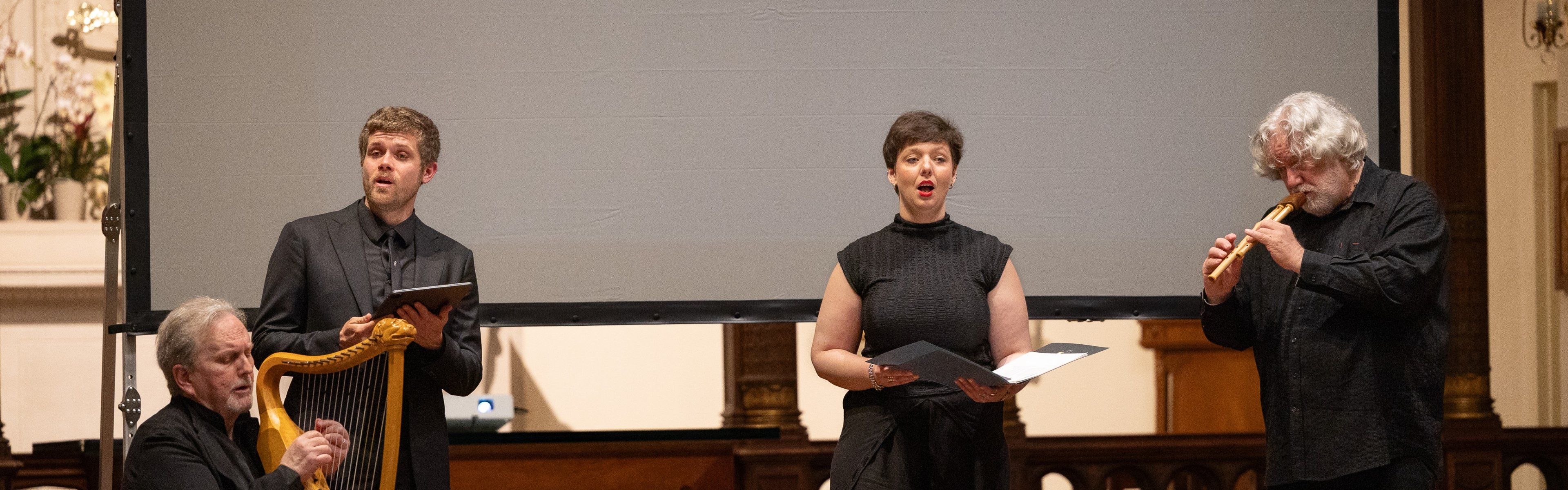
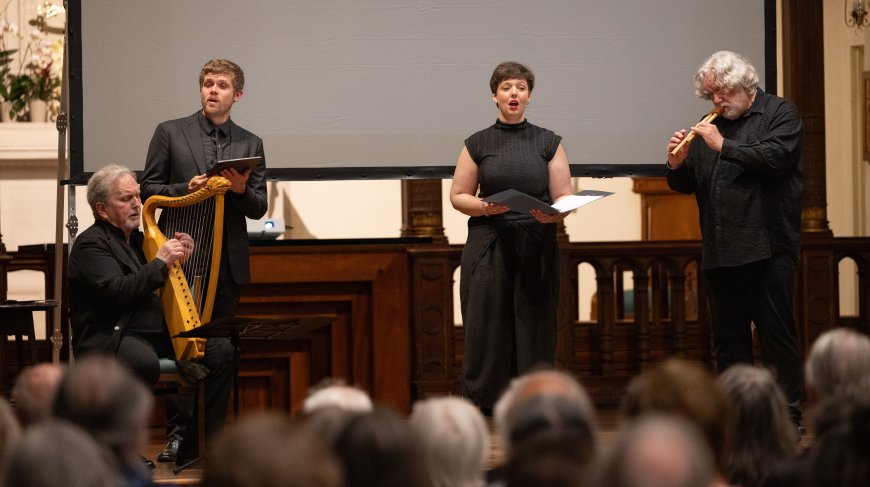
At St. Mark's Episcopal Church on Thursday, June 11, the venerable early music ensemble Sequentia offered a mesmerizing program of 11th-century German songs, interspersed with purely instrumental works, exploring the Muses of classical antiquity and the art of music itself. It was the group's first appearance at the Berkeley Festival & Exhibition since 2018.
The 90-minute program’s scaffolding comprised three excerpts from Benedictine monk and scholar Notker Labeo’s Scande Caelo, his version of the mythological tale “The Marriage of Philology with Mercury and the Seven Liberal Arts.”
Scande Caelo is about the romance and marriage of Philology with a god and the arts. In the first excerpt, Astronomy and Urania praise Philology. In the second, Geometry, Calliope, and Polyhymnia praise Philology, and in the third, Melpomene praises Philology.
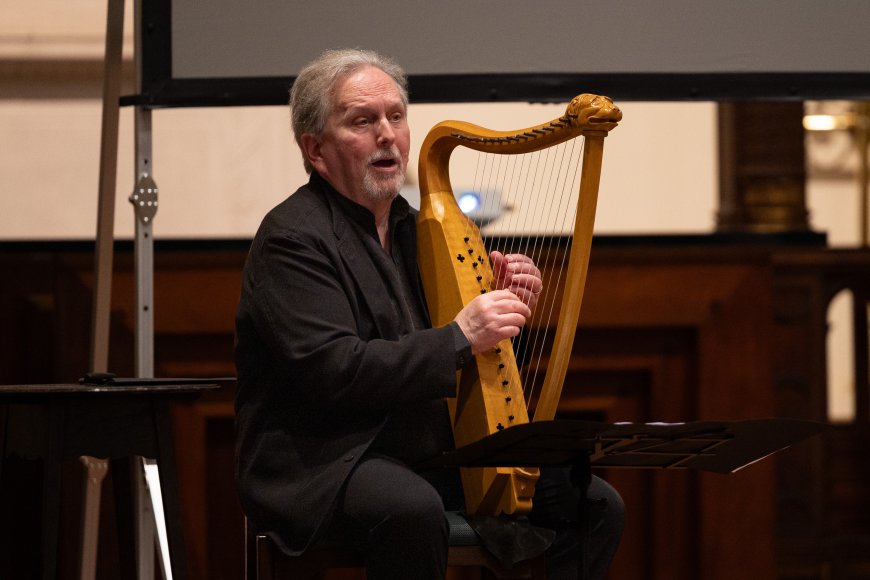
Medieval harpist, singer, scholar, and Sequentia co-founder Benjamin Bagby reconstructed excerpts from Scande Caelo, including with them, as a refrain, a recently discovered two-part organum. Bagby performed all the excerpts, accompanying himself beautifully on the harp, his singing rhythmically free and very much about the words. Scande Caelo felt theatrical and improvisatory, performed with great spontaneity.
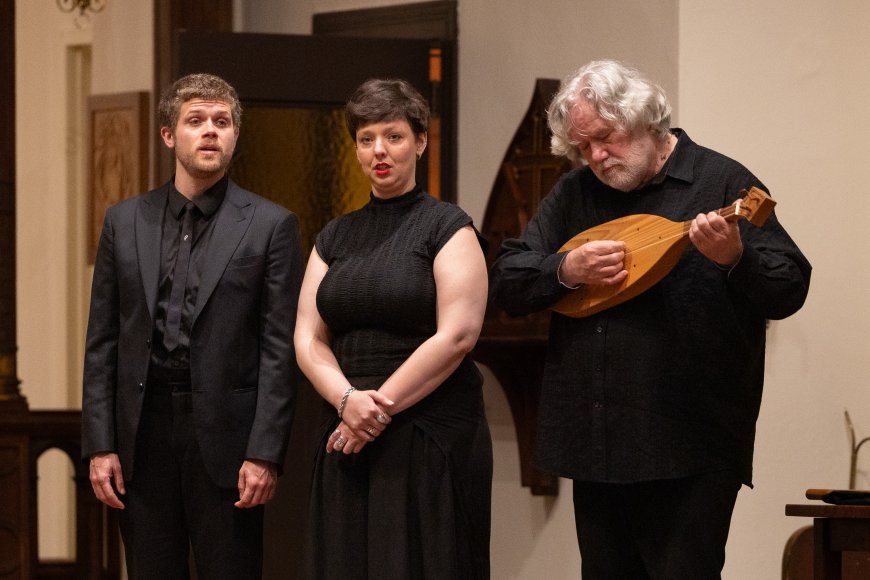
Vocalists Jasmina Črnčič and leiken sang the recurring organum refrain with regal calm, accompanied on cithara, a small lutelike instrument, by Norbert Rodenkirchen. Both singers possess voices of plangent beauty, full of character, whether singing separately or together, Črnčič’s voice hovering between the soprano and mezzo-soprano ranges, leiken’s a warm tenor.
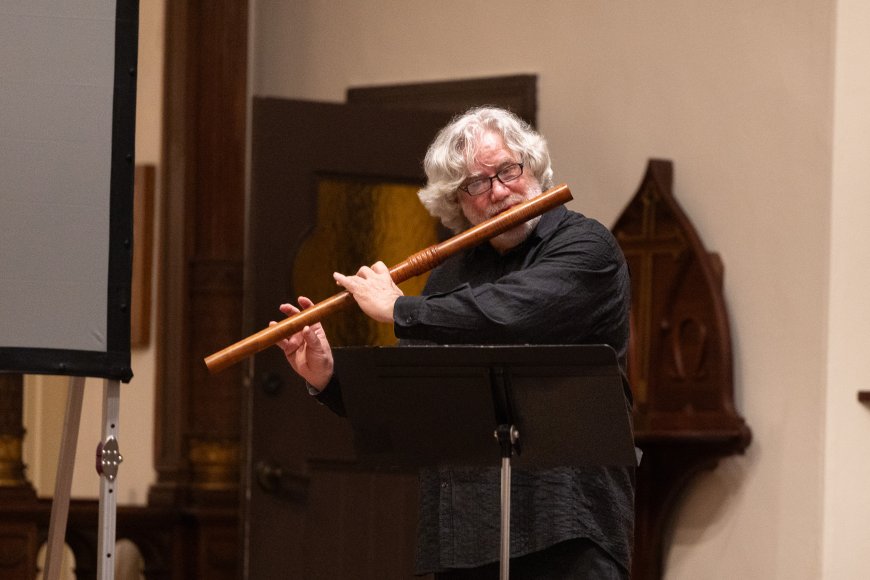
Rodenkirchen, who designed the program and transcribed many of the works on it, opened the program with a brief number on a medieval transverse flute, one of several he played during the evening. He’s a flutist of great power and variety, playing with glorious tone and phrasing here and later, whether as a soloist or accompanying the vocalists.
Concertgoers more familiar with, say, the relatively recent music of Bach, Haydn, or Verdi might find this music a bit thin. The Berkeley Festival’s audience is, however, well-versed in medieval music, its close two- and three-part harmonies, open fourths and fifths, its use of modality rather than major or minor tonality, and its lack of dissonance. You’re truly in a different musical world here, one with its own riches.
The texts, which were conveniently projected during the program, are quite florid and sometimes obscure and a bit difficult to understand. Several of the songs were distinctly (sometimes hilariously) didactic. “Ter terni sunt modi” (There are three times three) teaches music theory, recommending that the singer — or perhaps the listener — commit certain information to memory, and was rather like being in a lecture class, eliciting some amused laughter from the audience.
“Rota modo artes” (Way of skills) teaches about how “heavenly music” originates from the then-known seven planets and the intervals associated with the planets. Arithmetic also made an appearance in this charming song. “Naturalis concordia vocum cum planetis” (The natural harmony of voices with the planets) continued that theme, expounding on the relationship of pitches with the order of the planets, with music as compelling and detailed as a Schubert song.
We were reminded in “Omnia vincit Amor” that yes, “Love conquers all” and we must all submit to love’s powers. The program closed with a pilgrim’s song, “O Roma nobilis” (Oh noble Rome), proclaiming the glories of the eternal city, and here Črnčič’s voice seemingly doubled in size and power, easily filling the audience’s ears and the church.