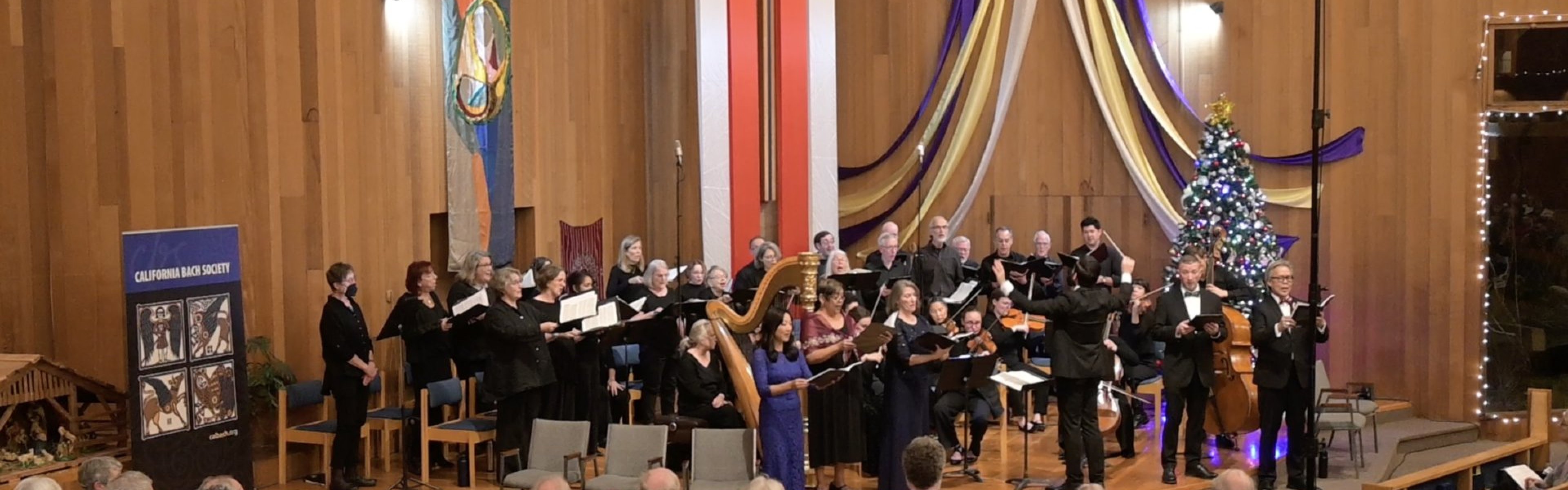
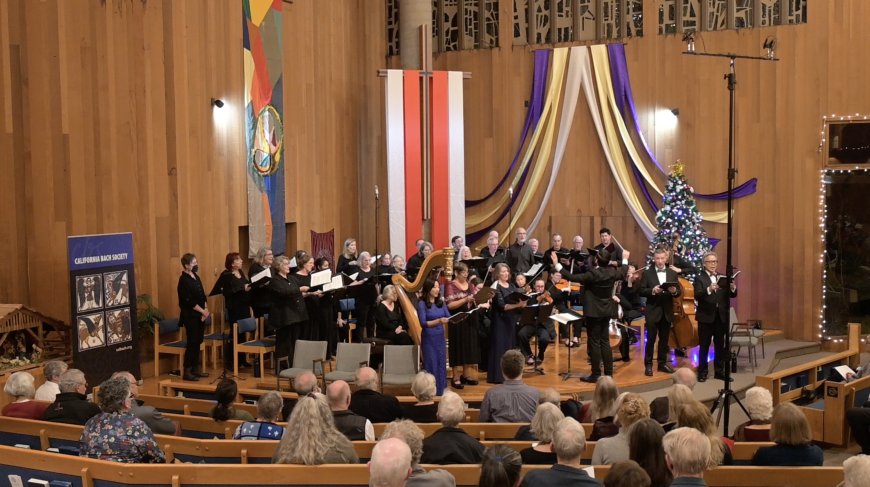
California Bach Society, a fixture on the Bay Area musical scene for more than 50 years, has a milestone year in its 2025–2026 season. Nate Widelitz is the chorus’s new artistic director, following Paul Flight’s 18 years in the post (2006–2024) and an interim year during which Magen Solomon and guest conductor Derek Tam led the group. For their Christmas concert, Widelitz mixed works from the 17th, 19th, and 20th centuries, with the later works built on interpretations of Baroque forms.
The program, heard on Sunday, Dec. 7, at St. John’s Presbyterian Church in Berkeley, showed the chorus’s strengths and weaknesses. The group has a good sound and solid musicianship, but there is intermittent weakness in attacks in all sections, and the sopranos have tuning problems. Widelitz, a clear and communicative conductor, could have led with more tempo variety and rhythmic snap.
Nonetheless, it was an enjoyable program of comparative rarities. The larger works were by the French composers Camille Saint-Saëns and Marc-Antoine Charpentier.
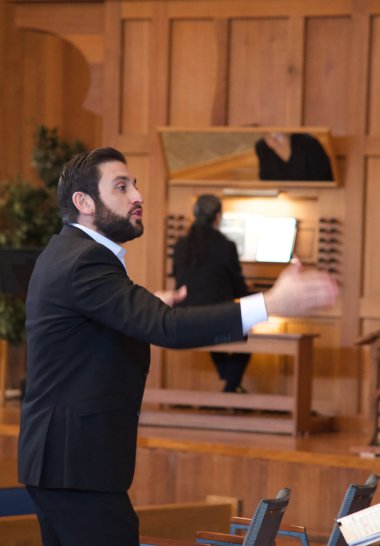
If you’re primarily familiar with Saint-Saëns from his thundering orchestral music and the popular opera Samson et Dalila, you might find yourself surprised by his Oratorio de Noël, Op. 12, from 1858. This 10-movement work, for strings, harp, and organ, takes about a half-hour to traverse the same biblical territory as Handel’s Messiah and Bach’s Christmas Oratorio, both much longer works. The oratorio is charmingly intimate and might occasionally remind you of the composer’s Carnival of the Animals.
Saint-Saëns builds the work across that half-hour, starting with an instrumental prelude, then varying the vocal forces in each of the nine movements that follow. Different solo voices and pairs of voices are juxtaposed against each other and the chorus. The eighth movement, “Laudate coeli,” has a solo quartet of soprano, mezzo-soprano, alto, and baritone.
The well-balanced solo quartet of soprano Rita Lilly, mezzo-soprano Mindy Ella Chu, tenor Corey Head, and bass Chung-Wai Soong sang gracefully, though Lilly had pitch problems that were particularly noticeable when she was in unison with the organ. Chorister Melinda L. de Jesús joined the soloists for the “Laudate coeli.” Mindy Ella Chu shone in the Romantic-flavored third movement. Corey Head sang with gentle beauty in the fourth.
The sixth movement, “Quare fremuerunt gentes?” (Why do the nations rage?), gave the chorus a chance to sing out loudly, and they did the best they could, but perhaps a chorus of 26 is too small for this score. Across the concert, the organ often seemed louder than needed, its penetrating tone dominating the sound of the chorus.
Charpentier’s Magnificat, H. 80 (My soul magnifies the Lord), is a gorgeous piece, interspersing solo voices with the chorus. His “In Nativitatem Domini canticum,” H. 414 (On the nativity of the Lord, a song), a longer recounting of Christ’s birth, packed an enormous amount of drama into just 15 minutes.
In the “Nativitatem,” Soong’s interpretation of the lines where the shepherds kneel before the newborn baby was full of awe. Chorus soprano Vai Rangarajan took some of the solo lines in that work. Here and elsewhere, the small Jubilate Baroque Orchestra provided excellent accompaniment and continuo.
The concert began with various shorter pieces, including the only instrumental work of the afternoon, a ricercar by Johann Jakob Froberger that was given a lively performance by organist Yuko Tanaka. German composer Hugo Distler’s brief “Es ist ein Ros entsprungen” (Lo, how a rose e’er blooming), composed in 1933, is a variation of Michael Praetorius's famous 17th-century carol. Distler’s surprising harmonies, while consonant, bring it into the 20th century.
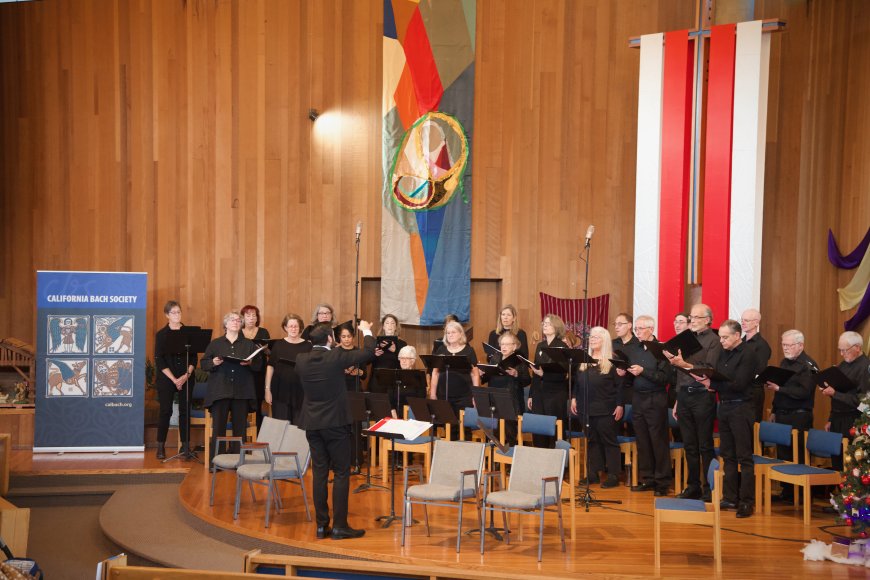
The text of Brahms’s motet O Heiland, reiss die Himmel auf (O Savior, rend the heavens), attributed to Friedrich Spee, starts with calls to Jesus and God to open the heavens and pour dew on the house of Jacob, concluding with a plea to be led to “our Father’s land” and praise to the Redeemer. The music is a technical tour de force: In just five minutes, Brahms sets each of the poem’s five verses with its own theme and with different contrapuntal techniques. California Bach’s performance had force and tenderness; it could have built to a bigger climax.
Widelitz’s enthusiasm for the chorus and music may take him far with this group. Some of his work is cut out for him: bringing more confidence to all, better tuning to the soprano section, and more boldness in tempo. It’s clear that he will continue California Bach’s long tradition of imaginative programming and ability to connect with the community