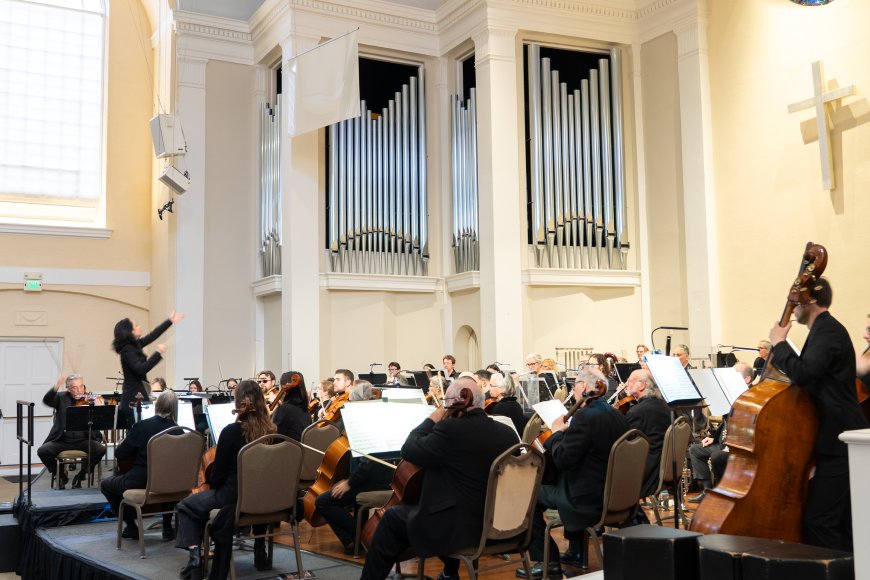
Berkeley Symphony embarked on a music director search last year, following Joseph Young’s departure at the end of the 2024–25 season. As in the orchestra’s past, all guest conductors should be regarded as candidates for the position.
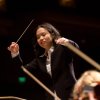
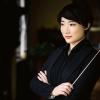
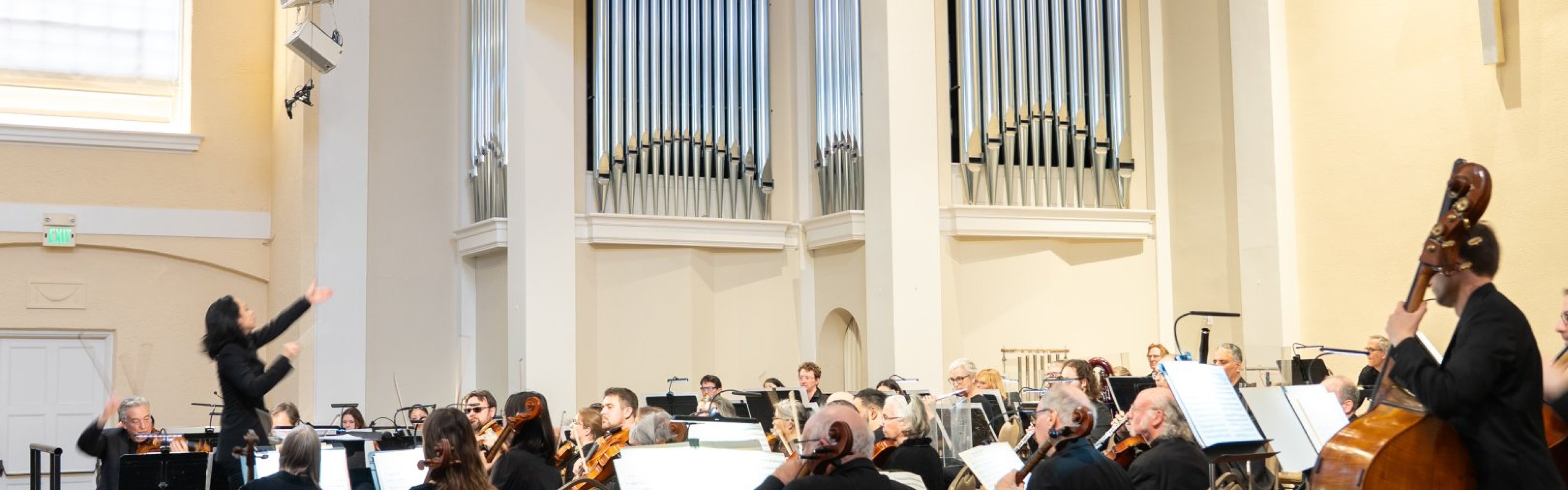
Carolyn Kuan, music director of the Hartford Symphony (a position she’s leaving in 2027), recently scored a triumph leading the world premiere of Huang Ruo and David Henry Hwang’s The Monkey King at San Francisco Opera. It was good to see her on the podium for Berkeley Symphony’s season closing concert at First Congregational Church, though the results were a bit inconsistent.
The Jan. 25 program, titled “Fables & Folklore,” included Huang’s Folk Songs for Orchestra, Clarice Assad’s O Saci-Pererê Concerto for Guitar and Chamber Orchestra, and Dvořák’s Symphony No. 8 in G Major. The unifying factor was each work’s roots in folk music and folklore.
Kuan’s long association with Huang includes the 2012 premiere of the original, three-movement Folk Songs for Orchestra with the San Francisco Symphony. A fourth movement, inserted between the second and third movements, was commissioned by the BBC Symphony and premiered in 2019.
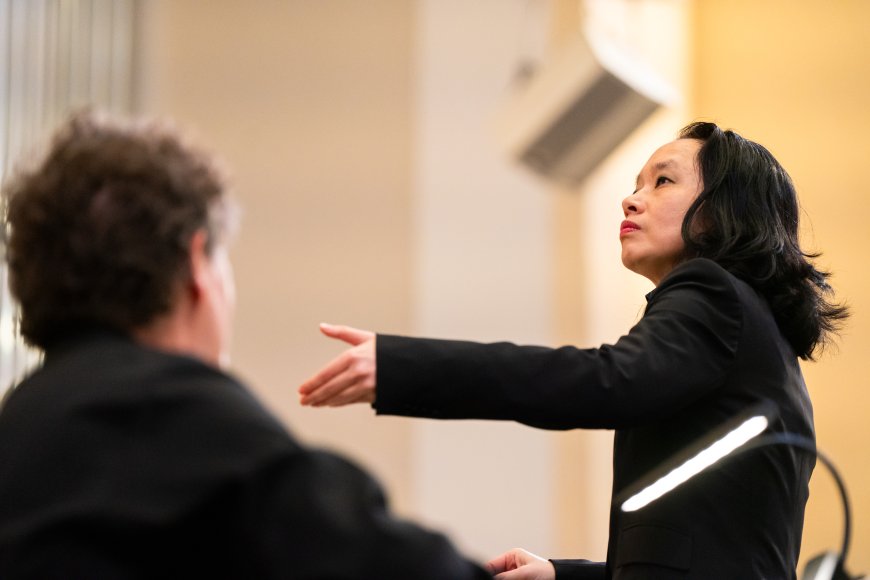
It’s a delightful work, with each movement based on music from a different region of China. The cheery, broad melodies of “Flower Drum Song from Feng Yang” are followed by the melancholy “Love Song from Kang Ding.” Its long-breathed melodies, from Sichuan province, carry from the solo winds through the strings.
In her spoken introduction to the work, Kuan noted that the style of “Little Blue Flower” is closer to that of The Monkey King than to the other three movements. Featuring an extended violin solo, the movement is more international in style, and has more dissonance and less percussion than the others. Concertmaster René Mandel brought vibrant tone and emotional intensity to the solo, soaring over the rippling orchestra.
The last movement, “The Girl from Da Ban City,” is based on music from Xinjiang province. Its martial, heavily syncopated tune vaguely reminded me of certain Scottish folk tunes.
According to Thomas May’s program notes and the composer’s website, Saci-Pererê is a figure in Brazilian myth, a shape-shifting trickster found in “a fusion of Indigenous and Afro-Brazilian” cultures. The three-movement concerto, from 2013, attempts to embody the multiple facets of Saci-Pererê’s personality and behavior.
Performed by Marc Teicholz (to whom it’s dedicated) on Sunday, the concerto is full of so many ideas that its roughly 23 minutes seemed far longer.
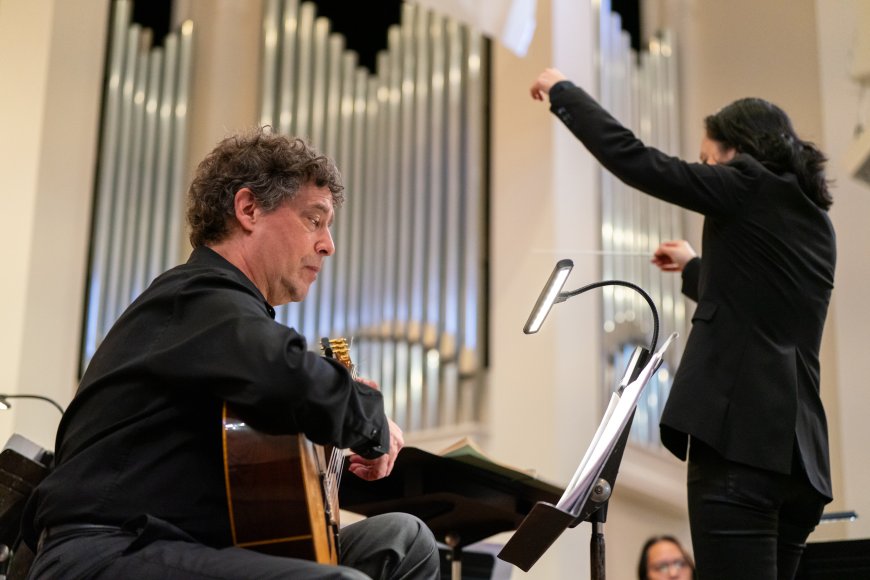
The jaunty first movement opens with a bang and proceeds with quite a bit of drama. As well as using novel percussion instruments, the score calls for vocalizations and finger snaps from the orchestra members. At a critical moment, the guitar seems to battle the clarinets and bassoons. Well into the movement, Assad inexplicably, and rather startlingly, brings in the Dies Irae chant tune. The music then glides to a whimper of an ending.
A fine cadenza leads into the beautifully ruminative middle movement. With unsettled, impressionistic harmonies and mysterious orchestration. It’s by far the most successful part of the work. The finale is an unfocussed grab bag of themes that are barely developed. Presumably this is intentional, but it doesn’t work very well.
Perhaps Kuan needed more rehearsal time to pull the performance together. The first movement of Dvořák’s symphony also came across as less than perfectly prepared, an assemblage of gorgeous melodies that didn’t quite cohere. Was the problem the conductor or the composer? Still, the movement came to an exciting conclusion, and you couldn’t help but be beguiled by its sheer beauty.
In the slow second movement, it was the quietest phrases that stood out the most, perhaps because the church’s small size and geometry can make anything louder than mezzo-forte sound too loud. Kuan led the third-movement waltz with sweep and flow; the finale had plenty of drama and energy. Overall, it was a fine performance of an exhilarating work.