Opera Philadelphia was in the last weeks of being able to pay its employees when countertenor Anthony Roth Costanzo took over in 2024. The story of Opera Philadelphia’s metamorphosis should be familiar to all opera lovers by now. Costanzo gambled all on the belief that there is a large audience for opera, and that this audience is hungry for new works and creative approaches to the classics. Astonishingly—in the face of so many naysayers who point out, arguably accurately, that only the classics sell—he was proven right. Even more astonishingly, Costanzo’s approach not only rescued Opera Philadelphia from its formidable $4 million debt but also ended the season $2.1 million in the black. It’s safe to say that Costanzo did what so many companies have been struggling to do: make a sustainable opera season out of both old and new works, drawing regulars and newcomers. In other words: make opera relevant and revelatory.
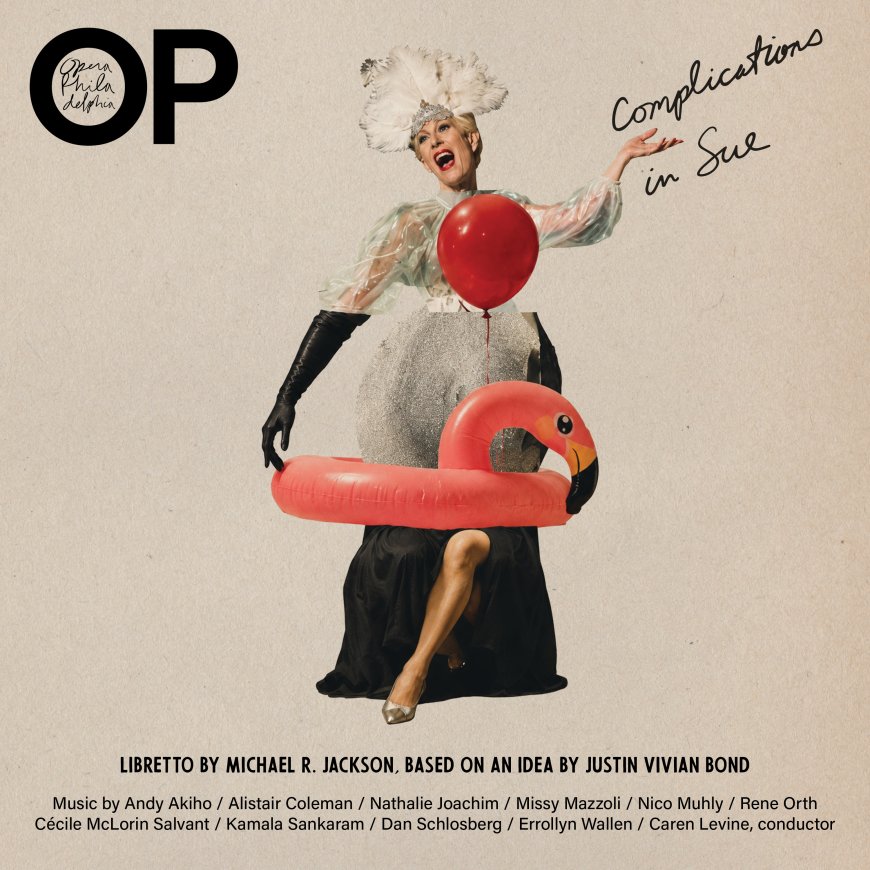
Costanzo made this possible by pushing new modes of engagement and doubling down on artistic risk-taking. (Proof of the company’s boldness lies in the fact that not all its experiments have been successful. I’m thinking specifically of the climate-oriented The Seasons and an art-gallery Il viaggio a Reims, both of which proved dramatically thin.) The climax of Costanzo and the company’s efforts was the centerpiece of the past year’s season, the new opera Complications in Sue. The live recording released Aug. 21 on BCM+D Records — captured at the Academy of Music on Feb. 5 and 6, 2026 — now makes it possible for all of us outside Philly to judge Opera Philadelphia’s and Costanzo’s heroic efforts for ourselves.
Sue’s fame centers on the unbelievable story of its composition. Knowing there wasn’t enough time to commission a wholly new opera for the 2025–26 season, Costanzo drew on the efforts of a vast team. The idea for Sue came from Tony-nominated, MacArthur Fellow Justin Vivian Bond (with whom Costanzo performed the listen-to-believe-it duets album Only an Octave Apart), and the libretto from playwright Michael R. Jackson (author of the Pulitzer-winning musical A Strange Loop).
Sue is the story of a life, told in ten decades across ten scenes. The opera comes at Sue’s life askew, through moments and characters that at first seem slight and random. The fun of Bond and Jackson’s conception is gradually realizing just how much these corners of a life reveal about a person. For Sue, the result is a person simultaneously generous and cold, in and out of love, hopeful and despairing, as frustrated as she is frustrating—someone we desperately don’t want to be, and desperately want to be.
The polyphonic nature of the story is matched by an equally polyphonic score. Crunched for time, Costanzo outsourced the opera to ten composers. Each one received the text for a single scene, a ten-minute time limit, and a deadline. The resulting list of collaborators is a blueprint for the next decade of American opera, if you haven’t been following them already: Andy Akiho, Alistair Coleman, Nathalie Joachim, Missy Mazzoli, Nico Muhly, Rene Orth, Cécile McLorin Salvant, Kamala Sankaram, Dan Schlosberg, and Errollyn Wallen.
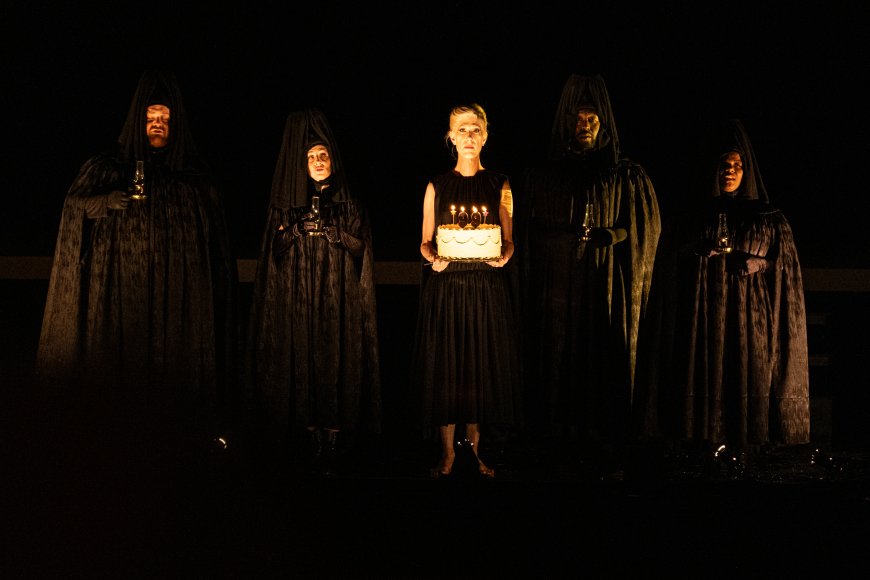
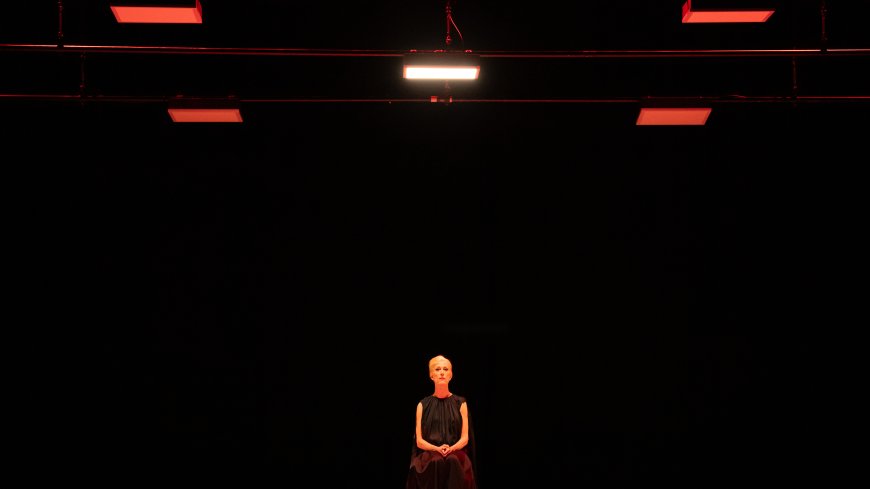
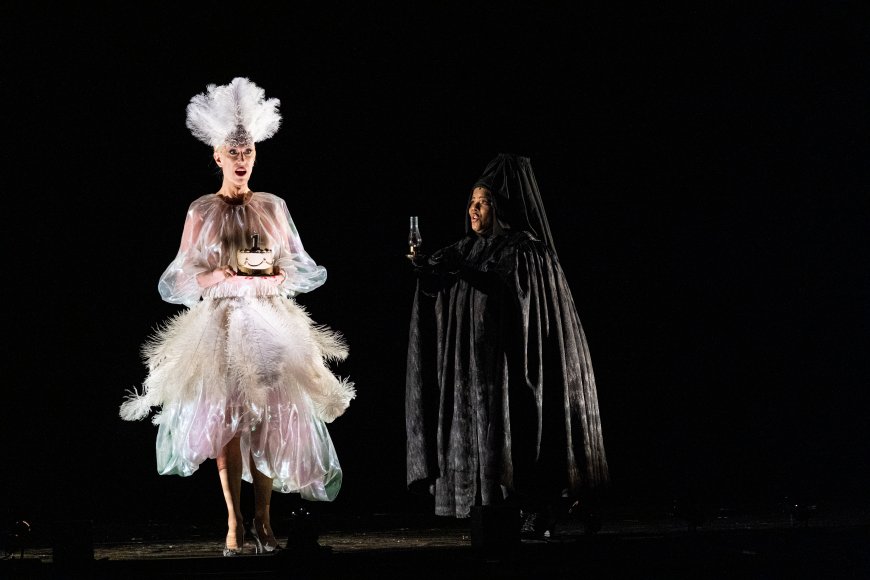
So far, so good. But there’s one more trick to Sue. Bond, one of the opera’s creators, is also its star. Yet Bond sings only for a brief moment; the rest of the time, they perform pantomime and, on a few occasions, speak. The singing is instead done by a wide array of changing characters in Sue’s life, from Sue’s classmates and ex-husband to Mrs. Claus and Death itself. (The four performers responsible for all these roles, Kiera Duffy, Imara Miles, Nicky Spence, and Nicholas Newton, splendidly conjure so many lives.)
Sue, the central character and raison d’être for the whole thing, thus has a strange double existence: visible but mute, silent but expressive. On recording, none of this registers — except as absence. Cheers and laughter make frustratingly clear that we’re missing entire events, jokes, and meanings. The ten scenes are still a blast to listen to, yet I can’t shake the sense that seeing it might be an entirely different experience.
Nevertheless, an opera this smart offers plenty to enjoy on its own terms.
Take scene 7, starring Sue’s unnamed 65-year-old neighbor. He’s been pining for Sue, as his monologue reveals, and his long-simmering desire has forced him to confront his loneliness, fear, and thwarted ambitions. Composer Alistair Coleman’s musical rhetoric, alternating between syncopated, racing passages and stalled, aching halos of strings, turns this satirical monologue into a portrait of the particularly modern, oblivious, profound despair that creeps into the most normal lives.
The scene doesn’t ask for pity for this obsessive neighbor. Underneath this existential portrait, the scene is interested in how large a role Sue unknowingly plays in another’s life. Invisible connections like these, as powerful as any milestone, are one of the opera’s revelations.
Many of the scenes deserve this kind of close look, but I can’t help but mention the end. Not the final scene, an overly sweet quartet fronted by Death. It isn’t Nico Muhly’s best work, and it risks sentimentalizing the sharpness of all that came before it. The real ending comes right before it, with music by Rene Orth.
Picture: Sue’s nursing home. The singers are a pair of unnamed octogenarians, sharing a teasing, lascivious conversation as they inch down the hall. Every line is laugh-worthy, from their puns and come-ons to their totally serious refrain — imagine the walkers — “we are running!”
But the coup of the scene is Orth’s: the whole thing takes place on top of the snare drum pattern from Ravel’s Boléro, complete with that piece’s colorful orchestral punctuations. After the two pledge to run past Sue’s tomb, the music takes on a genuinely aching, even—I’ll admit—tearful quality, and the two sing a soaring duet of defiance, all over a Ravel hit that maxes out triteness and enchantment at once.
But uplift would be exactly the wrong note for Sue. There is one surprise left, and it’s brutal. In the middle of one of those soaring phrases, the music cuts out completely, and the two drop dead. “Death is for suckers,” sure, but even these two must face it. No uncomplicated inspiration here. The combination of corniness, unequivocal comedy, and Mahlerian transports is an apt example of what Jackson, Bond, and Costanzo mean by “complications.” Their opera is a hit; may its uninhibited, clever, and passionate voices open new doors for this company and these artists.