Many modern musicians routinely ask the following questions: What does it mean to play classical music in an era with so much political upheaval? How can this art form be in conversation with our society’s past and present. And can it help us imagine a better future?
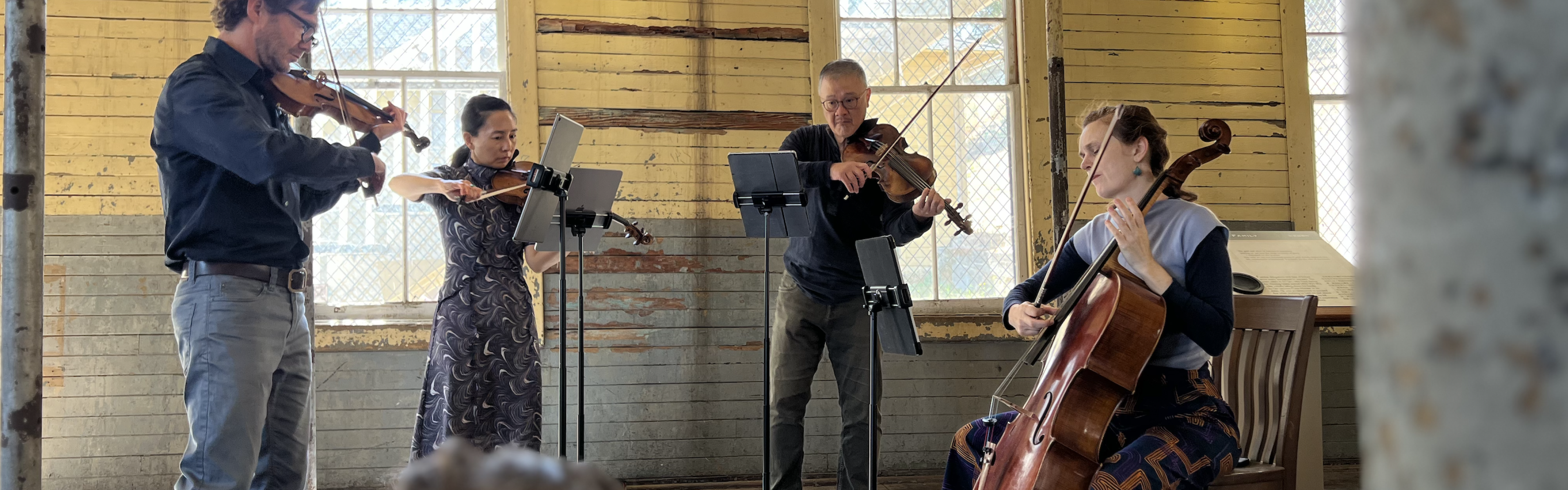
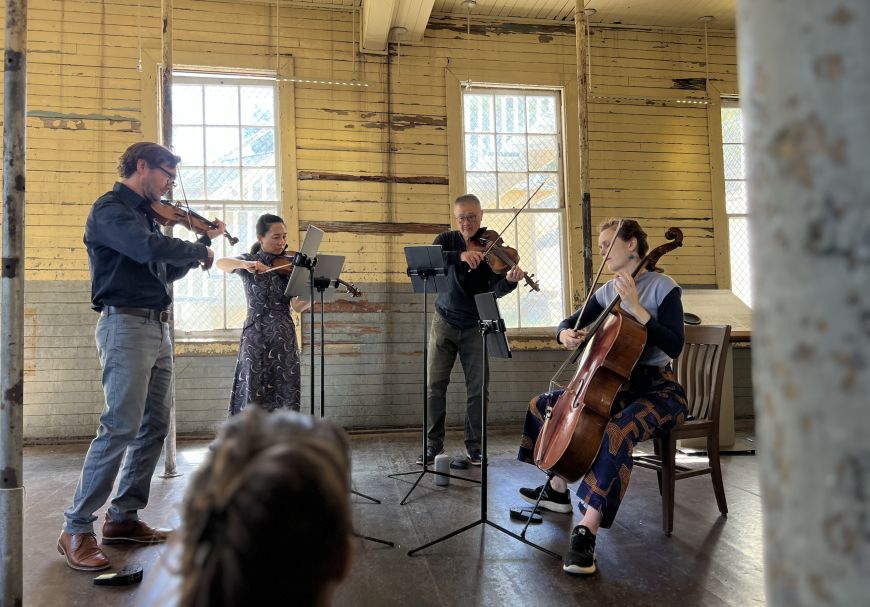
The Del Sol String Quartet addresses these questions with singular insight through their concert series at the Angel Island Immigration Station. The project was first conceived when Del Sol collaborated with composer Huang Ruo for his Angel Island Oratorio, which brought new life to the poetry of resistance inscribed on the walls by Chinese immigrants at the Angel Island Detention Center. These immigrants faced horrendously inhumane conditions and fiercely advocated for their improvement.
After subsequent collaborations with local Chinese-American creatives like artist-educator Andi Wong and current San Francisco Poet Laureate Genny Lim, sufficient cooperative relationships formed in the community to allow Del Sol to expand their programming at Angel Island into a regular concert series. Each concert focuses on a different immigrant community that held a presence on Angel Island.
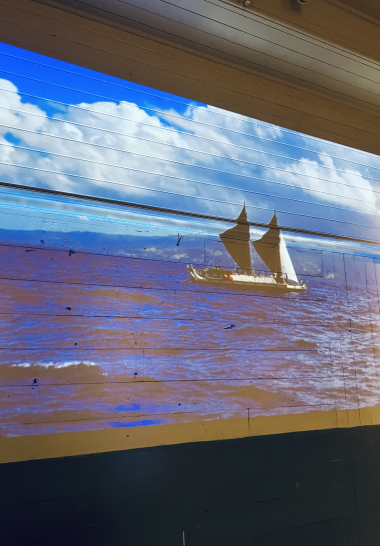
Del Sol’s July 11 concert centered around the Hawaiian and broader Oceanian community in commemoration of the 50th anniversary of the construction of the Hōkūle’a, a Hawaiian voyager canoe. The canoe was sailed by navigators like Pius ‘Mau’ Piailug and Nainoa Thompson, who revived the nearly extinct practice of traditional Polynesian navigation and traversed the Pacific Ocean without Western instruments. They did this through a complex knowledge of stars, the movements of animals, and ocean currents.
Each work on the program was an atmospheric piece depicting a different aspect of nature. Three pieces on the program were world premieres.
The first piece, Ka Makani Pa’akai (The Salt Wind) (2025) by Hawaiian-American composer Michael-Thomas Foumai, was inspired by the book of poetry of the same name by Hawaiian poet laureate Brandy Nālani McDougall. The quartet started abruptly, with intense focus, without tuning up in front of the audience. Foumai’s music held dense, rich harmonies reminiscent of the ocean. Quivering tremolos and pentatonic melodies characterized this lush pastorale. The work portrayed the two-sidedness of the ocean’s salt wind, how it both nourishes and cuts deep into the skin. Contrasting passages featuring snap pizzicati were reminiscent of the iconic pizzicato movement of Ravel’s string quartet, while the more lyrical pentatonic passages recalled more modern works by Joe Hisaishi and Ryuichi Sakamoto. Nevertheless, Foumai spoke with a voice all his own, featuring a sumptuous harmonic landscape befitting the contrasts of the ocean’s temperament.
Australian composer Peter Sculthorpe’s String Quartet No. 12, “Earth Cry,” (1994) was the only work on the program that was not a premiere. Regardless, its intense, brooding atmosphere felt entirely contemporary, starting with a brief opening section recalling Bartók’s “Night Music” style before jarring, sul ponticello glissandi led into an aggressive ostinato section with short, repeated figures played in rhythmic counterpoint, almost like a prolation canon. The cello featured heavily in this work, and throughout the program, acting as the engine for the action throughout the Sculthorpe, whether wailing with sul ponticello slides, playing lyrical soli, or providing incisive ostinati over which the other strings sang. The drama built to a recapitulation of the opening, the tutti strings bringing the work to a somber, even tragic, finish.
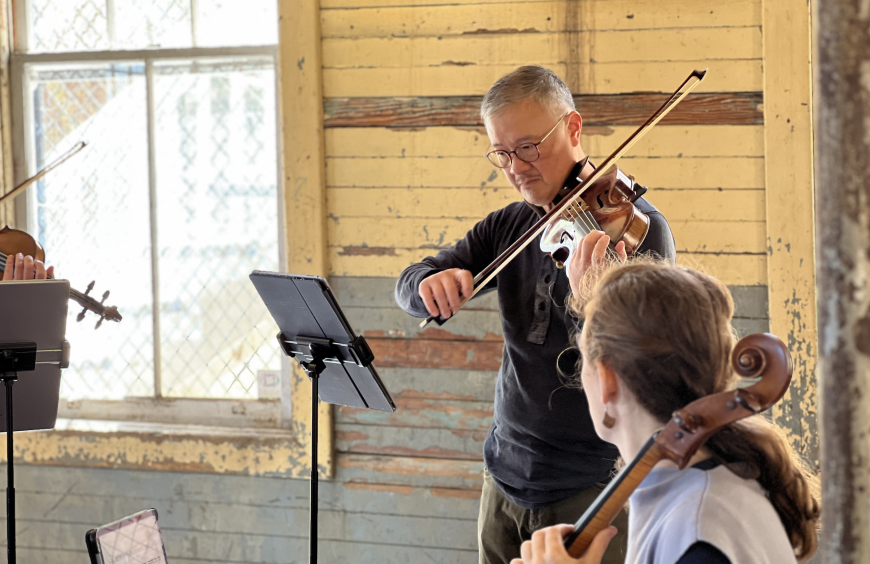
Bay Area composer Edward Simon’s Guardian of the Oceans was the standout hit of the program. Initially a work for jazz band, Simon’s piece roughly followed a theme and variations structure, beginning with an airy ponticello motif representing climate anxiety that developed slowly over increasingly tormented textures. Recurring waltz-like sections evoked Terry Riley’s classic G Song, but this neo-romantic air was quickly abandoned as the nervous atmosphere grew and the anxiety motif took center stage, reaching its climax as a violent, cascading canon which crashed into devastating unison playing from the strings, followed by a tender final passage, punctuated by a soft, closing pizzicato chord. Simon’s piece had something for everyone in it, while maintaining a cohesion that shepherded the listener across its tense emotional landscape.
The afternoon concluded with Hawaiian composer Leilehua Lanzilotti’s Moananuiākea, a tone poem depicting the journey of the traditional Hawaiian navigators. A “conch shell call” motif demarcated the work’s start, middle, and end, as the music wandered through hazy mists, rolling waves, falling rain, and still, stagnant currents. Lanzilotti painted this picture through a diverse palette of string techniques both established and ingenious, from bariolage to muted pizzicato “raindrops.” Some moments lingered longer than necessary, but the visceral image of the ocean voyage was crystal clear.
Rarely does chamber music feel as cutting-edge and necessary as Del Sol’s. It was well worth the ferry trip to be transported to even more distant musical shores.