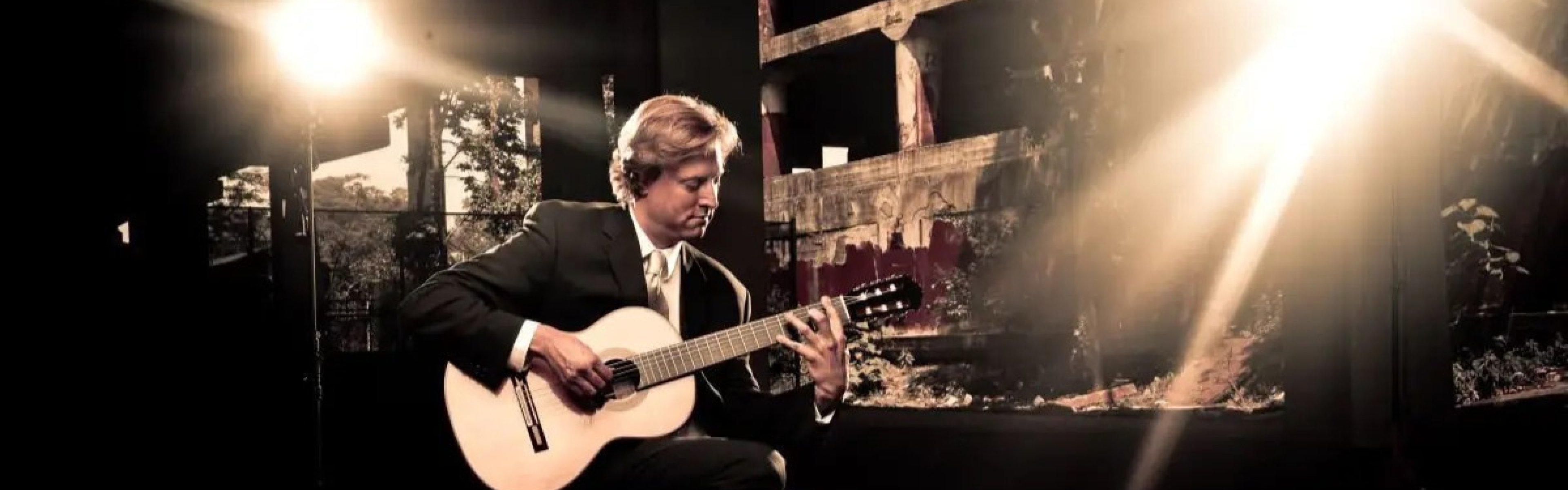
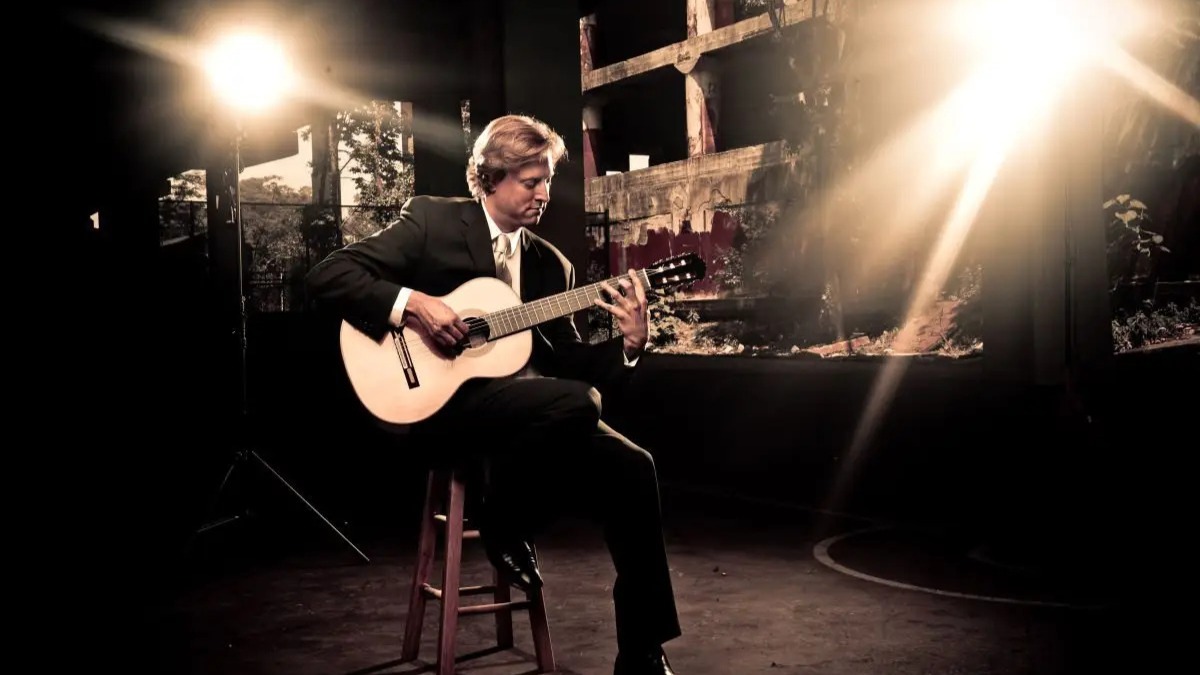
Jason Vieaux, a 2015 Grammy Award-winner and current San Francisco Performances artist-in-residence, combined forces with Jiji, a rising star in the classical guitar world and Vieaux’s former student, for an engaging and eclectic evening of solos and duos presented by San Francisco Performances at the Taube Atrium Theater on Saturday evening.
The music ranged from J.S. Bach and Domenico Scarlatti, through classical guitar standards, to jazz and world music. The outstanding offerings were the San Francisco premiere of a major new composition by American jazz master Pat Metheny and a powerful composition by the young Icelandic composer Gulli Björnsson.
Pat Metheny’s composition Four Paths of Light is a major addition to the classical guitar repertoire: a 20-minute, four-movement suite which Jason Vieaux played with stunning virtuosity and interpretive skill. The first movement is aggressive and dissonant, influenced by Metheny’s love of the heavy metal band Pantera and reminiscent of his collaboration with avant-garde composer John Zorn on the former’s album Tap: Book of Angels Volume 20.

The second movement is an introspective ballad, and in this performance Vieaux effortlessly floated a characteristically ethereal Metheny melody over a gentle Brazilian choro rhythm. The third movement is the climax of the suite, a perpetual motion contrasting a complex rhythmic dance with a brief lyrical interlude featuring higher registers and harmonics. The fourth movement is a bleak epilogue that reprises the melody from the second movement in a new light.
A stark, hypnotic tremolo is pervasive, not in the style of classical warhorses like Francisco Tárrega’s “Recuerdos de la Alhambra” but more like that used by Benjamin Britten in his Nocturnal after John Dowland and reminiscent of the conclusion of The Pat Metheny Group’s 2005 album, The Way Up. The entire suite is tightly constructed with the motives and harmonies of the first movement used throughout although in very different styles and Vieaux’s mastery was an intellectual as well as musical triumph.
Gulli Björnsson’s “Dynjandi” (Thunderous), commissioned and premiered by Jiji, is a musical portrait of a magnificent chain of waterfalls, located in northwestern Iceland, which empty into the Arnarfjörður fjord off the North Atlantic. The Dynjandi waterfall cascades down a mountainside, creating a total of seven falls; the form of the piece is correspondingly split into seven sections which portray the swirling water of each fall with spectacular spiral arpeggios, the still pools of water with fugal counterpoint, and the links between the two with irregular clusters.
It is a tightly constructed piece based on a two-voice contrapuntal motive presented at the beginning. The extraordinary imagination of its composer and the vision and virtuosity of Jiji, who both commissioned the piece and performed it with dazzling aplomb, have given guitar audiences a wonderful new piece.
The first half of the concert included other solos performed by both artists. Jiji began the evening with “Asturias (Leyenda)” by Isaac Albéniz. She offered a fresh interpretation which took more inspiration from the rasgueado technique used by the flamenco guitarists who inspired Albéniz than is usual among classical guitarists or indeed even possible for pianists. She followed that with an engaging story about hearing Vieaux play “Asturias” when she was a teen in Korea and immediately deciding she wanted to move to the United States to study with him.
She then played a delightful group of three short pieces that were an homage to her teenage love for the guitar. “Over the Rainbow” by Harold Arlen was a common request of her mother, “Very Berry Strawberry” was her own composition memorializing her favorite flavor of ice cream, and “Tango en Skai” by Roland Dyens was her first virtuosic piece based on popular music. Jason Vieaux preceded the monumental Four Paths of Light with a stately performance of the Prelude from Bach’s Prelude, Fugue, and Allegro BWV 998.
I found the second half of the concert disappointing after the excellent first half, and I blame the amplification system. Vieaux usually played the principal part and Jiji the accompaniment, but her guitar was significantly louder in the mix. And though there were some musical moments, the poor balance between the instruments was disturbing.
However, the music was well chosen and the interpretive approach was expressive: Egberto Gismonti’s "Água e Vinho" and Ralph Towner’s "Duende" were soulful; Enrique Granados’s Valses Poéticos were graceful and elegant; the manouche jazz of Stephane Wrembel’s “Bistro Fada” was a delightful interlude; the Afro-Brazilian rhythms and guitar percussion of Paulo Bellinati’s “Jongo” greatly pleased the audience; and finally, Vieaux’s heartfelt interpretation of Stanley Myers’s “Cavatina" from the movie The Deer Hunter was a perfect encore.