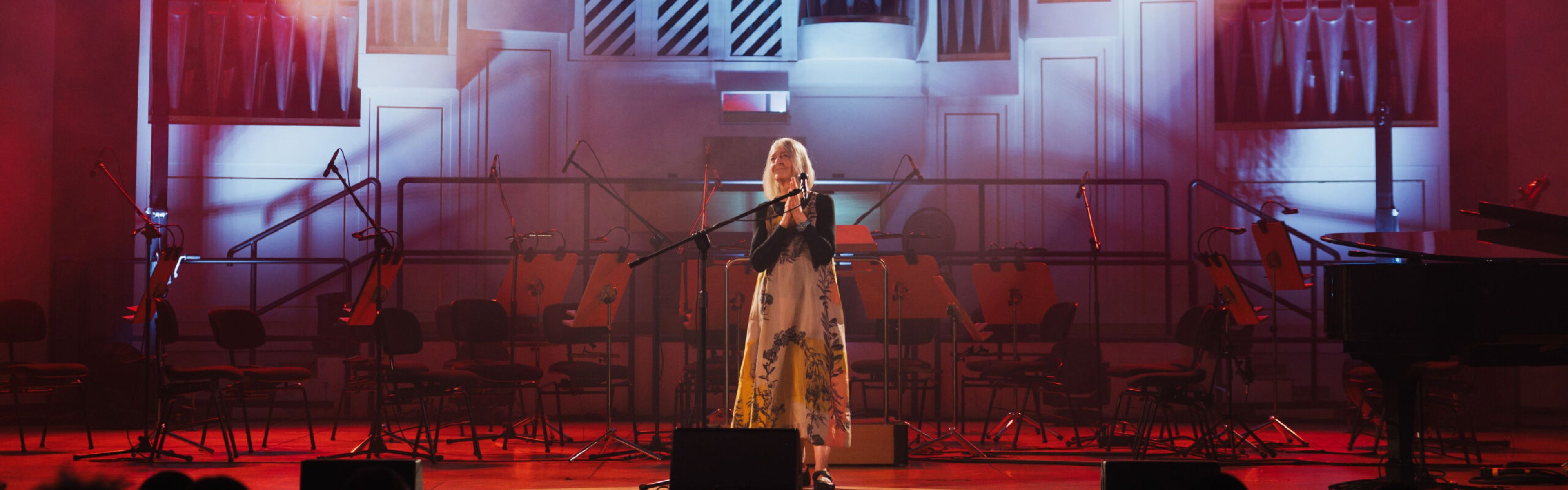
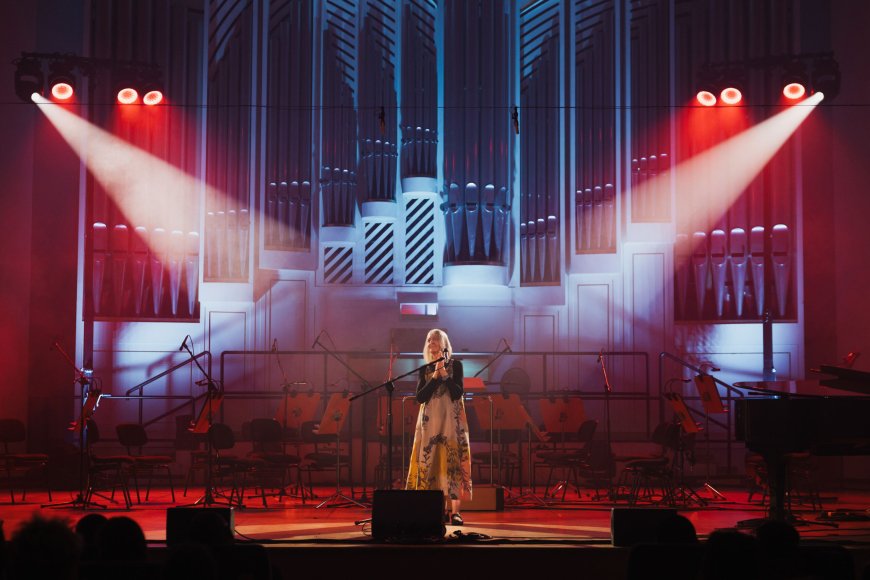
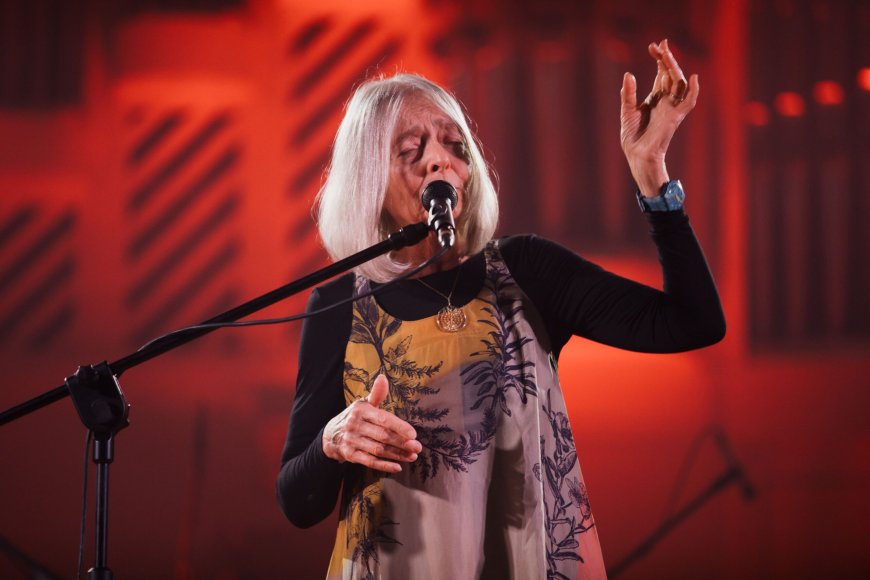
As ever, revolutionary singer and composer Joan La Barbara brings her atmosphere with her wherever she goes, including in her May 23 concert with 2220 Arts + Archives. With her air, she creates an atmosphere of playfulness and depth, with stories and sound that transform spaces into shifting environments.
Featuring La Barbara’s solo and ensemble work, the show was the final concert in the residency of harpist, composer, and sound installation artist Shelley Burgon at 2220 Arts + Archives. A student of Pauline Oliveros, Burgon is a celebrated interpreter of works by John Cage, Morton Subotnick, and James Tenney, as well as a collaborator with artists from Anthony Braxton to Björk.
La Barbara has been a pillar in contemporary classical music culture since the 1970s, applying the practice of extended techniques for instruments to the voice. In her own work and in collaboration with John Cage, Robert Ashley, and Morton Feldman, among many others, La Barbara developed a vocabulary of vocalizations from circular breathing singing to subharmonics, to what I would describe as the sound of microorganisms partying in a petri dish.
At the concert, the audience heard the organic chaos of the jungle, pieces that breathed in and out of pitched embraces and unpitched environments. La Barbara began with pieces that form the central practice of her art, the “live composed” pieces “Solo Music,” “Sound Paintings,” and “Sonic Atmospheres.” They are typical of her modus operandi: stream-of-consciousness singing over layered recordings of herself.
Her works “Solitary Journeys of the Mind” (2011), “Twelvesong” (1977), and “Erin” (1980) followed, “Erin” being the most well-known of the set because of its inclusion in the alien first-contact movie Arrival (2016). It opens with high energy squirming and swarming but is also remarkably architectural — I could see the changing shape of the space, morphing into new surface textures as she dove into her virtuosic techniques.
“Windows” (2014) followed — part of her work inspired by the artist Joseph Cornell. An electroacoustic piece recorded with ensemble Ne(x)works, it feels like a slow zoom through the desolate, yet noisy areas of a city. Crows, wind, and dark pervasive hums and clunks give way to the underside of a lonely pier with water and fingerbells, ending somewhere muffled and private.
Much like she does with the music itself, La Barbara weaves a net of personal history when she speaks about her pieces. We saw the serious German recording technicians wearing white gloves during the sessions for “Twelvesong,” and learned that she and Jóhann Jóhannsson only ordered mineral water when they met at a bar to discuss the uncredited use of her work in Arrival.
La Barbara was then joined by Modern Currents Ensemble, led by Burgon and made up of a team of performer-composers, all surrounded by their various electronic kits. The lineage that connects Burgon and La Barbara became clear with the back-to-back performances of La Barbara’s “Words on Water (Shimmer)” (2008) and Burgon’s “Conchoidal” (2016). They felt like a matched pair, exhibiting the gradual quiet construction of feathery, breathing spaces. Like dreams, both composers are excellent at delivering you to a place without you having any idea how you got there.
An unfortunate visual monotony set in over the course of the evening. In electroacoustic performances, it can be hard to distinguish what is live and what is coming over the PA. After La Barbara’s solo set with recordings, I was looking forward to having a more engaging second half with the arrival of the ensemble. However, this experience continued.
The most captivating point of the evening was the opening of “Conchoidal,” when vocalist Katheryn Shuman produced high-line tones which slowly gained the company of harp, then saxophone, in these cold points of light. Spoken by La Barbara, the line “ripples of a shell” was audible as the piece ended, the phrase reflecting on the diaphanous waving textures of the height of the piece.
We rounded off the night with a premiere of sorts. The original visual score for “Winds of Time,” written by La Barbara for a John Cage memorial performance, was run over by a truck in the rain. A fresh score made for the premiere. For this performance, as Cage might have wanted, they played from that original squished score, “rain drops, smooges, tire tracks and all.”