
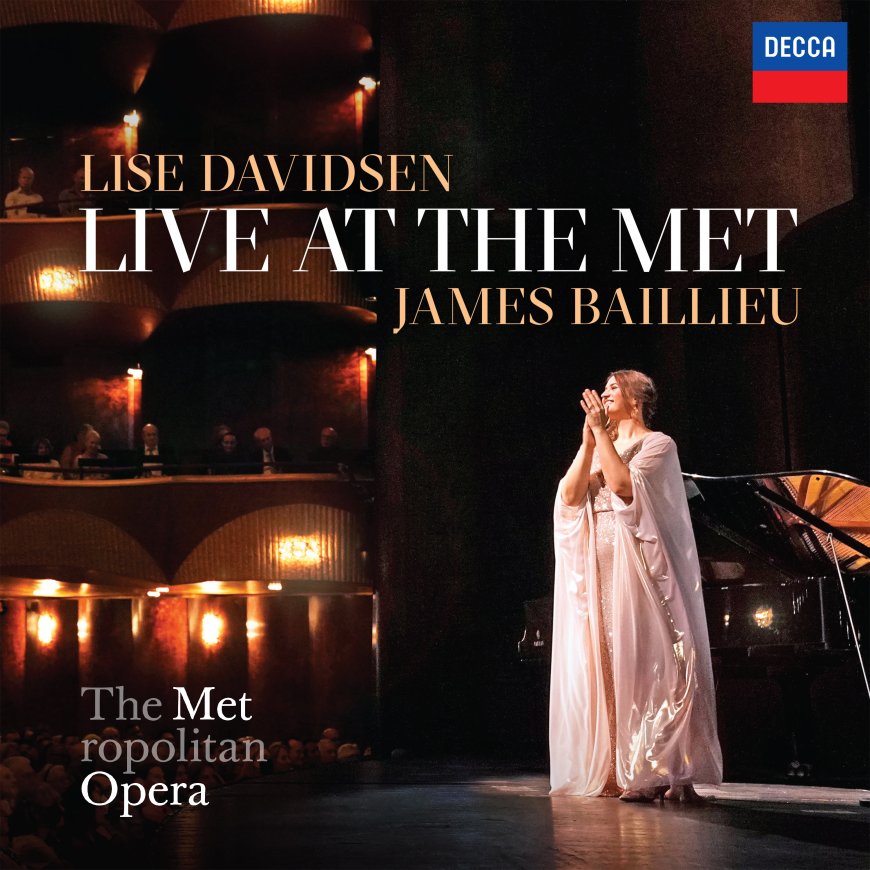
Right as Norwegian dramatic soprano Lise Davidsen, 39, is overwhelming audiences and critics alike as Isolde at the Met, Decca Records has seized the moment by releasing Lise Davidsen: Live at the Met. A record of most of her September 14, 2023, Met recital with pianist James Baillieu, the recording surrounds Davidsen’s sole Wagner excerpt, Elisabeth’s “Dich, teure Halle” from Tannhäuser, with music by Giacomo Puccini, Giuseppe Verdi, Richard Strauss, Franz Schubert, Jean Sibelius, Edvard Grieg, Emmerich Kálmán, and the one composer born in the 20th century: Frederick Loewe.
Frederick Loewe? Yes, there are two surprise light opera goodies on the program: Kálmán’s wild “Heia, heia, in den Bergen ist mein Heimatland” from Die Csárdásfürstin and Loewe’s “I Could Have Danced All Night” from My Fair Lady. Even if Davidsen cannot narrow the voice down to fine-lined lyric soprano proportions, she performs both with gusto. You will certainly get a kick out of her Norwegian-flavored Cockney accent, an approach that sounds as though she danced through the night with vengeance, and a slightly flat high C boosted above the stave by audience delirium.
Throughout the recital, the sheer size and voluptuousness of Davidsen’s voice prove both a major blessing and a minor curse. While songs by Schubert, Strauss, Grieg, and Sibelius have been successfully performed and recorded by more than one Wagnerian soprano — think Jessye Norman, Lotte Lehmann, and Kirsten Flagstad — each has been able to pare down her voice to some semblance of a fine line with point. Davidsen’s voice is far rounder, with more complex overtones. Those accustomed to song recordings by some of the soprano giants of this repertoire — from Lehmann and Elisabeth Schumann through Elisabeth Schwarzkopf, Elly Ameling, Barbara Bonney (in Grieg and Sibelius), and today’s singers — will need to adjust.
Part of the adjustment will be to a vocal production that shortchanges consonants higher in the range. As compensation, however, are some of the most beautiful and radiant sounds ever recorded by a dramatic soprano, along with a 100 percent emotional commitment that thrills in selection after selection.
If only Decca hadn’t cut so many corners. Not only did the label skimp on lyrics and translations — there’s not even a link to the material online — but it also failed in the engineering department. Perhaps because an Atmos mix was a priority, the stereo version’s 24/48 resolution lacks the dynamic and soundstage expanse of higher-resolution efforts (e.g., 24/96). In addition, Baillieu’s piano sounds disappointingly flat and uninvolving — almost as if Davidsen’s voice is all that matters.
Nonetheless, as a showpiece of Davidsen’s versatility, the recital scores major points. She may not be a born Tosca, but Amelia’s “Morrò, ma prima in grazia” from Un ballo in maschera shows how well she has internalized Verdi’s idiom. I wish she were more flexible with tempo in song — a few phrases border on pedantic, and she doesn’t quite know how to stretch a line while maintaining overall coherence — but the depth of her sound and commitment are wondrous. Given Davidsen’s hint in her recent New York Times interview with Zachary Woolfe that she may prioritize time with her twins over performance during this period of vocal prime, every recording is one to treasure.