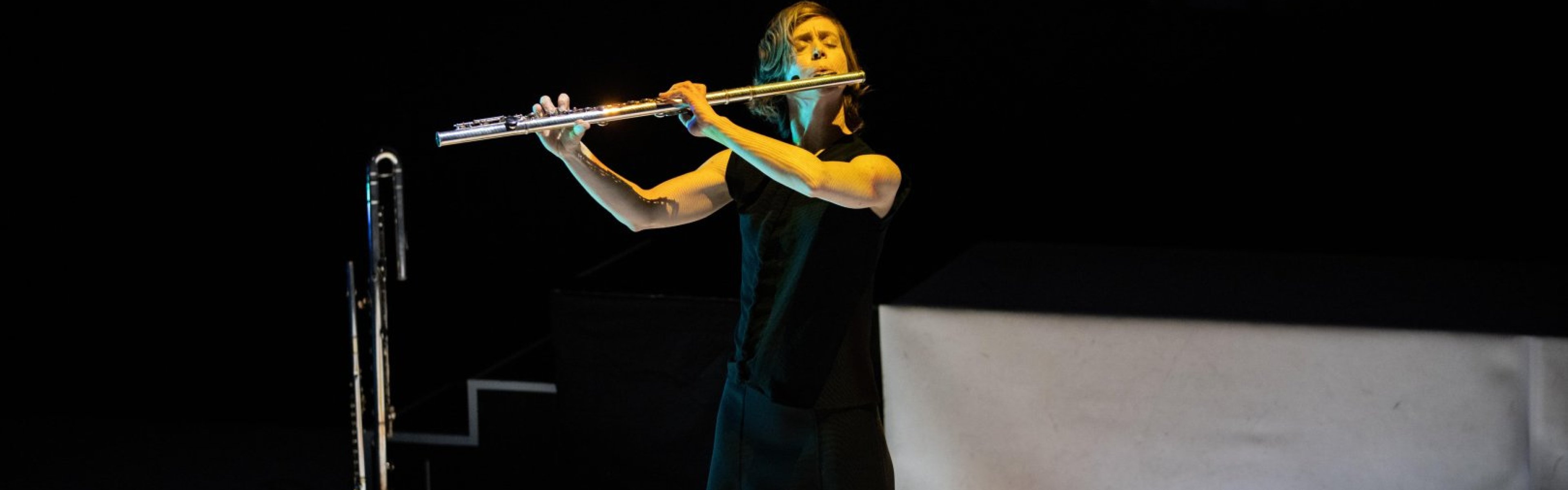
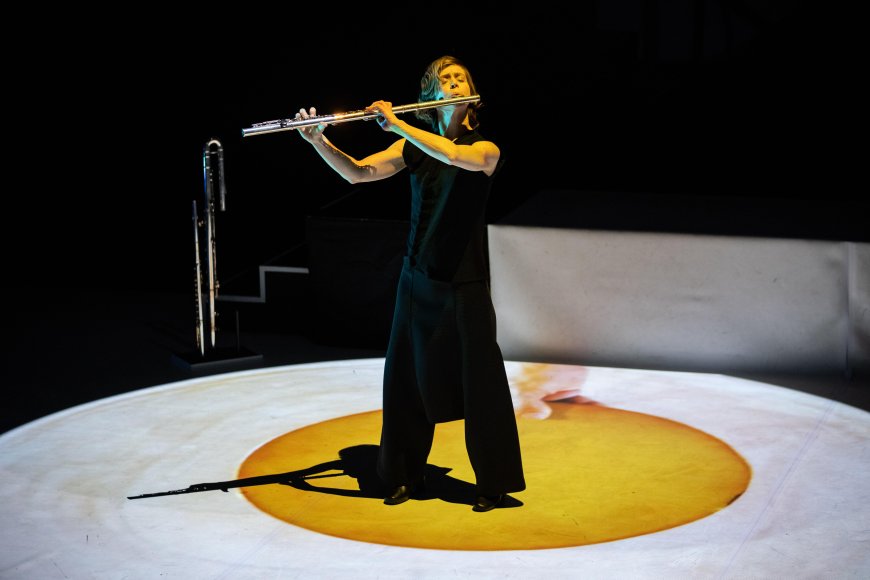
Flutist Claire Chase’s recitals are not like most you may have attended. There’s no music stand, no collaborative pianist for most of the works, no chaste separation between performer and audience. Chase will bowl you over with the power of her playing and also chat you up, describing the works she’s about to perform directly to the audience. There’s no one else who combines such exceptional virtuosity with intensely dramatic physicality.
At her San Francisco Performances debut on April 18 at Herbst Theatre, Chase presented a selection of works from Density 2036, a 24-year commissioning project that is adding important new works to the flute repertory at an astounding rate. (The title is a riff on Edgard Varèse’s Density 21.5, the seminal 1936 flute solo that launched extended flute technique.)
The musician opened with Solo from Elwha! for flute and environmental sound, a collaborative work credited to Annea Lockwood and Chase herself. The environmental sounds come from the Elwha River, on Washington state’s Olympic Peninsula.
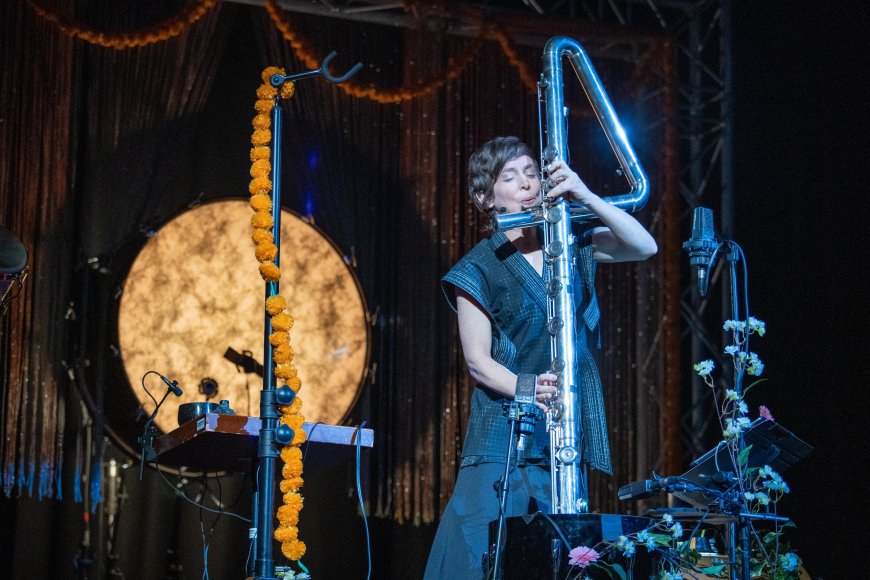
The complete Elwha! is about 40 minutes long and uses seven different flutes. The Solo is played on the standard concert flute, and it’s so richly composed as to leave you wanting to hear the whole work. Against the rushing river, the flute plays long, low tones, circling around one pitch. Recorded birdcalls emerge from the river’s sounds. The flute’s pitch droops, lifts, ruffles, flows onward.
Susie Ibarra built Sunbird, performed in an arrangement by Chase herself, around transcriptions of sunbird song. The work features call-and-response between recorded flutes and the live instrument, leaving the listener essentially surrounded by birdsong.
The Herbst performance marked the latest local appearance of Marcos Balter’s Pan, this time in a suite consisting of the sections “Death of Pan,” “Echo,” and “Soliloquy.”
“Death of Pan” seemed even more intense than in Chase's 2023 performance. The god is in extremis, with Chase not just playing the flute, but yipping, gasping, panting, chanting, growling, and spitting out syllables that might be Greek, or not. At times she’s in duet with herself, through complex live processing: for the solo suite, Chase prerecorded the electronics and processing and played with a fixed track. You hear Pan’s brilliance as a musician as well as the torture he’s going through as he’s flayed alive.
“Echo” is almost entirely the flutist’s duet with herself, accompanied by soft percussion in the form of electronic bells, as Pan serenades the nymphon Echo. In “Soliloquy,” the god tries to make amends, too late, for bad behavior. Spectral electronic chimes ring, the music fixates on a few pitches, keys click, and the music dies away.
Pauline Oliveros’s Thirteen Changes, from 1986, isn’t a traditional notated score, but rather a text score — an invitation to interpret written prompts musically. Oliveros wrote brief poems, or prompts, that any musician, or group of musicians, may interpret as they wish. The prompts are evocative, atmospheric, open-ended: “Standing naked in the moonlight — Music washing the body,” “Elephants mating in a secret grove,” “A solitary worm in an empty coffin,” and more.
Chase’s interpretation of Thirteen Changes can be performed with live processing by composer Rand Steiger, but that isn’t practical for all performances. Chase recorded an improvisation for each of the prompts, to which Steiger added his own signal processing. Chase then improvises in concert on top of the processed files. It’s a feat of remarkable virtuosity: a double improvisation with a third party in the middle.
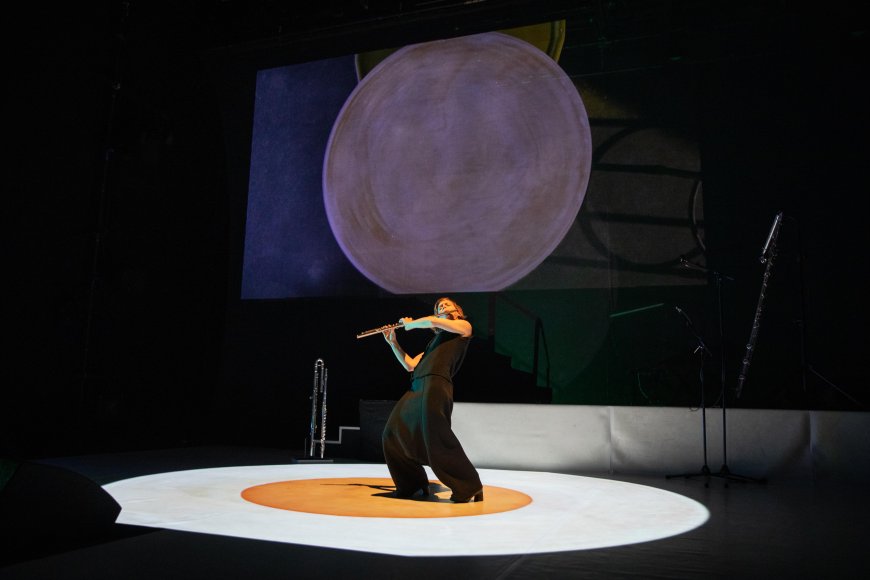
Her takes are unimaginably varied: a whale-like bass flute with joyous high notes for “Standing naked in the moonlight”; rattling piccolo keys, blips, and bloops for “Atomic energy — Rotating molecules”; an ocarina and ghostly electronic sounds for “A singing bowl of steaming soup”; eerie wails for the solitary worm.
The program closed with two works by the pioneering American minimalist Terry Riley: Pulsing Lifters, performed with new music specialist Sarah Cahill as collaborator and pianist, and the solo suite from The Holy Liftoff, arranged by Chase and Samuel Clay Birmaher.
Pulsing Lifters, a gentle and rhythmically straightforward work, made quite the contrast with the great complexity and profusion of extended flute techniques in the first half of the program. The flute and piano play in harmony, and there’s a good deal of repetition, and some contrast, within the sections. Sound engineer Jacob Felix Heule, Chase’s collaborator throughout, contributed some live processing.
The solo suite from The Holy Liftoff is quite another matter. It’s not in any way a fixed work. Built through an ongoing conversational exchange of drawings between Riley and Chase, it’s now up to around four to six hours of music and runs through numerous contrasting sections. You hear flutes in parallel motion, low flute pedals, passacaglia-like and canonical passages. A mournful litany gives way to jazzy, percussive phrases, followed by typically flute-ish swirling. The Solo Suite might be a bit too long, or, given the enormous amount of music in The Holy Liftoff, perhaps it’s a bit too short