Los Angeles Opera has the distinction of having presented full-scale productions of Philip Glass’s Portrait Trilogy: Einstein on the Beach, Akhnaten, and Satyagraha.
LA Opera’s revival of Akhnaten, which opened Saturday at the Music Center’s Dorothy Chandler Pavilion, hardly represents a cost-saving strategy. This remarkable production, originally created for English National Opera and first staged in LA in 2016, represents a commitment to the work’s place in the repertory.
In my 2016 review of the premiere, I called the piece a “must-see” for its musical and visual impact. It still is.
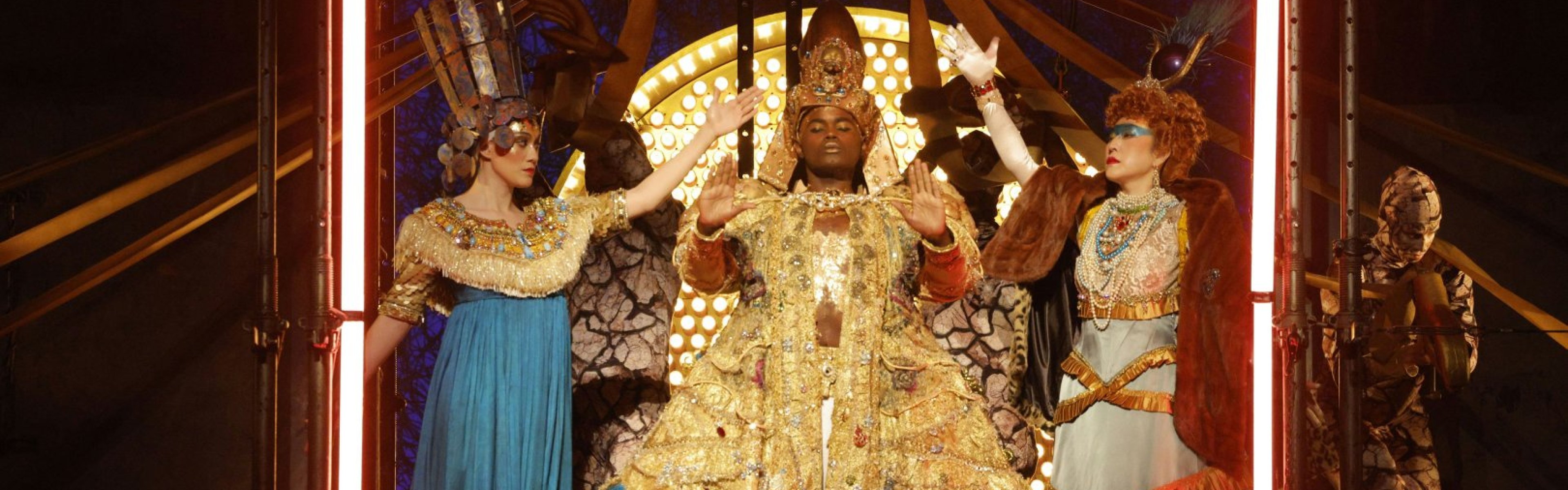
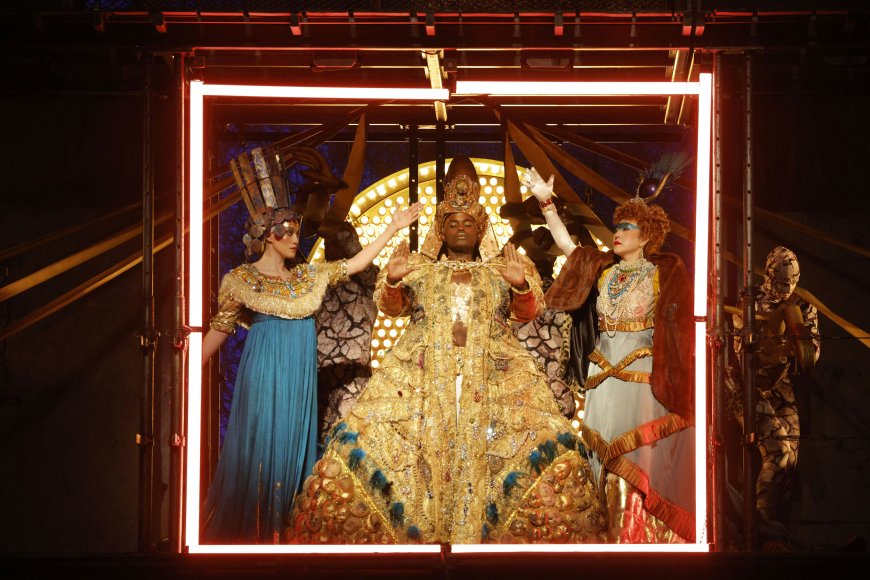
Directed by Phelim McDermott, with dazzling sets and costumes by Tom Pye and Kevin Pollard, this Akhnaten is grand opera at its grandest.
The revival is, however, distinctly new in two significant ways.
In 2016, the conducting duties were handed to Matthew Aucoin, who was clearly out of his depth. In the current revival, the dynamic Dalia Stasevska stands tall, with a flamboyant style of conducting reminiscent of Gustavo Dudamel. Never tentative, her leadership was clear from the first assertive pulsation to the opera’s final fading diminuendo.
Glass never accepted the label “minimalism,” which is still used to categorize his work. While his structural foundation relies on repeating and modulating arpeggios, the way the layers of instrumental complexity evolve, though meditative or even trance-inducing, is anything but minimal. A section can flow quietly for several minutes and then, with a change in orchestration, burst forth in a fortissimo.
McDermott’s production famously incorporates a 10-member troupe of jugglers whose ball-tossing and mallet-flinging have been meticulously choreographed by Sean Gandini and mirror the motion of Glass’s score.
In much the same way, Stasevska’s conducting was a juggling act whose goal was to create an exquisite balance. Drop a ball (as happened more than once on opening night) or play a note off-key (as also happened) and there’s nowhere to hide. And in the case of the exposed passages for the winds and brass, the slightest wavering can and did stand out like a rifle shot.
On Saturday, Act 1 was a triumph for the orchestra. Fatigue, however, crept into Act 2 as the phrasing lost specificity. But like a jockey rounding the clubhouse turn, Stasevska went to the whip in Act 3 and the entire ensemble responded.
The other major difference in this revival is countertenor John Holiday in the role of Akhnaten replacing Anthony Roth Costanzo, who sang the LA premiere.
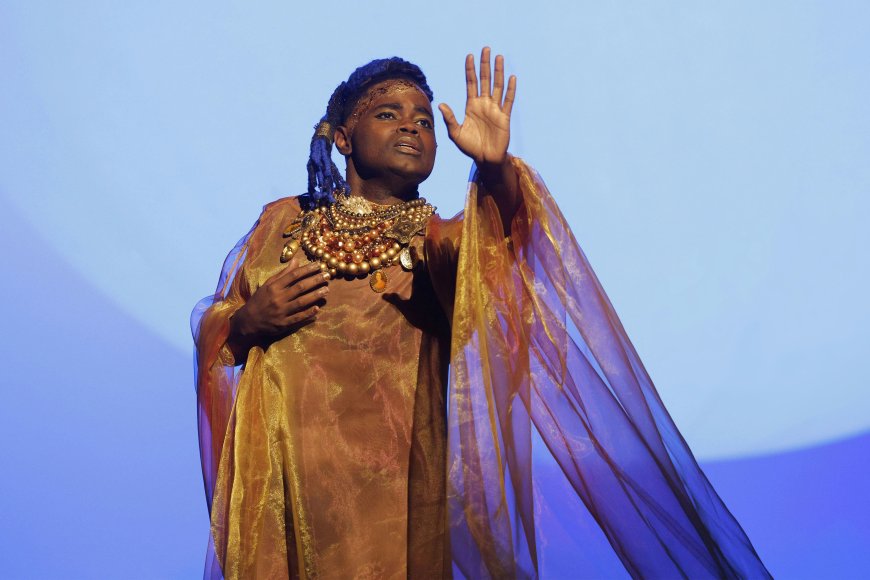
He may not bring that otherworldly quality to his performance but his Mozartian lyricism and pitch-perfect harmonizing are major assets to the show.
Looking exactly like the famous statue, mezzo-soprano Sun-Ly Pierce projects a stately presence as Akhnaten’s bride, the princess Nefertiti. So Young Park prowls the court as Akhnaten’s mother, the dowager Queen Tye. Horemhab (general and Egypt’s next pharaoh) is sung by baritone Hyungjin Son. Yuntong Han strides the stage imperiously as the High Priest of Amon. In the opera’s most lyrical interlude, Akhnaten and Nefertiti are treated to a wafting serenade by their six daughters, sung by Emily Damasco, Julia Maria Johnson, Katie Trigg, Abi Levis, Erin
Alford, and Kristen Choi.
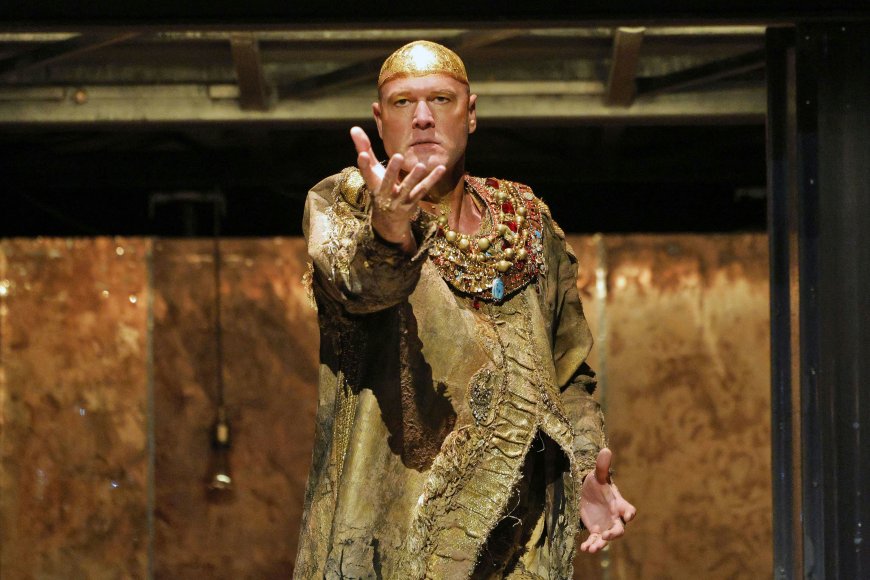
The opera also features a major speaking role — Amenhotep III — who serves as narrator and was performed with Prospero-like presence by Zachary James.
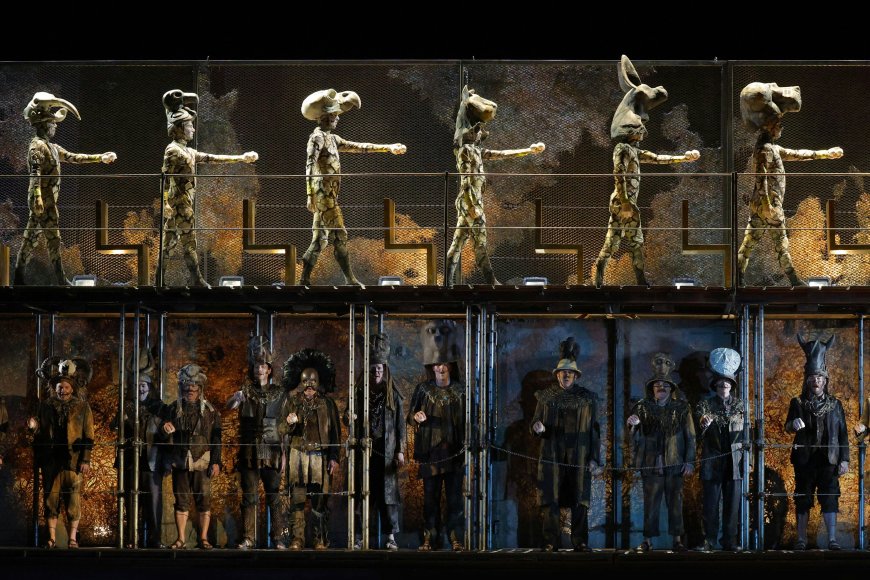
Glass’s substantial score calls for a full chorus representing the people of Upper and Lower Egypt, who sing in a variety of languages including Hebrew and Akkadian, to texts compiled by Shalom Goldman. The LA Opera Chorus was sonorous and solid in a critical role.
As in any grand palace drama, there are myriad dignitaries, military figures and priests, all of whom were costumed in a fantasy mix-and-match of eras and locales.
The opera ends on a bittersweet note as the once grand palace city of Akhnaten becomes just another stop on the tourist trail, its former grandeur turned to dust, part of an endless cycle of regime change in the region.