The Monkey King arrived on stage for the first time at the War Memorial Opera House last Friday, its eponymous hero — or anti-hero — leaping, dancing, rolling, floating through the sky, and making trouble everywhere he set foot.
A San Francisco Opera commission, The Monkey King is composed by Huang Ruo with an English and Mandarin libretto by David Henry Hwang. (Supertitles are in both English and Chinese.) Loosely based on the classical Chinese novel Journey to the West, the opera tells the story of a monkey who succeeds in making himself a king, only to discover that his path isn’t righteous. He needs to learn the sutras and open his heart, because “power alone is not enough.”
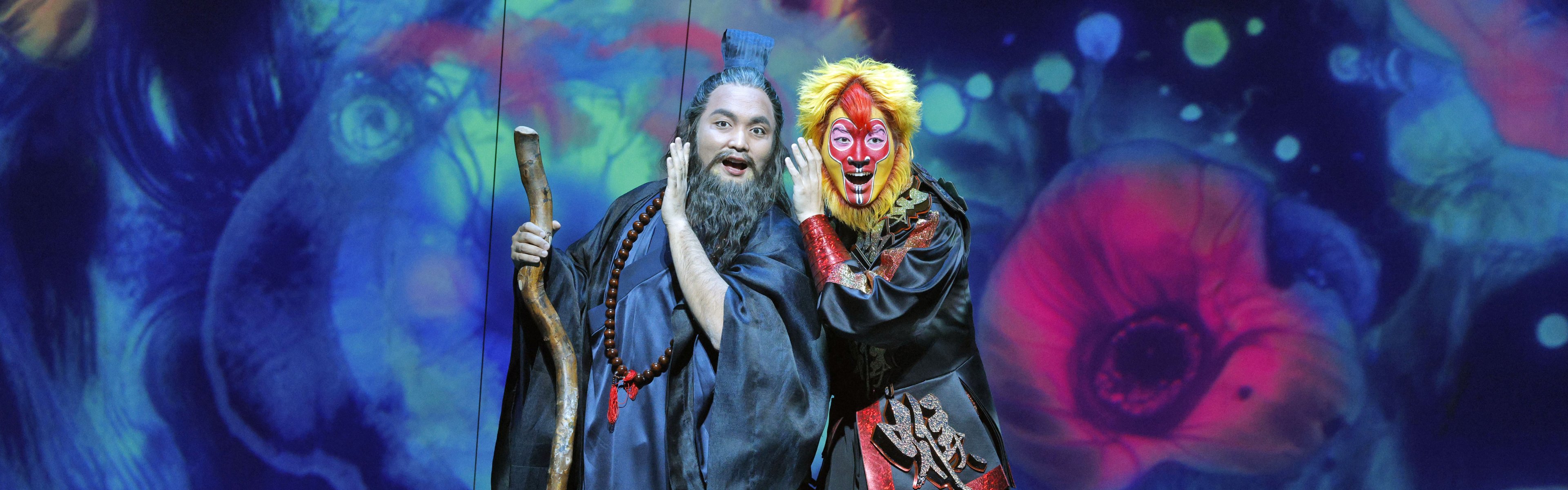
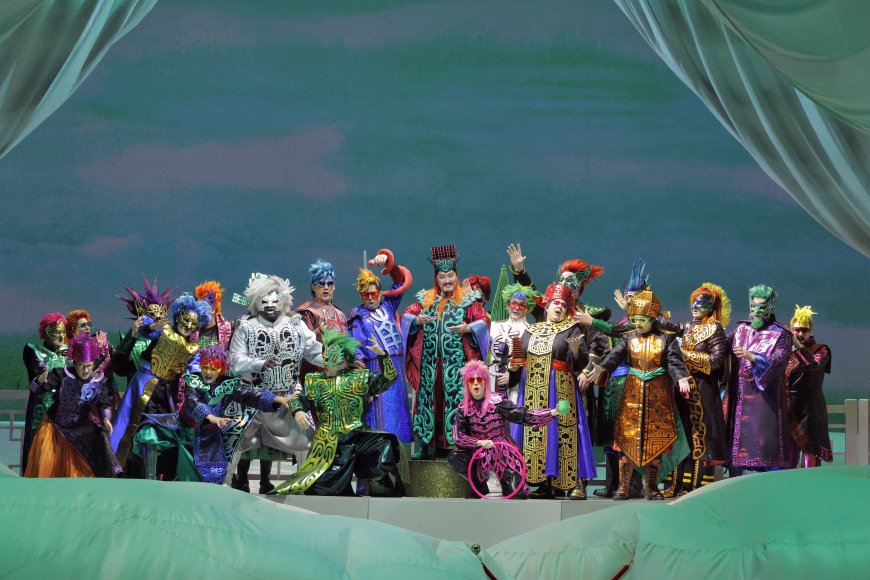
The Monkey King is a visual feast, and very likely the most spectacular work that San Francisco Opera has ever presented. The opera is brought to vibrant life by the astonishing stage designs and puppetry of Basil Twist, the gorgeous and fantastical costumes of Anita Yavich, wonderful choreography by Ann Yee, the evocative lighting of Ayumu “Poe” Saegusa, and magnificent performances by everyone in the cast.
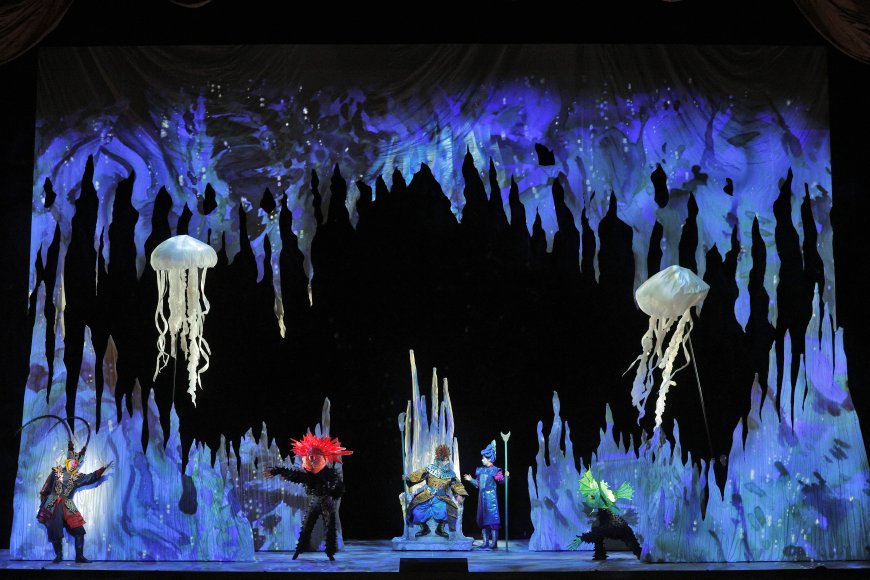
It’s also a triumph for director Diane Paulus, who brilliantly unites every element in an exceptionally complex production. She makes each character a distinct individual, while creating beautiful, coherent stage pictures even in the densest crowd scenes.
In eight scenes spread over two fast-moving acts, the Monkey King’s adventures take him from the jungle to the depths of the sea to the heavens. Like the title character, the opera is wry, funny, irreverent, and a tremendous amount of fun. (I challenge you to name another opera where the title character has the audacity to pee on the Buddha’s thumb.)
Three individuals play the Monkey King: a singer, a dancer, and a puppet, the latter manipulated by several black-clad puppeteers. Through some miracle of stagecraft and direction, transitions from one iteration of the character to another are virtually seamless.
It helps that the puppet is nearly human-sized and that all three portrayals wear identical costumes and makeup. It helps even more that tenor Kang Wang, making a terrific company debut and singing with a tireless baritonal voice, is himself extremely nimble. It’s nearly impossible to distinguish him from the sensational dancer, Huiwang Zhang.
Huang and Hwang neatly provide moments of repose by interweaving Monkey’s adventures with appearances by Guanyin (the bodhisattva, or “enlightened one” of compassion), the Buddha himself, and Monkey’s teacher Master Subhuti. Guanyin, sung with serene, rich-toned beauty (and occasional sarcasm) by soprano Mei Gui Zhang, floats on a lotus above the stage. Authoritative bass-baritone Jusung Gabriel Park sings both the Buddha and Master Subhuti.
Huang’s underlying musical style in the opera tilts minimalist, with a certain amount of riffing in the orchestra. The more active sequences in the opera are dominated by declamatory vocal lines, while the more tranquil moments bring forth lovely melodies.
The composer’s orchestra is small, with just 34 strings and pairs of wind and brass instruments, enriched by a harp, the Chinese pipa, and an array of Asian percussion instruments. Over the minimalist substrate, Huang deploys all sorts of arresting and colorful wind and brass sonorities. In her SF Opera debut, Carolyn Kuan conducts with fierce attentiveness, deftly shaping this operatic juggernaut and moving it firmly through its course.
The well-structured, singable libretto plucks an assortment of episodes from Journey to the West, weaving them into a journey of discovery by the title character. The Monkey King is a trickster character, a relative of Reynard the Fox, Coyote, and Loki/Loge. His exploits set up some of the most visually stunning sequences in this opera, which, uniquely, uses 4,500 yards of fabric for sets, props, and various scenic effects.
Basil Twist’s sets and puppets are pure magic. Pillars of fabric rise to represent mountains and the Buddha’s hand; puppet horses leap, run, and nuzzle the Monkey King; jellyfish float above the stage. Even uncomplicated sets like the red curtain and fiery projections for the Furnace of Eight Trigrams are spellbinding.
Each role is strongly cast. Hongni Wu, last heard as Bao Chai in 2022’s Dream of the Red Chamber, brings her shimmering mezzo and comic skills to the Crab General and Venus Star. Tenor Konu Kim — Bao Yu in Dream of the Red Chamber — is hilarious as the Jade Emperor, frustrated at every turn by Monkey.
You could only wish that the marvelous bass Peixin Chen’s role as the Supreme Sage Laojun were more substantial. The San Francisco Opera Chorus sang beautifully as Buddhists, monkeys, courtiers, and warriors, with more costume changes in a short opera than this reviewer can recall seeing before.
It’s also hard to recall an audience that was more spontaneously appreciative than The Monkey King’s on opening night, which added to the high spirits and delight of the evening. There was applause for the singers, scenery, dancing, and even the magical staging.
The Monkey King is a great show that comes with a great message about compassion and power. It’s a light-hearted counterpoint to Parsifal and Dead Man Walking, which San Francisco Opera performed earlier this season. We’ll probably never know if this confluence of works was a happy coincidence or the result of careful planning
If you’d like to see The Monkey King, few tickets are available across the remaining performances, which run through Nov. 30. If you haven’t already secured a ticket, consider standing room or the livestream, which will be available on demand from Nov. 23-25.