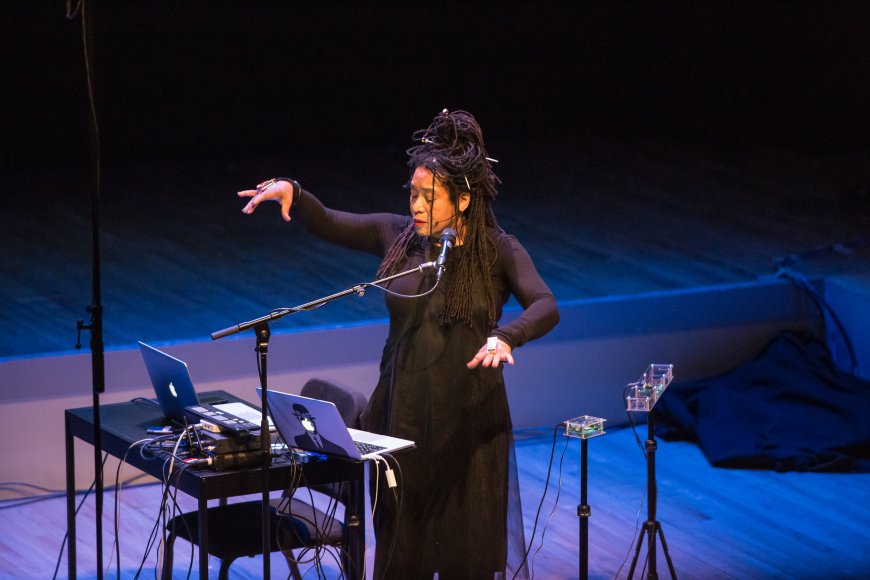
In a sonic theater tucked away on a quiet San Francisco street, Pamela Z presented the fruits of her 2025 Berlin Prize Fellowship last weekend: Arbeitsklang / WorkSound, a spatial sound performance incorporating sounds and fragments of speech recorded by the composer during her residency in Berlin.
The work was composed for Audium, the theater in which it premiered, and it makes spectacular use of Audium’s 176 speakers. Pamela Z — who often performs her own work and is also a media artist — will perform her piece every Thursday though Saturday this March. Each performance will be a unique, unrepeatable experience because she uses custom MIDI controllers to manipulate her sounds in real time.
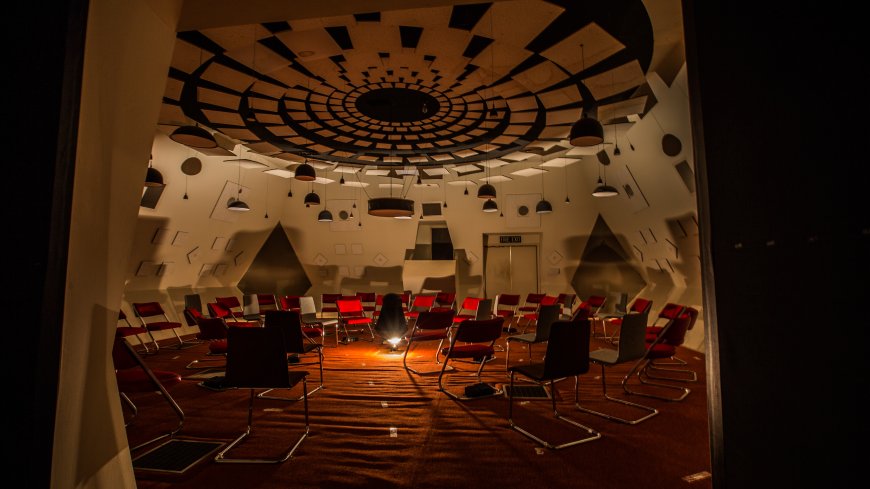
As soon as listeners set foot in the Audium theater, the lights fade and the surroundings become pitch-black. It is in this lightless, sleep-like space that Pamela Z begins to perform. Here, sounds feel as if they originate by one’s shoulder or behind one’s ear, as if they are moving toward, past, or away from the listener. The audience develops an intimacy with sound that exists in no other space.
Arbeitsklang / WorkSound is, as Pamela Z states, a work of sound about the sound of work. Every sound in the piece has an association with labor and the workspaces of Berlin. The fragments of speech listeners hear, too, are derived from interviews the artist conducted with working Berliners. During her residency, she spoke to people in a range of fields, asking them about their work and the sounds associated with such work. The differences in her interviewees’ voices — their accents, the speeds at which they spoke, the presence or absence of vocal fry — became a continuous locus of interest in Arbeitsklang / WorkSound. The piece celebrates Berliners’ vocal diversity as much as it does the diversity of their work.
Combining voices with industrial noises ranging from sewing machines to factory ambience to Gutenberg printing presses, the piece spans the entire spectrum from noise to music. It begins, however, at a narrow point on this spectrum: industrial sounds severed from their real-world environments, along with voices. Uninformed about the sources of these sounds, listeners are encouraged to listen not for what the sounds signify but rather for their innate sonic qualities — textures, reverberations, unfamiliarities. It is possible to name some with confidence: tinkling cowbells and the dense sizzling sounds of cooking or frying. Nevertheless, the piece keeps the audience mostly in the dark, visually and sonically.
Eventually, voices name work-related sounds and describe them, inaugurating a different mode of listening. Listeners now may recognize a knife being sharpened and have their suppositions confirmed. They may hear a voice saying “cutting board” and expect to hear the sound of a knife hitting a cutting board. Such games of recognition and expectation are certainly fun, but depriving the sounds of ambiguity subjects the audience to a kind of sonic Mickey-Mousing that is less interesting than the initial mystery.
Pamela Z revitalizes the performance when she shifts toward melody. At one point, she overlays fragments of speech with metallophone sounds, transcribing these fragments into pitches and rhythms; at another, she introduces fragments of her own singing, first in monophony and then in harmony. These melodic vocalizations mingle with industrial noises to display the marvelous full sonic spectrum, prompting listeners to juggle different modes of listening at once: timbral, semantic, harmonic.
Toward the piece’s conclusion, the composer nudges her audience with a gentle reminder that they cannot bask in her space forever: voices declare the end of a work shift, the end of a day, and as industrial noises die down, listeners may feel as if they, too, are about to leave work — albeit a line of work in which they are inclined to remain. When the sounds fade and the lights brighten, it is as if listeners have awakened from a dream — sometimes mysterious, sometimes humorous — in Audium’s one-of-a-kind theater, a dream that dignifies even their own labor.