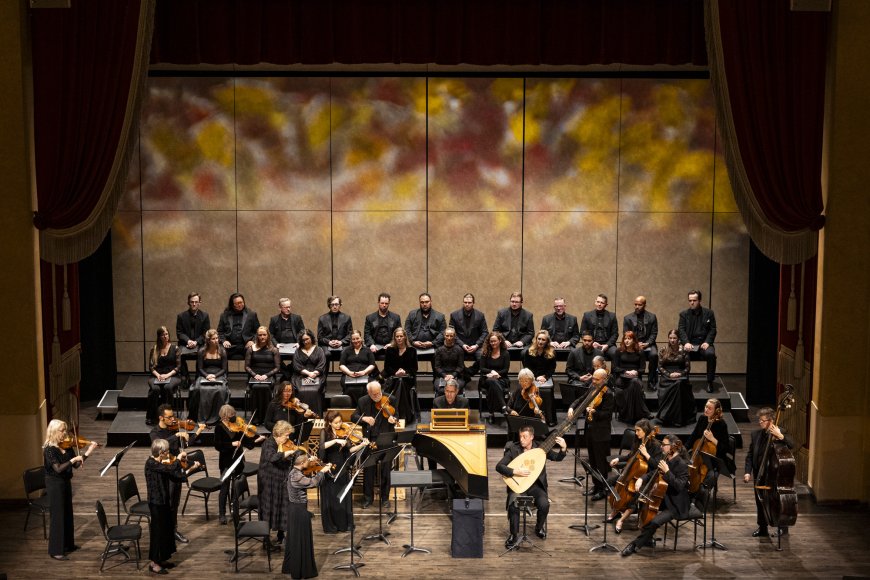
December is not a month when you expect to be surprised in a concert hall. In the classical music world — and especially with a period instrument band — it’s a time for traditional fare.
But Philharmonia Baroque Orchestra & Chorale deviates from the norm.
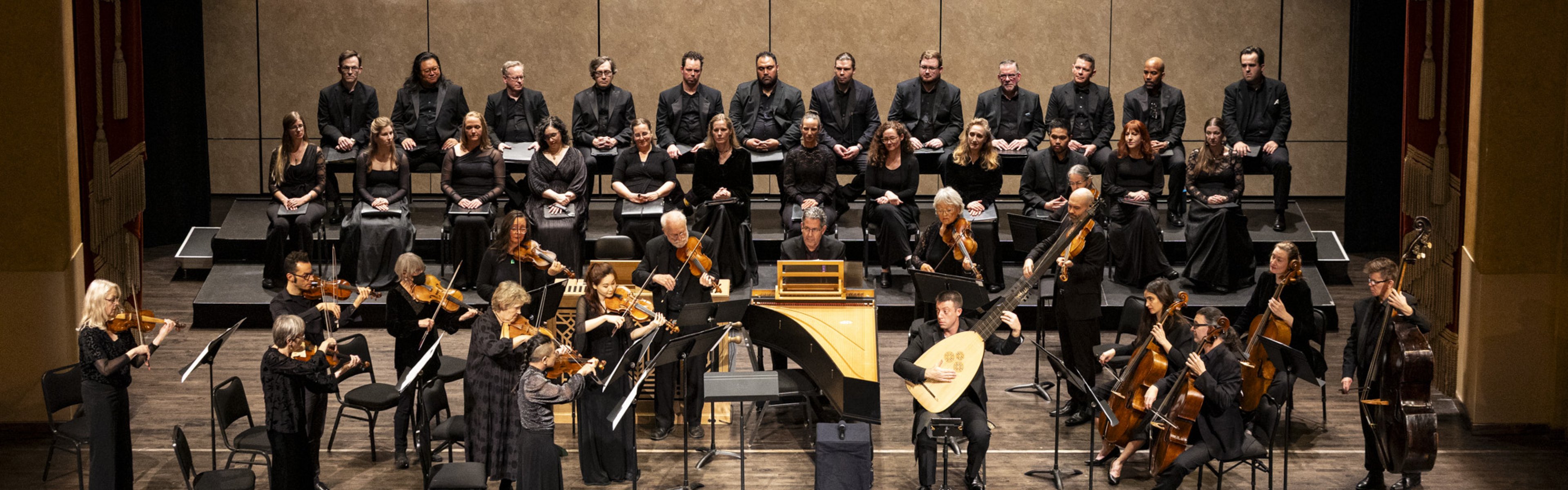
Its Friday, Dec. 5 concert at the Herbst Theatre was anchored by Antonio Vivaldi’s Gloria, conducted by Philharmonia Chorale Director Valérie Saint-Agathe, but two new choral works are also on the program. In the end, Caroline Shaw’s The Holdfast proved to be its riveting center, drawing fulsome applause from the sold-out San Francisco crowd — and the composer herself, who was in attendance.
Shaw loves to bring contrasting texts into her choral works. Ostensibly, The Holdfast — co-commissioned with Glasgow’s Dunedin Consort and Wigmore Hall — is a setting of Thomas Hardy’s “The Darkling Thrush,” a poem about the promise of renewal hidden away in the deep of winter. In the midst of life, we are in death.
Shaw’s own texts reinforce the end message of Hardy’s poem about renewal. Her third movement, “The Resilience of Lichens in Winter,” lists lichens, which is where the title of her work comes from.
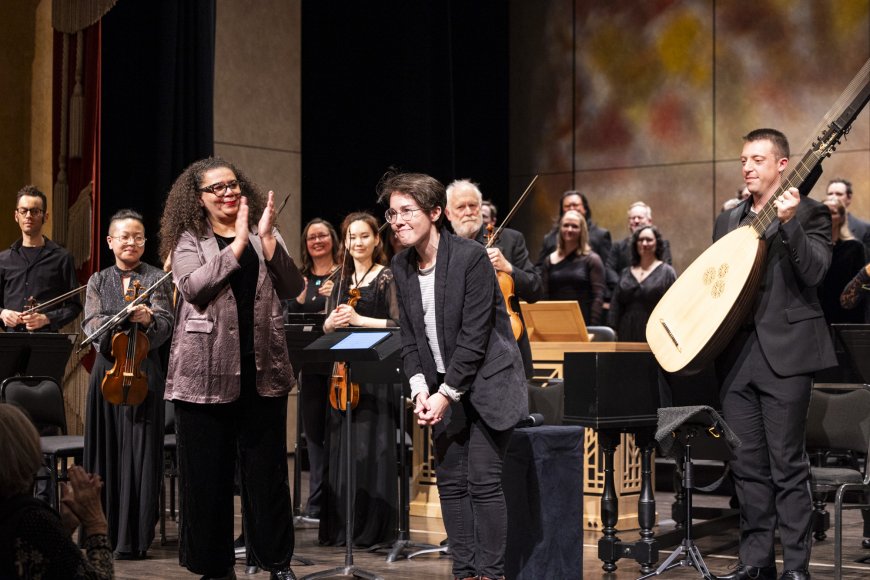
A holdfast is the rootlike structure that attaches lichens to a support. Metaphorically, that’s how we endure winter. More commonly, it’s what we do when our core beliefs are threatened. In the midst of death, life persists, as Mahatma Gandhi said.
Shaw’s setting of Hardy’s poem involves no tricks. It’s melodic and doesn’t play with the rhythm of Hardy’s iambic lines. Rounds (where one singer begins and another follows with the same tune) are associated with children’s songs and games, and here they function to break Hardy’s rhythm and allow the music to expand, while the brief third movement brings in modern musical techniques of overlapping voices.
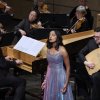
Throughout, Shaw’s painterly sense of color evokes Vivaldi’s Four Seasons. The Holdfast begins with an icy pairing of plucked strings by the theorbo (a bass lute, played by Adam Cockerham) and the harpsichord (played by Corey Jamason). The string orchestra is brilliantly used, and some effects — like the ghostly violin harmonics in the third movement — sound weirdly new when played on period instruments. Overall, it’s a beautiful, deeply layered work from a highly personal and deft artist.
Roderick Williams’s Quem Pastores Laudavere (When the shepherds praised), commissioned for the Philharmonia Chorale, received its world premiere on Friday. As a setting of the famed Christmas tune by 16th- and 17th-century German composer Michael Praetorius, Williams’s work is effective in a wholly different way.
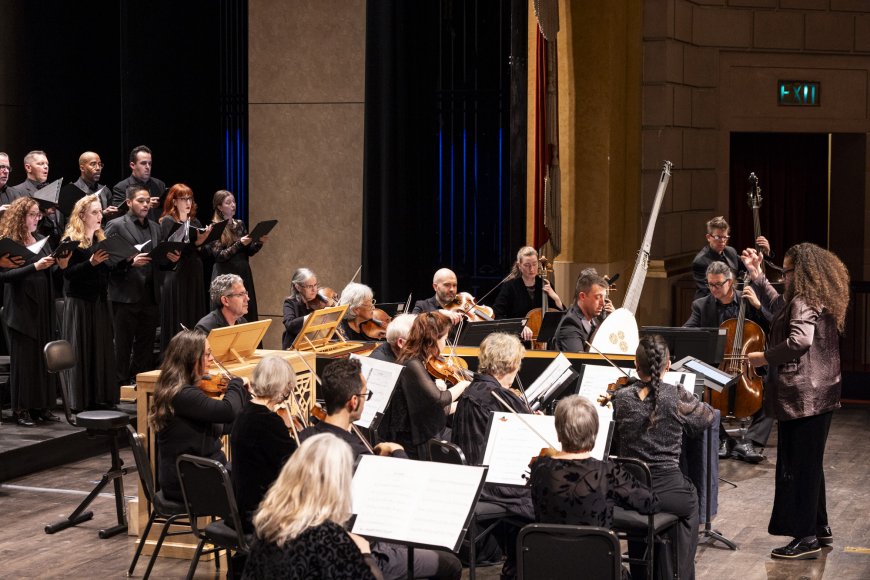
Williams, now an acclaimed opera singer, soaked in the English choral tradition that infuses this piece as a boy chorister. Written in 12 parts for the Chorale’s 24 singers, the work is a deconstruction of the tune that ends in a reconstructed harmonization. Cool things happen along the way, like when the basses evoke 16th- and 17th-century Anglican anthems by singing a cantus firmus in long notes, with the upper voices in imitative polyphony. The harmony is clustered and de-centered until the basses sound the fundamental keynote of the tune. This is followed by a harmonization that the composer calls “soupy and schmaltzy,” but I was happy to go along with it.
The traditional part of the concert included Arcangelo Corelli’s Christmas Concerto, (Concerto Grosso in G Minor, Op. 6, No. 8) where the orchestra’s warm but incisive string tone was on full display. The pastoral final movement with its shepherd-like drones, from which the work derives its nickname, was a primer on what a cohesive string section should sound like.
Vivaldi’s Gloria raised the temperature, as it’s designed to. The composer’s rhythmic vitality and invention can’t be tamped down, even in a liturgical work like this one.
The Chorale sang it brilliantly, with soloists drawn from its ranks. Longtime orchestra oboist Gonzalo X. Ruiz was gorgeous in the “Domine Deus, Rex coelestis” movement, accompanying Julia Grizzell’s graceful soprano, and countertenor Kyle Sanchez Tingzon was excellent in the “Domine Deus, Agnus Dei.”
The final fugue left the audience delirious with excitement.
In the foyer, prior to the concert, singers from the San Francisco Girls Chorus sang traditional carols. It almost need not be said: they were brilliant and professional as always.
This article has been provided in partnership with San Francisco Chronicle.