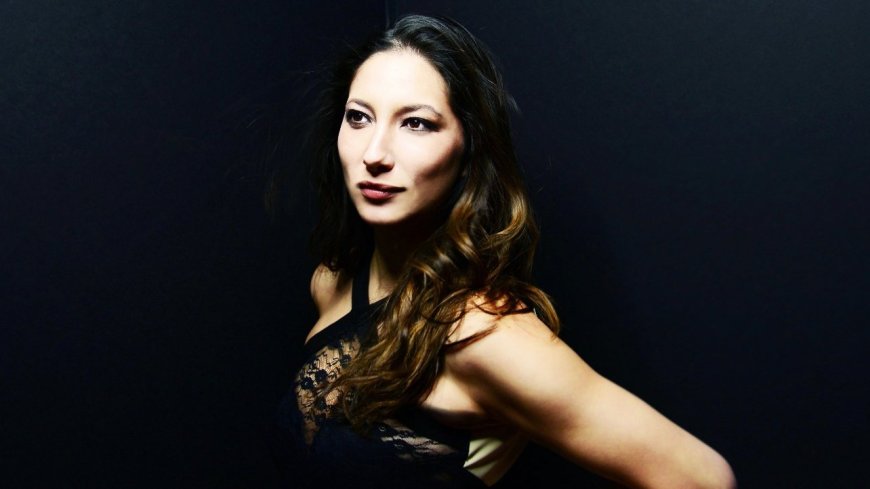
Tanya Gabrielian is too good a pianist to remain unknown.
Hearing her recital for Old First Concerts on Friday night, along with a dozen or so co-adventurers, felt like discovering a great indie band. Here was a thinking musician making interesting repertory choices, writing her own program notes, and performing with seasoned attention to detail and phrasing. It was a pleasure to listen to her.
Of course, the California native might have wanted her San Francisco concert to remain low-key. She was trying out a new work in her repertory and it was not an easy one. She joked before launching Alfred Cortot’s rarely played transcription of Cesar Franck’s Violin Sonata in A Major that we were in an appropriate venue to offer prayers to help her get through it. For her sins, a critic was in the audience, but he was impressed.
Franck, an organist himself, did the pianist no favors, writing turbulent music for the instrument particularly in the driving second movement. In the last movement, his closing theme requires the player's hands to simultaneously leap to opposite ends of the keyboard. You can check your left hand or your right, but you can’t check both. That’s where the prayers come in.
Cortot (1877-1962), a master technician despite his tendency to hit wrong notes and then leave them on his recordings, was the most influential French pianist of his generation. One of his specialties was editing piano music for Éditions Durand, for whom he prepared many scores by Frederic Chopin, Franz Liszt, and Robert Schumann. Cortot’s analytical mind saw the clever interplay between violin and piano in Franck’s sonata and probably figured he could fit the tight counterpoint under his hands.
Like Cortot, Gabrielian is analytical to a fault. But unlike Cortot, Gabrielian — who won two piano competitions in her youth as well as a major recital prize from the Royal Academy of Music — is accustomed to being note perfect.
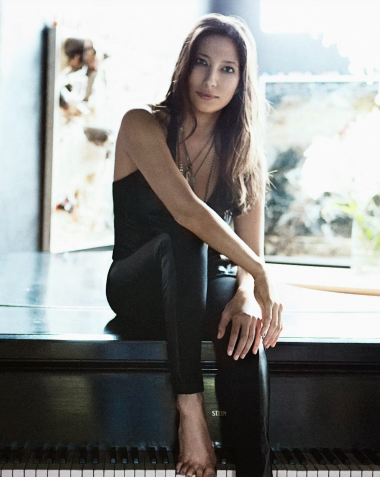
Though she fell short of absolute perfection, her interpretation of Cortot’s transcription was highly musical and expressive. She threw herself at the piece without reserve, an attitude that served Franck far better than a more cautious perfectionism. Her strong fingers dug into the keys and produced a powerful sound that rang out and almost overwhelmed the church’s reverberant acoustic. She clearly understood the music, making her best impression in the Recitativo-Fantasia, where the fireworks yield to introspection, a mood that is Gabrielian’s interpretive strong suit. The final movement, with its heart-in-mouth degree of difficulty, came off well and will get better the more she plays it.
Gabrielian’s other ambitious choice was Lullaby (2015) by Iranian American composer Sahba Aminikia, who was present at the concert. Gabrielian pulled it off with such elan that no one in the audience would surmise its technical difficulty. Hypnotic, played at a whisper dynamic, and with long sections performed with the sustain pedal down, this is a work that requires immense artistry to pull off. There was no showiness here, Gabrielian just nailed it.
As an opener, Gabrielian offered the beloved Kinderszenen (Scenes of childhood) by Robert Schumann. I found her take on this familiar masterpiece enchanting. Fully indulging her “Eusebian” fantasy side, she gave a lingering wistfulness to “Träumerai” (Dreaming) and poetic depth to “Der Dichter spricht” (The poet speaks). But contrast is essential to a suite of character pieces, and she inhabited the much more frenetic sections — knights, a game of blind man’s bluff, and a range of moods — with surety and prowess.
Gabrielian has been heard in major venues in the U.K. and U.S. and perhaps she has been away from the West Coast too long. But if there are takeaways here, it’s that Old First Concerts is worth checking out, and Gabrielian should be brought back to the Bay Area soon.