While Grete Pedersen’s stewardship of the 89th Carmel Bach Festival has been aimed at resuming the mission of founders Dene Denny and Hazel Watrous: of celebrating the very old and the very new, traditionalists could still drink their fill at the fountain of patron saint Johann Sebastian Bach. Choral director Andrew Megill chose to have it both ways on consecutive days — mostly Bach on Tuesday in the Sunset Center (July 14) and 20th-century adventure at the Carmel Mission Wednesday (July 15).
In the “Bach at Sunset” concert, the Cantatas BWV 39 (Brich dem Hungrigen dein Brot) and BWV 105 Herr, gehe nicht ins Gericht formed a sandwich around a somewhat lighter bit of writing, Venetian composer Antonio Lotti’s Missa Sapientiae. The title of BWV 39 literally means “Break your bread with the hungry,” which in the context of 2026 came off as a not-so-veiled Biblical thrust at the prevailing mean-spirited policies of the current custodians of American government. The same can be said for another English translation from the opening chorus, “And those in misery, bring into your home” (take that, Stephen Miller). BWV 105, which Megill thinks is one of the four or five best cantatas of the 215 or so that have survived, is based on the Parable of the Unjust Steward from Luke 16.
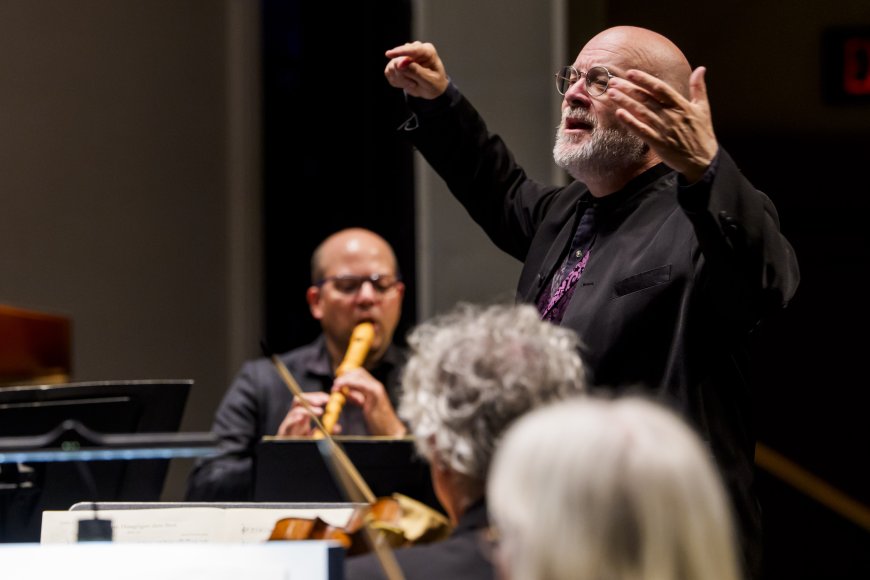
In considerable contrast to the Bach cantatas, the Lotti mass began brightly with a Gloria (the Kyrie seems to have been omitted) in which the orchestra stops cold several times to make room for a cappella passages for the vocal soloists. There are strangely abrupt endings to various sections, a lilting selection in triple meter for a quartet of singers, and ultimately one last choral canon near the close.
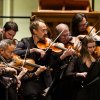
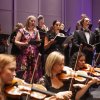
Soprano Clara Rottsolk seemed to tremble with emotion as she sang, tenor Thomas Cooley displayed pinpoint diction, Jesse Blumberg brought a strong compassionate baritone, and some exposed recitative passages in BWV 105 allowed countertenor Reginald Mobley to let his sweetly agile voice fly, unobstructed by the instrumental ensemble that seemed to get in his way in BWV 39. Under Megill’s direction, the Festival Orchestra, Chorale, and Chorus sounded more refined and cohesive than under Pedersen, though Pedersen lit a hotter fire underneath them over the past weekend.

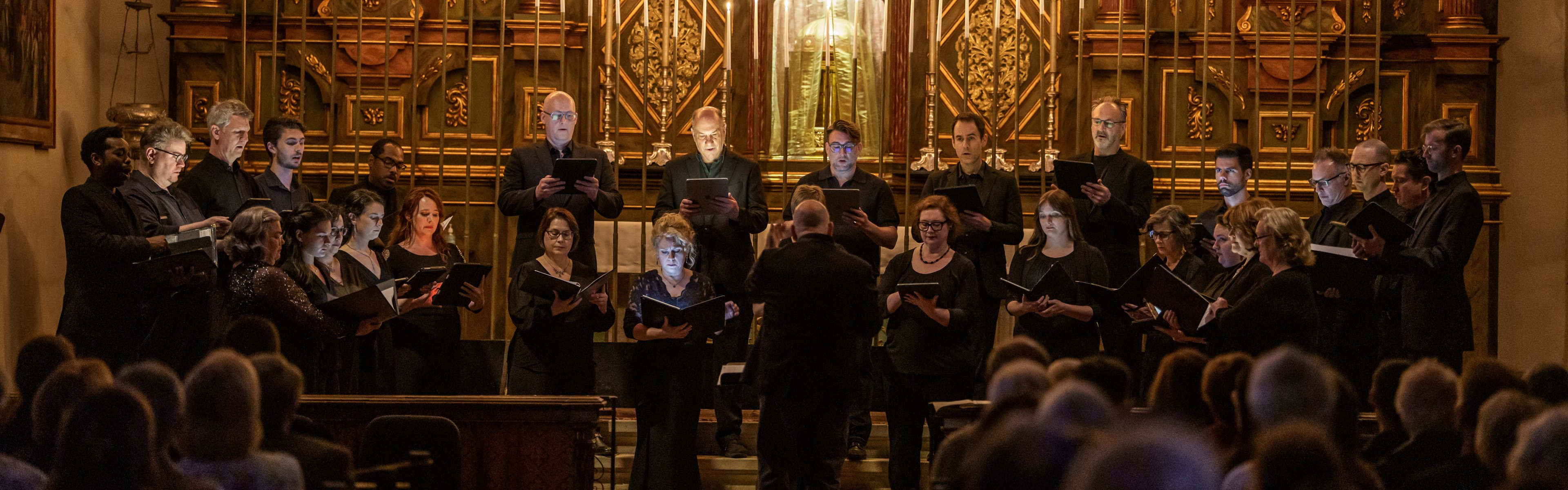
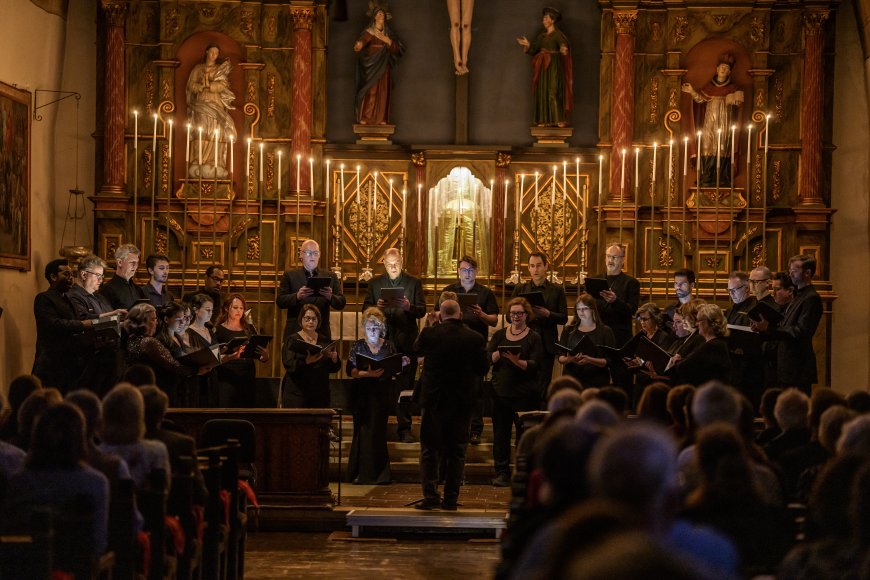
The traditional choral concert on the 15th — in the ancient Carmel Mission, complete with candlelight processional and recessional with the choristers, many of whom carried amusingly anachronistic digital tablets instead of paper scores — found Megill setting his sights almost entirely upon the 20th century. He built the program around the poetry of Rainer Maria Rilke (hence the concert’s title, “Nature’s Poet”), choosing music that was either direct settings of Rilke, or inspired by Rilke, or written contemporaneously with Rilke. Even Bach got into the mix, as a composer whom Rilke had been listening to a lot.
Frank Martin’s Mass for Double Choir was subdivided into four sections (omitting the Credo) and scattered throughout the evening as a running thread. Ramona Luengen’s In tiefsten Nächten was richly harmonized in a manner reminiscent of the popular contemporary choral master Morten Lauridsen. Paul Hindemith’s Six Chansons set Rilke’s portraits of animals and nature in short, sometimes rollicking little snapshots; one was just a few seconds in length. Einojuhani Rautavaara introduced a beguiling set of tunes in his Die erste Elegie, some of which resolve in unpredictable ways, while Stephen Andrew Taylor’s Only Yes has a consoling text that reminded Megill of his most important mentor, Joseph Flummerfelt. The processional and recessional, plus an interlude, came and went with the accompaniment of violinist Cristina Zacharias playing excerpts from Bach’s solo sonatas and partitas.
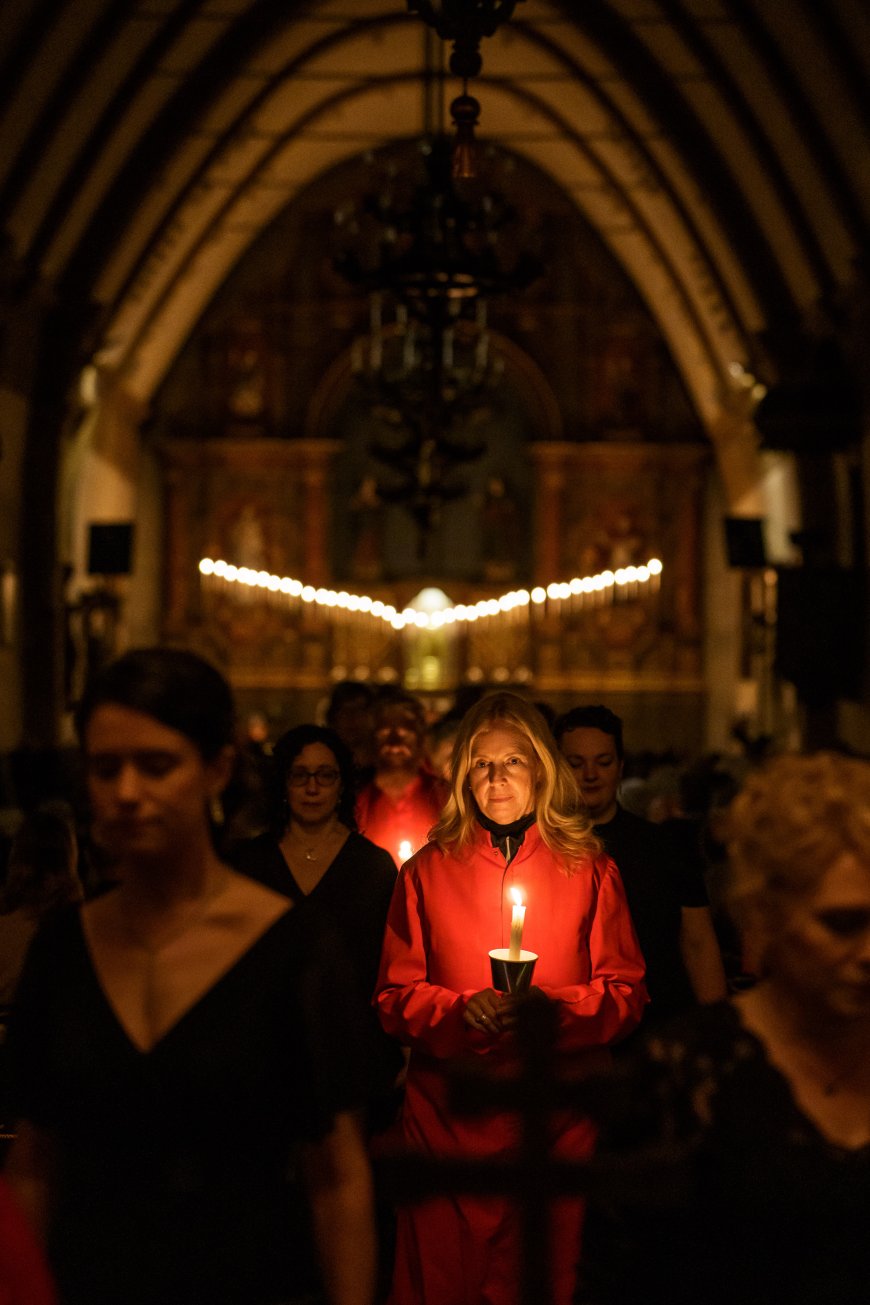
The whole thing became an amazingly unified, 69-minute-long collage of supposedly unrelated styles during which it was often difficult to tell them apart without a scorecard. That may have been the point of the exercise — one world united by Rilke and nature in God’s house.
On Tuesday over at Tower Music – the traditional outdoor prologue to the main concerts at the Sunset – Suzanne Mudge’s brass sextet trotted out Philip Glass’s Brass Sextet from his pre-minimalist youth, thus scooping the July 31 performance at the Cabrillo Festival by 17 days. It’s not much of a piece, three rather dour movements written in 1962–1964 in an anodyne neoclassical manner that give no hints of coming attractions. But we listen to it as we would the juvenilia of any major composer — with fascination, if not complete admiration.
Earlier that day at the All Saints Episcopal Church, three groups of chamber music players skirted Bach entirely and put on an entertaining program called “Roaring '20s” — specifically the Parisian Roaring '20s. The lineup consisted of works by one genuine French composer (Francis Poulenc) and fellow travelers from Czechoslovakia (Bohuslav Martinů) and Russia (Igor Stravinsky) who got into the mischievous Parisian boulevardier spirit.

Poulenc’s Le Bal masque was a rogue’s gallery of portraits set to the most flippantly mordant music in the composer’s arsenal, with baritone Edward Nelson exerting plenty of command and a few falsetto notes in a strenuous effort to be heard over the octet. Martinů’s La Revue de cuisine, ostensibly about a love triangle among dancing kitchenware (don’t ask me to explain!), contained more screwball instrumental fun, including a rather arthritic attempt at Charleston rhythms. Stravinsky’s Octet, an early manifestation of his era-defining neo-classicisms, also hints at the Charleston in its brief coda but mostly runs in its own abstract lane, flavored with the open-air freshness of Gay Paree. All three were handled with precision, great spirit, and deadpan humor.
As always, most programs repeat during the second week of the festival, followed by the “greatest hits” concert, “Best of the Fest,” July 25. Next year, the 90th festival will feature Bach’s mighty St. Matthew Passion as the centerpiece.