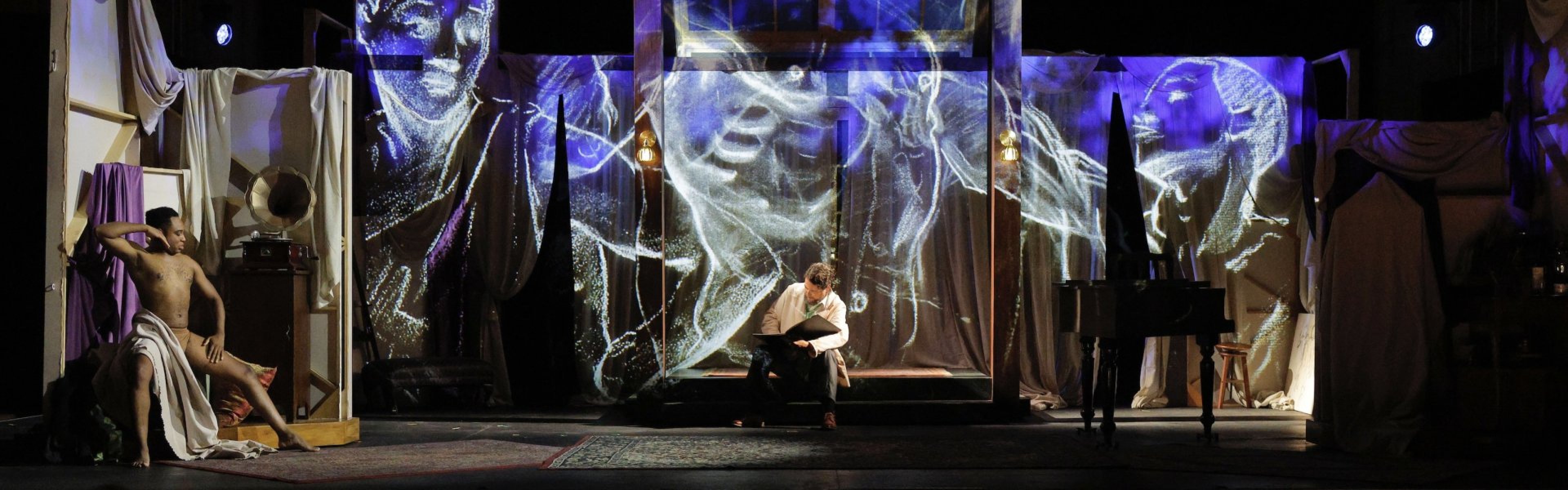
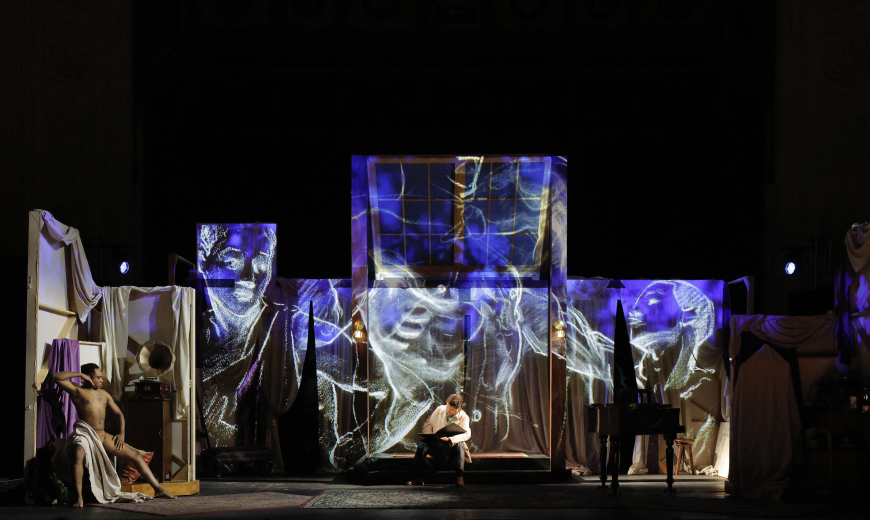
While there are many excellent contemporary American operas, few boast a score as musically compelling as Damien Geter’s American Apollo, which rounds out West Edge Opera’s 2026 summer festival.
The new production of the 2024 chamber opera, which opened Saturday, Aug. 8, at the Oakland Scottish Rite Center, is well directed by Nataki Garrett, beautifully sung and acted, and emotionally moving. Though less theatrical than the two West Edge productions that preceded it, this American Apollo makes you want to hear more of Geter’s music. (Luckily, the Oakland Symphony plans to premiere his first piano concerto next March.)
Lila Palmer’s libretto speculates on the relationship between John Singer Sargent, the famed Bostonian painter, and Thomas McKeller, a Black elevator attendant who became Sargent’s model in 1916 for murals of Greek gods that adorn the Isabella Stewart Gardner Museum.
This being an opera, love blossoms between them. But there’s a thorn. In Sargent’s murals, the bodies of the gods are white. None of their faces are McKeller’s, and the young man is understandably upset by this double erasure. Sargent promises to paint a portrait of McKeller that sees and honors him, but it’s not until after the artist’s death that McKeller finds the now-famous painting.
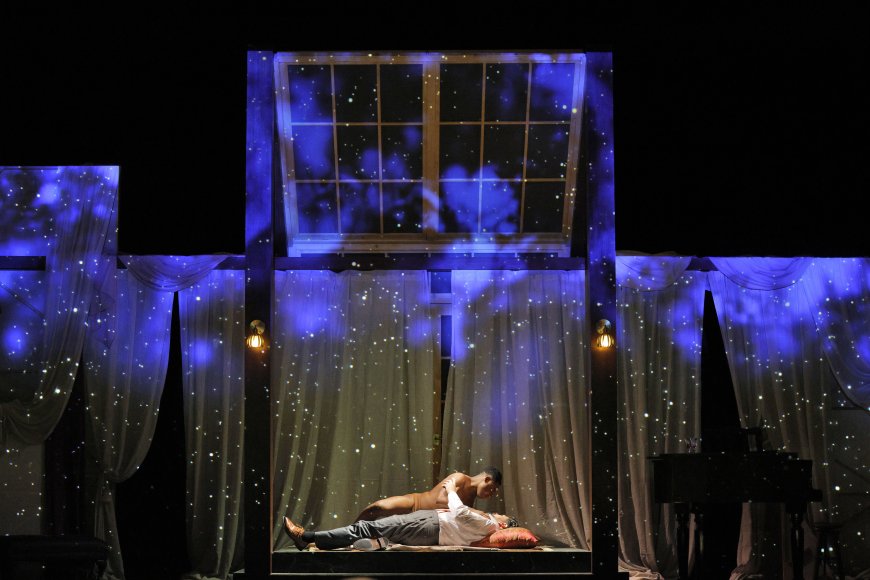
As Garrett says in her director’s note, “We are told that this is collaboration. Sometimes it even feels like love, and that is what makes it so difficult to name.”
The heart of Geter's music lies in the scenes in Sargent’s studio, where the relationship between the two develops. In the first scene, Sargent winds up his Victrola, which spews out an exotic melody. Tinges of that music return when McKeller’s body is mentioned. It’s both foreign and alluring.
When Sargent sits at the piano singing Reynaldo Hahn’s famous song “À Chloris” (1913) in his studio, he apologizes for his singing before McKeller takes over. Geter subtly weaves the song into the rest of the scene, as well as the climactic love scene, emphasizing how the music and the art made in Sargent’s studio is connected to our common humanity.
Geter further abstracts the studio from the outside world by giving it unique timbres, such as harp arpeggios, that have long been associated with the classical world.
Geter’s music is Ravel-like in its clarity of texture. Musical lines interact contrapuntally without being pinned down, instrumental sonorities are constantly shifting, and many styles are referenced and subsumed into the score’s flow. Everything is evanescent because, as Palmer’s libretto repeatedly emphasizes, in love “nothing is guaranteed.”
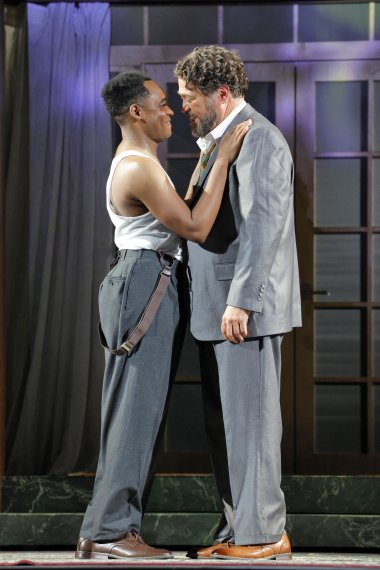
Garrett’s direction is key to the production because baritone Markel Reed (as McKeller) and tenor John Bellemer (as Sargent) must have chemistry, and Reed spends several scenes nearly naked. Their natural rapport is a testament to the director’s work, and both Reed and Bellemer luxuriate in Geter’s well-characterized vocal lines, phrasing them conversationally without shortchanging the rhythms.
Soprano Marnie Breckenridge plays the formidable Isabella Stewart Gardner with an insouciance that belies the tragedy at the root of her character. She’s still in excellent voice and a huge asset to the cast.
Meanwhile, Soprano Alexandra Armantrading is sympathetic as McKeller’s sister, and tenor Matt Hidalgo strongly characterizes the role of Nicola D’Inverno, Sargent’s previous model and lover.
Conductor Kedrick Armstrong, music director for the Oakland Symphony, is brilliant, bringing out the score’s multifarious colors and motivic connection while holding things together through tricky metrical changes.
If this show requires some attention from the audience, it repays that many times over in its emotional reach.
Michael Zwiebach is a freelance writer. This review has been provided in partnership with the San Francisco Chronicle.