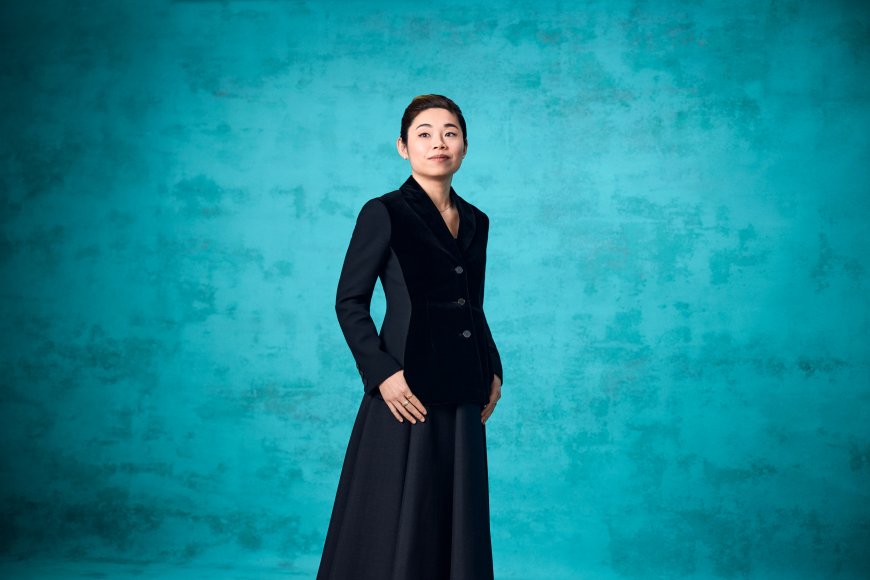
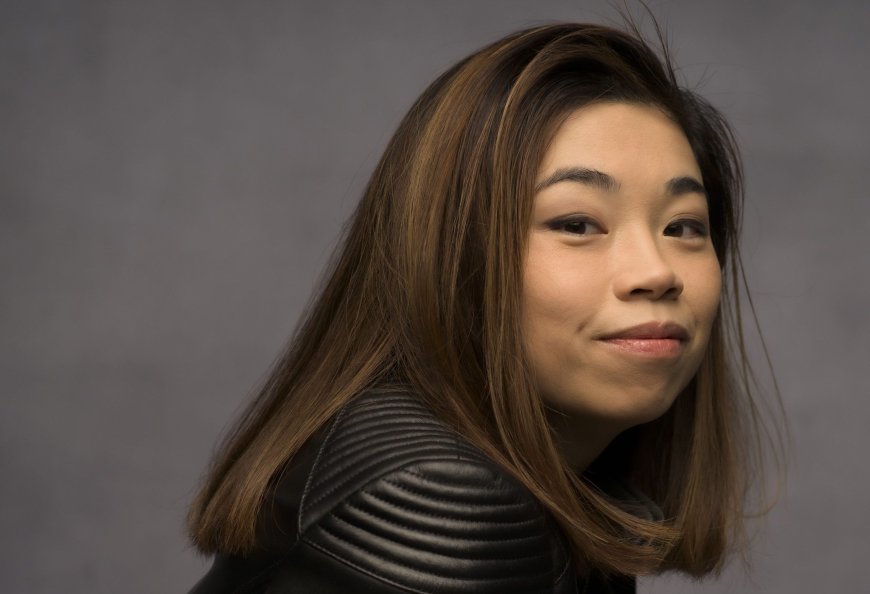
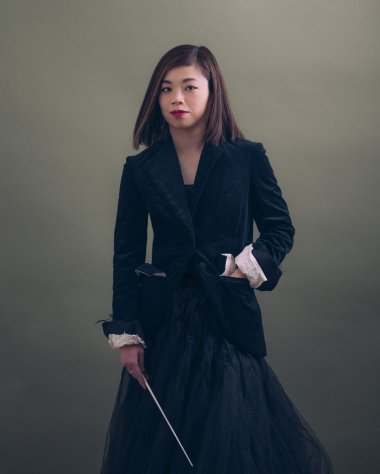
Elim Chan is the music director designate of the San Francisco Symphony and will assume the role at the start of the orchestra’s 2027-2028 season. Born in Hong Kong, Chan, 39, studied piano and cello as a child, but it was in college that she realized music and conducting were in her future.
She took her B.A. in music at Smith College, then went on to earn her master’s and doctorate at the University of Michigan. In 2014, even before receiving her DMA, she won the Donatella Flick Conducting Competition, the only woman to do so in the 18 times the competition has been held. Her win earned her a cash prize and a position as assistant conductor of the London Symphony Orchestra
Chan has served as principal conductor of the Antwerp Symphony and principal guest conductor of the Royal Scottish National Orchestra. She was recently appointed to a two-year term as artistic partner with the Vienna Symphony and will make her opera debut at Zurich Opera in 2027, conducting John Adams’s Doctor Atomic.
She made her SFS debut in 2022 and returned in 2023 and 2025 with programs that featured the works of Tchaikovsky, Elizabeth Ogonek, Gustav Holst, and Benjamin Britten. On June 5-6, she’ll lead a program of music by Felix Mendelssohn, Hector Berlioz, Richard Wagner, and Claude Debussy.
In the 2026-27 season, she returns with a concert of works by Brahms, Arvo Pärt, Mendelssohn, and the first SF Symphony performances of John Adams’s Doctor Atomic Symphony.
According to articles in the San Francisco Chronicle and The New York Times, Chan intends to have a residence in the city and is now scouting the neighborhoods.
Who did you study conducting with? What were their pedagogical emphases?
At Smith, I started with Deanna Joseph and then Jonathan Hirsh. He's the one who witnessed [a] moment when I stepped on the stage when I was in [my] sophomore year and it was just like thunderbolts on my head.
[At Michigan], I studied with Ken Kiesler. I learned that you need to have solid technique and… you really need to ask all the questions there are, to look at each note… Sometimes you have to find a way to approach a score and dissect it in limited time.
I [had] the great opportunity to meet with Gustav Meier. He got to some very fundamental things with me. He was so much about the rhythm, especially in the gut… You have to connect and stay with the rhythm, because when you're in the moment, you start to lose it, you start to go with the phrase… and then you lose that sense of rhythm. Gustav was so strong on that. He always was like, "It's always this, in the gut, you have to feel it.”
Are you teaching conducting or is that something in the future for you?
I have done some master classes. It's also fun when orchestral musicians are interested in conducting.
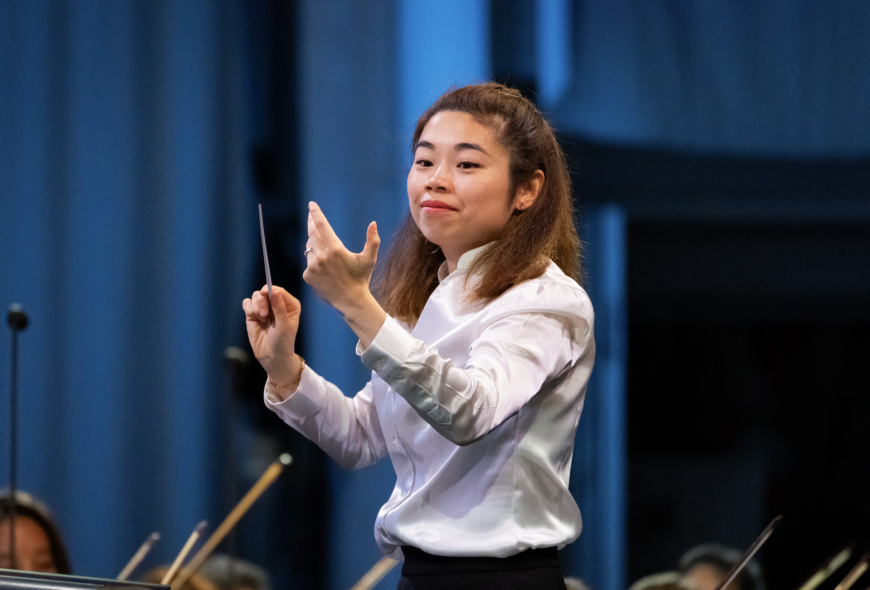
The few masterclasses I've done I enjoyed. At first, I thought, “Okay, how do I do it?” Because I always thought conducting is almost impossible to teach, because I don't want whoever I teach to mimic me. It's not a dance and it's not something you want to choreograph. That's also something that Kiesler was big on: "The gesture needs to always have meaning."
But the few times I've done it, it makes me so excited. I want whoever is on the podium to be themselves. We all have different bodies, and you have to be really comfortable with what you have. From there, you express what you have in your head and what you hear. I try to honor that. It's actually great fun because, when I can talk about it, I'm also teaching myself.
You’ve mentioned your love of Russian composers to other interviewers. What repertory do you particularly like in addition to them?
Look at my June program — no Russians. I'm equally, even more excited. You have Berlioz, who I love. I'm fascinated by Berlioz. Other than him being an incredible human, eccentric — eccentric is an understatement — just singular.
It's in my plan to dive into more of Berlioz and not just the Symphonie fantastique. He has wonderful pieces that are not heard often enough. I recently discovered Tristia for chorus and orchestra. It’s three movements and the second movement is only for women. It's basically about Ophelia, so there's this link with Hamlet, a Shakespearean connection and it's just really beautiful. And of course, you have the Requiem, which is wonderful.
Of course you have [Debussy’s] La Mer, which is a masterpiece. It's just quite a perfect piece. Other than Debussy, of course, Ravel. I love the French because [the style] comes from the Russian.
And of course you go from there to Béla Bartók, who is like rhythm, folk, colors, drama, theater, ballet…. Bluebeard’s Castle. Just thinking out loud, but the French repertoire, Bartok or even [Witold] Lutoslawski. And Wagner is on the program. I just recently went back to Brahms [Symphony No. 4] a few days ago.
You mentioned Berlioz and Wagner. Is semi-staged opera something you’re hoping to do?
Yes, that’s why I mentioned Bluebeard’s Castle, but [there’s] also more to come like one of my favorites, Vanessa by [Samuel] Barber.
I love voice, I love voices. And I know for sure I'm going to put the chorus to work because I know they're doing really great and Jenny [Wong, director of the Symphony Chorus] is wonderful. I have works in my head, like [Dmitri] Shostakovich’s 13[th Symphony], “Babi Yar,” which needs a wonderful low baritone or bass soloist, but also the men’s chorus. Pieces that you don't hear often enough, [like] Rachmaninoff, The Bells.
How about Ralph Vaughan Williams’s A Sea Symphony?
I love the Sea Symphony; I love the Dona Nobis Pacem. I sang in all these myself in chorus over the years. I've been singing in choruses whenever I could. And now I get to be on the other side.
What kinds of barriers have you run into in the field, as a woman, as a small woman, as an Asian woman?
The ones that you mentioned. Also I think leadership style, how women lead. People are not used to it yet. It's often because when people don't feel comfortable, they act out, or sometimes — actually, many times — they're not even conscious of the way they react to someone like me or my other colleagues. I'm grateful to see more and more orchestras start to pay attention to this. They work with their musicians and say, "Hey, actually, why do we react differently in our attitude because of just a different kind of person up there, because it's not the default maestro, right?"
So many things are in the works to change [this], but yes, it's challenging… sometimes it's like, "Oh, and how do I react then? What is my reaction?" I have to always tell myself it's not personal and always remind myself these are excellent people and we're all here to learn. Sometimes it just takes a private conversation.... because we all have insecurities and prejudices.
I also tell myself, "Okay, Elim, don't assume. Don't assume someone comes in and makes a bad face on something." Actually, it's not always about me.
Are there special projects you have in mind?
I want to bring in all my collaborators, my friends who I think the community will be excited [by]. I can't really tell you names, but I want something… for the community. Can we do something like a free concert, open air, with things that I would love people to sing along [with]? I love people to engage, so it's not a passive thing that [the] audience just comes in and listens [to].
I want them to be able to be an agent too, or maybe they can pick the program. Maybe they don't even get a program but just come and see something. But I want something to be way more a dialogue than before, because I think the audience totally loves it here.
How are you thinking about connecting with the city and especially with the multiple Asian communities here, who are big participants in the arts?
That’s a big part of my artistic planning, because of course the Pacific Rim… The celebration of that community, of course, and I'm not talking about just doing a Lunar New Year concert — that's like a minimum, right? … There's so many cool composers writing and [I want] to [bring them] into the fabric, into the repertoire of the orchestra.
I mentioned a Japanese composer, Noriko Koide. I got to know her music in the [BBC] Proms and I've done her music now everywhere. I'm going to bring her here as well and hopefully also commission her. Because I just believe [in] her voice and people should get to know her without making a thing out of it — that this is a Lunar thing or this is a Chinese thing — but it's just a big celebration of people.
There’s Unsuk Chin, Donghoon Shin, Huang Ruo. Tan Dun is still writing, Angel Lam, Hong Lam, Anthony Cheung, who actually is from the Bay Area. I just did his piano concerto in LA in the Green Umbrella series [with pianist Gloria Cheng], but he's someone I just like. He's just wonderful and his music also was just played in New York. I was really proud of him and now there's so many [Asian composers].
I just feel responsible to showcase them, to give them a chance, to give them the platform.