The San Francisco Symphony’s new music director, Elim Chan, hasn’t taken the podium yet, but the electricity surrounding her appointment already ignited Davies Symphony Hall.
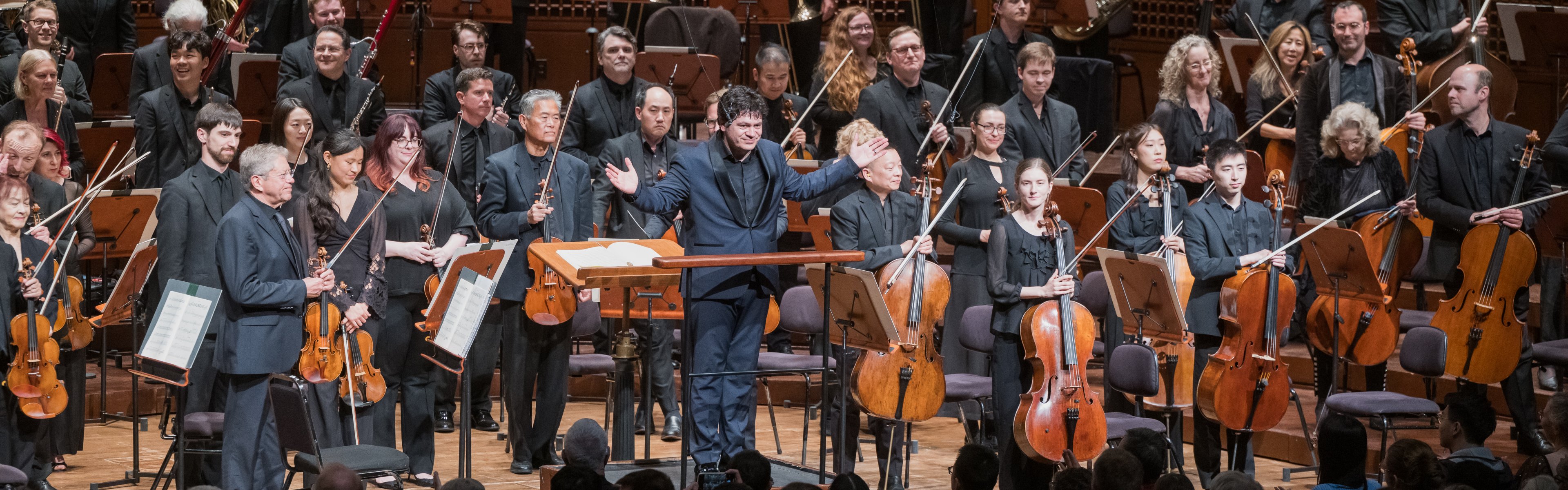
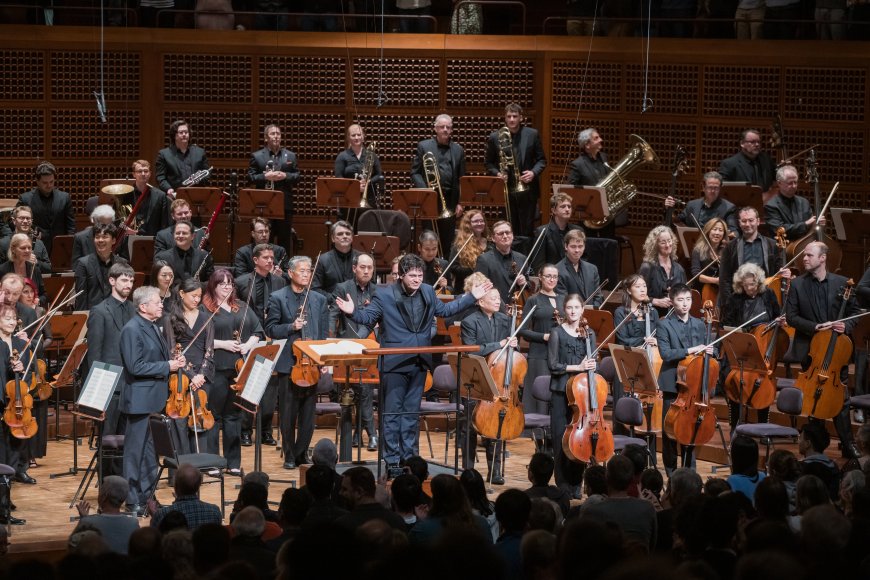
The energy from the recent announcement of her appointment coursed through a highly combustible program Friday, May 22, conducted by Cristian Măcelaru, who led the Symphony for the world premiere of Tyler Taylor’s Embers and two sweeping Romantic showpieces.
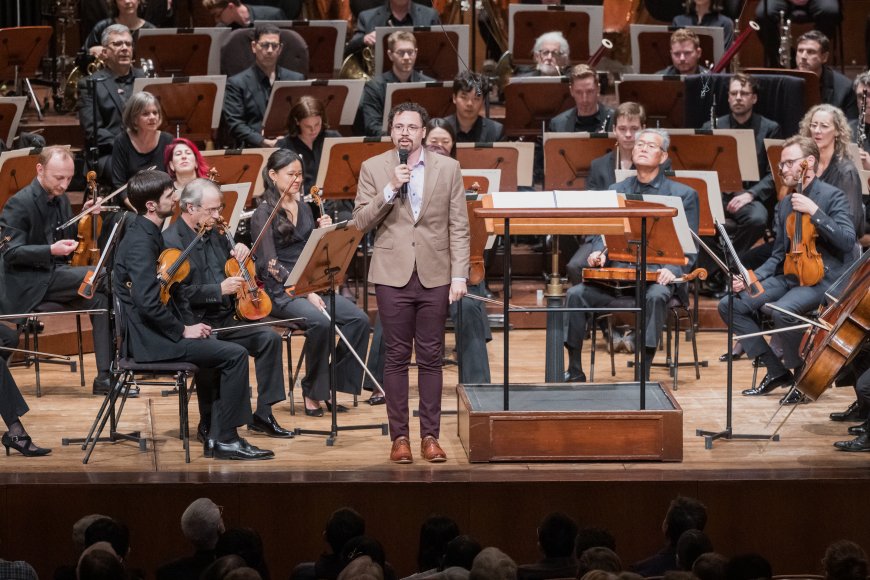
In Taylor’s printed and spoken comments about Embers, the fourth winner of the Emerging Black Composers Project reflected on community, “what we share as humans and artists,” and the nature of embers, which start small but can grow into something powerful.
The commissioned piece is a moving addition to the set of classical works that evoke fire and other natural phenomena, a relative of such diverse works as Wagner’s Magic Fire music and Berkeley native Gabriella Smith’s Breathing Forests, also a Symphony commission.
Embers opens with a thump from the whole orchestra, then trails off into a dark theme that slithers from note to note in the strings. Undulating woodwinds, with a prominent low flute tune, continue under high, keening strings. As the orchestra grows louder and the strings divide, the mood turns threatening.
Irregular raps from the percussion punctuate Embers, crackling like a growing fire, as the orchestra quiets down. Taylor varies the opening theme, creating immensely high tension as the orchestra again winds itself up into a blazing, yet not triumphal, frenzy. The fire crackles along in the background, as the orchestra fades out.
Embers has moments of beauty and moments of terror, reflecting the ambiguous nature of fire. Măcelaru, currently the music director for the Cincinnati Symphony Orchestra and the Cabrillo Festival of New Music, led the work sympathetically, finding every nuance of color and emotion in Taylor’s compact and powerful score.
The conductor carried all of that nuance forward into exciting performances of Rachmaninoff’s First Piano Concerto, with Macedonian pianist Simon Trpčeski, and Dvořák’s Symphony No. 9, From the New World.
Rachmaninoff was a great piano virtuoso of the late Romantic era. Since he wrote for himself, his piano music calls for extreme keyboard athletics. Trpčeski has technique to burn and brought it all to bear on the concerto, playing with both fire and romanticism. Măcelaru proved a superb partner, and the two combined for a wondrous degree of rhythmic freedom throughout.
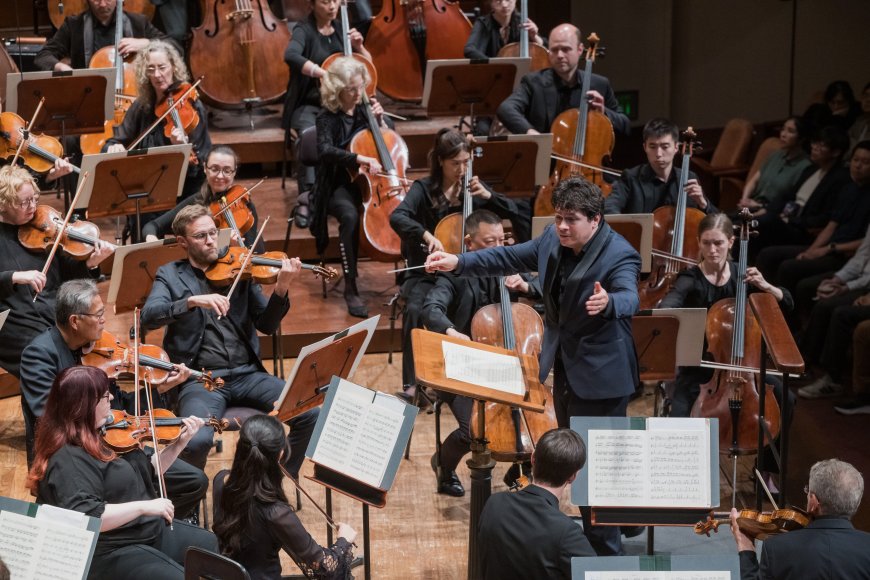
Trpčeski’s ability to spin out a filigreed line or project power ideally suited the first movement, and he played with melting tenderness at the start of its cadenza. The close of the movement built so passionately that the audience was — appropriately — moved to applause.
Trpčeski nodded to the audience with a smile, then went on with the concerto. The ruminative, understated piano entrance gave him the opportunity to toy with the crowd’s emotions, as he and Măcelaru deeply embraced the Romantic side of the work.
Rachmaninoff’s wit emerged as well, and that carried over into the warmly romantic elegance of the third movement opening. Trpčeski played the sweet second section with a hint of longing, and the crisp closing phrases added a circus-like rush to the conclusion.
A well-deserved standing ovation brought the pianist back for two encores. In a brief speech before the first, Trpčeski noted his pleasure in returning after an eight-year absence, and at a momentous turning point for the Symphony. He dedicated the first encore to Chan, who was seated in Loge A with Symphony CEO Matthew Spivey, bringing another roar from the audience.
The pounding third movement of Prokofiev’s Piano Sonata No. 7 made a splendid encore to the Rachmaninoff, but Trpčeski still couldn’t make his exit. Out came a stagehand with a music stand for associate concertmaster Wyatt Underhill.
The pianist dedicated this encore, Evgeny Svetlanov’s brief and delightful “Two Simple Tunes,” to the Symphony’s beloved music director laureate, Michael Tilson Thomas, who died last month nearly five years after being diagnosed with glioblastoma multiforme, an aggressive brain cancer.
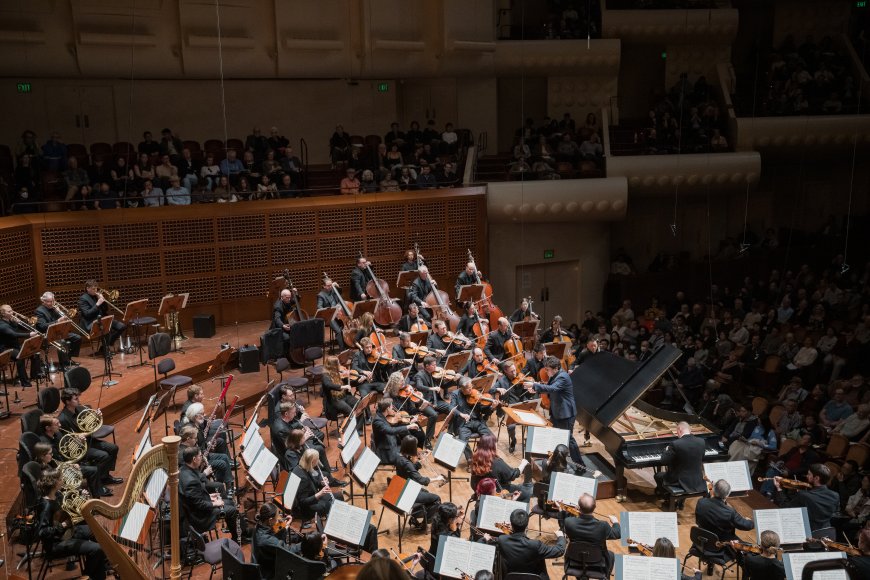
Then came the Dvořák. That this was the fifth Symphony performance of From the New World in five years — Xian Zhang, Joshua Weilerstein, Dalia Stasevska and Edwin Outwater have all essayed it — in no way dimmed the audience’s enthusiasm for it.
Măcelaru led the New World with muscular propulsion, using rhythm and dynamics to build the structure of each movement. He balanced the orchestral forces so surely that their sound was transparent, with every line audible even in the symphony’s loudest moments.
The performance flew by, and perhaps there could have been a bit less sheer speed. There seemed to be a bit of scrambling at the tempo change after the first movement’s opening and again at the beginning of the third movement. In between, the serene slow movement would have been even more beautiful if played more expansively.
Still, the many beauties and excitement of Măcelaru’s approach made up for his tempos. The strings played magnificently, with a polished sheen. Russ de Luna’s tender account of the slow movement’s English horn solo was, as always, a highlight of the performance, as were the interactions of principal flute Yubeen Kim and principal oboe Eugene Izotov.
The delicate close of the movement, played by 10 strings only, was as affectingly intimate as could be.
Lisa Hirsch is a freelance writer. This review has been provided in partnership with San Francisco Chronicle.