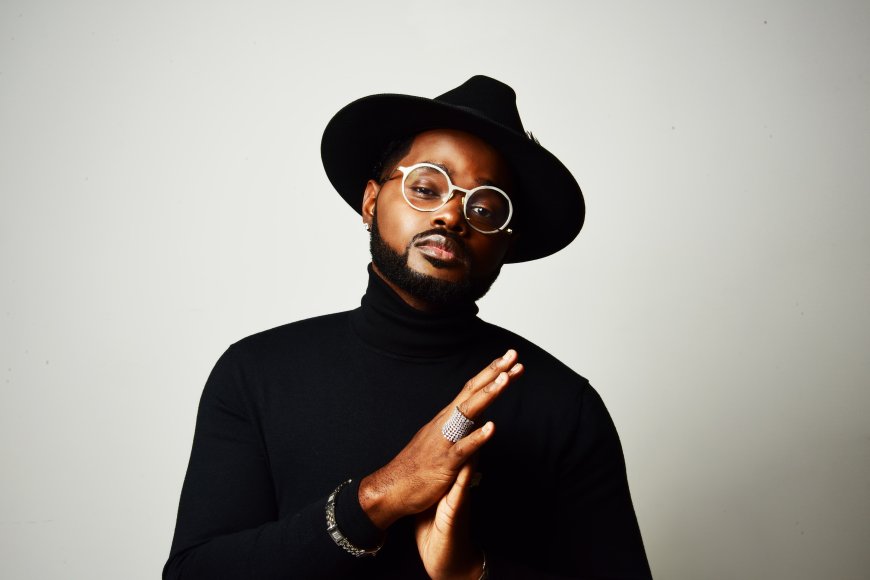
Whether he’s singing opera, gospel, jazz, or pop music, countertenor John Holiday wows audiences around the world. The Houston-born singer has been hailed by The Los Angeles Times as “one of the finest countertenors of his generation,” and opera director Barrie Kosky has described him as having “the voice of a shaman.”
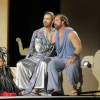
That voice will be heard when Holiday takes on the titular role in Los Angeles Opera’s acclaimed production of Philip Glass’s Akhnaten, running Feb. 28 – Mar. 22 at the Dorothy Chandler Pavilion.
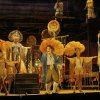
No stranger to LAO, Holiday first appeared as the Sorceress in Kosky’s 2014 production of Dido and Aeneas, and more recently as Orpheus’s Double in Matthew Aucoin’s 2020 production of Eurydice — the singer went on to make his Metropolitan Opera debut in the same production in 2021.
After earning degrees from Southern Methodist University and the University of Cincinnati College–Conservatory of Music, he performed Leonard Bernstein’s Chichester Psalms at Carnegie Hall with the Atlanta Symphony under Robert Spano. Two years later, Holiday received his diploma in Opera Studies from the Juilliard School.
Since then, the countertenor has been honored with the Marian Anderson Vocal Award and named one of 2020’s “20 for ’20 Artists to Watch” by New York City’s WQXR. In 2023, Holiday was appointed Associate Professor of Voice at the University of Maryland School of Music.
In 2024, he returned to the Met for its revival of Kevin Puts’s The Hours. Other highlights of the singer’s 2024–2025 season included a debut as Akhnaten in Kosky’s production at Komische Oper Berlin, and his portrayal of Cherubino — normally a pants role for a mezzo-soprano — in Washington National Opera’s Le Nozze di Figaro.
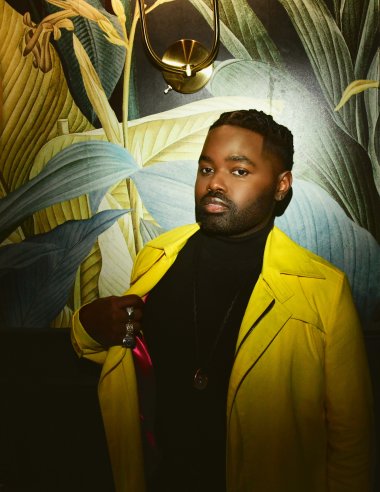
In addition to traditional concerts and recitals, he has appeared on the reality talent competition show “The Voice.” He’s also curated “The John Holiday Experience (JHE)” — a showcase of his love of multiple genres — that he’s performed in Dallas, Texas, Des Moines, Iowa, and Dayton, Ohio.
In a recent conversation with SF Classical Voice, the Maryland-based Holiday discussed Akhnaten, his approach to navigating his career as an African American countertenor, and why he doesn’t read his reviews.
Akhnaten is determined to lead Egypt into a new age, even as his plan to abandon the old gods puts both his kingdom and his life in peril — he’s often portrayed as a visionary, a radical, and a disruptor. What aspects of the character’s worldview resonate with you personally? And which aspects might challenge you?
There are so many beautiful parts of his life that [have] a symbiotic connection to this radical nature of his. I absolutely think that I am a radical in this art form. I am someone who crosses genres, I don’t just stay in classical music, I don’t subscribe to boxes. In that way, I’m radical. If somebody tells me I can’t do something, I show them how I can.
It is really important for one to determine for oneself what things to hold onto, and what things to let go of. I have that connection to Akhnaten, a free thinker who encouraged others to think differently. I hope that, in my time as a singer, I’ve helped other people see themselves in a different way, and also to stay true to the things that are within them. Because for me, I’ve held on to the things that make me who I am.
[As for] a challenge, I don’t know that there is one. Ultimately, I’m playing a role, but I would like to think that there are regal qualities to me. I like to carry myself in a way that is upright in the world. Nevertheless, I can’t think of a challenge per se, because I’m so very much in love with this role — not because it feels so close to who I am. It just feels like I’m meant to sing this role.
LAO’s upcoming production of Akhnaten is directed by Phelim McDermit and was first presented in L.A. in 2016. When the audience initially sees Akhnaten, he enters in full frontal nudity. Will you enter this way, as well? And has your preparation been any different for this role than others?
I prepare the exact same way musically, [and] I’ll be doing it exactly as Phelim has envisioned it. Unless I get uncomfortable, I’m going to try my best to stay true to the production. For me, I don’t find that I had to prepare for it differently, other than just physically getting my body as ready as I could.
Because I knew that there are elements to this production that were not in [Kosky’s], I did do some work with a trainer for the first scene. But I would say that [Kosky’s] production did have more physicality to it than this production.
I understand you don’t read reviews. Why not?
I’m hellbent on that. If it’s a very good review, it could blow my head up. If it’s a bad review, it could deflate me.
When I did a performance of [Handel’s] Radamisto at Juilliard, my father had recently been in a [motorcycle] accident and was in a coma. And my father in Radamisto was dying, too. During the rehearsal period and the performance, I was going back and forth between New York and Houston, because I was the guardian of my father’s estate.
When I went back to New York and thought I had executed a wonderful Radamisto, The New York Times came out and basically didn’t say anything good or bad. It just mentioned that we performed in the student production. I was taken aback by it. It kind of hurt and I didn’t know what to do about that.
I had a wonderful teacher at Juilliard who taught me Shakespeare, Eve Shapiro. She’s no longer with us, and I loved her very much. Eve took me [aside] and said, “May I tell you something, darling? I think you are probably your generation’s most amazing countertenor voice that they will ever hear. If you want to believe the good ones, you must also believe the bad ones. And if you don’t want to believe the bad ones, you mustn’t believe the good ones.” And that is why I do not read reviews.
That makes sense, John. You grew up in the small town of Rosenberg, Texas. How did being a countertenor play in that part of the country?
Being a countertenor played okay in certain environments. It certainly wasn’t easy among children. As a young kid I was supposed to have a high voice, but I was made fun of incessantly… [for] ‘quote unquote’ singing high. That was always the jab at me — that I had a high voice. But looking back, in a really cool way, now I get paid to do that thing that people made fun of. So, there you go.
What conversations do you hope this Akhnaten revival sparks about the future of opera, representation, and the countertenor voice?
I have been very privileged in my life to sing many contemporary pieces, and [I’m] often the first to do a new work. I tell [composers] — my dear friends Carlos Simon, Joel Thompson, the Blacknificent 7 — I’m always telling them, “Please write for countertenors. Our voice is just as important, the ethereal nature of it, if it’s written in a wonderful way.”
On the other side of that, as an African American countertenor in opera, I hope my work leaves the doors, windows, and cracks to be further opened, so that others of color can come in beside me to do these works. I believe every voice is important, every story is important.
By telling the stories of many people, that is how you bring other demographics to the opera. It’s how you enable others to see themselves reflected on the stage, and to want to sit in those seats that can be so very pricey. I just want to continue seeing faces that look like mine on the stage and countertenors in title roles.
Would you recommend opera singers audition for “The Voice?”
I would tell them to do whatever they want; whatever makes their heart soar. I would never presume to tell somebody what to do, [but] if they want to audition for the “X Factor,” “The Great Baking Cookoff,” do it. Why not stretch yourself?
I just love Maya Angelou. You will find me quoting her a lot. She charges us, as a young generation, to “stretch yourself, reach out, and just see what’s possible. You don't know what you can do unless you try.”