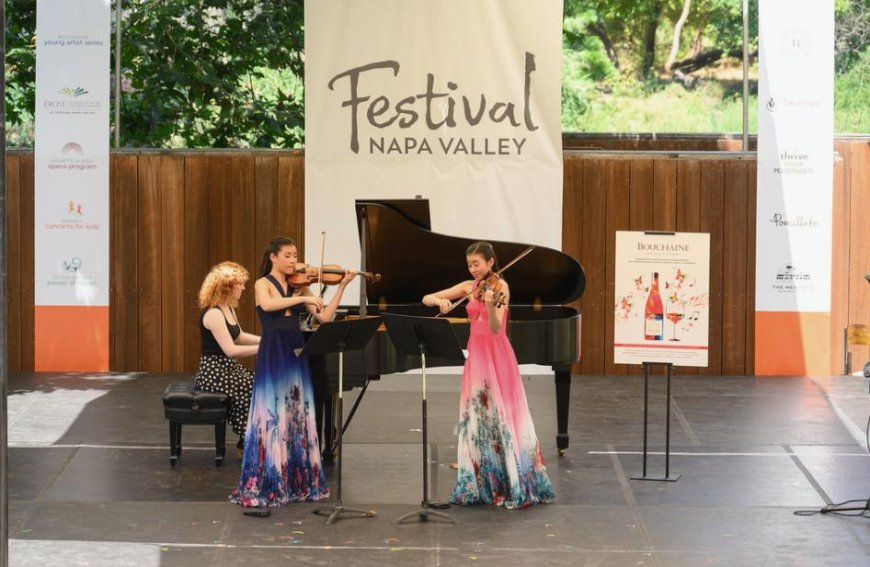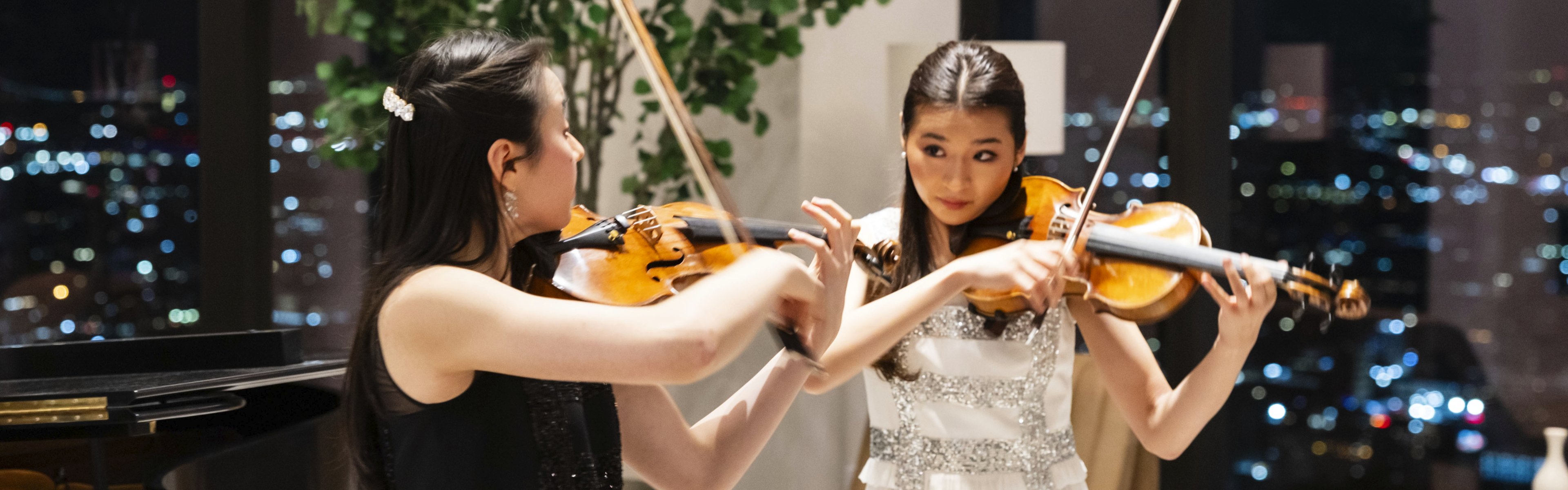
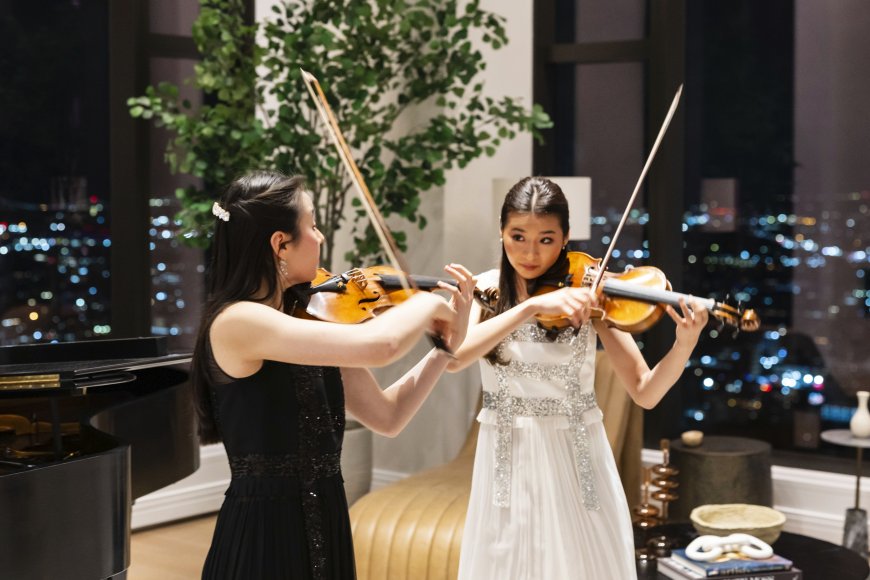
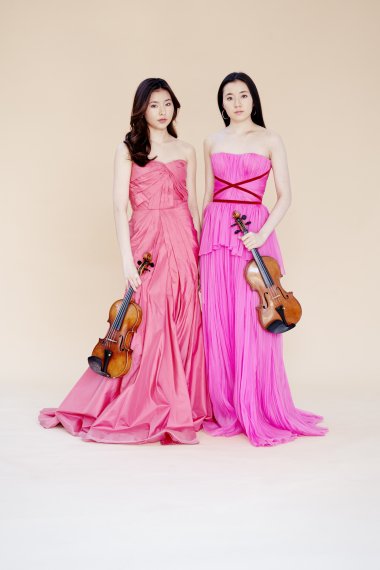
While there’s nothing new about violin prodigies, the sisters Hina and Fiona Khuong-Huu are causing quite a stir in the classical music world as a performing duo. Born in New York to French-Vietnamese and Japanese parents, Hina, who turns 22 this month and was first prize winner of the 2023 Elmar Oliveira International Violin Competition, and sister Fiona, born in 2007 and who debuted with the New York Philharmonic at age 16, will be returning to Festival Napa Valley for two unique programs on July 11 and 12.
For the first concert, the sisters will perform the world premiere of John Corigliano’s The Red Violin: Suite for Two Violins and Orchestra, based on the 1998 film and featuring the Pacific Symphony led by Alexander Shelley. The next day the siblings will share billing with pianist Steven Lin in a recital that includes selections - some from the sisters’ own arrangements - from their recently released album, “Dear to Us.”
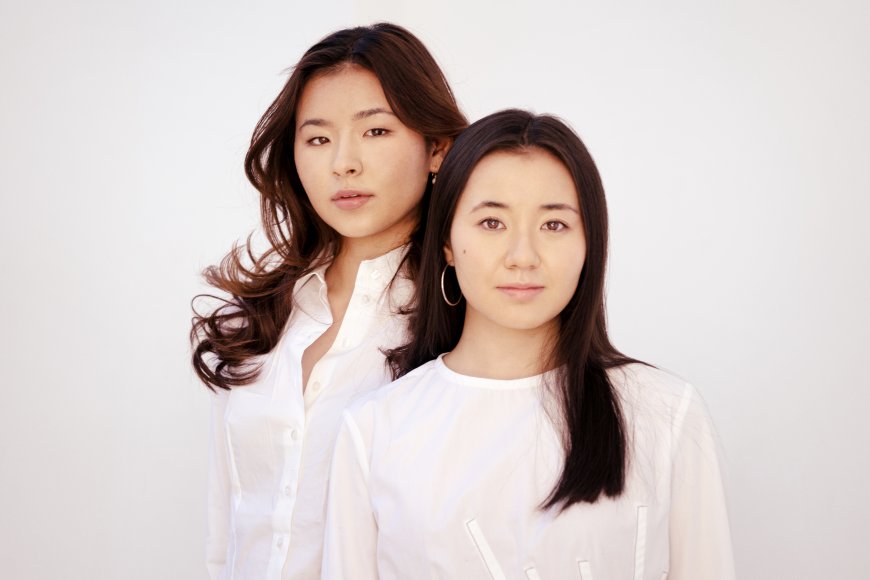
These gifted sisters have already achieved significant individual milestones. Hina, who has performed worldwide as a soloist and collaborator with leading ensembles, recently made her acclaimed Kennedy Center debut. In the 2025-26 season, she bowed with the Binghamton Philharmonic, the Atlantic Classical Orchestra, and Boston’s Bach, Beethoven & Brahms Society, while continuing collaborations with the Jupiter Symphony Chamber Players. Named a “VC Artist” by the Violin Channel, Hina, who studied at Columbia University, will be continuing at Juilliard in the fall, working on her master’s degree.
Fiona, formerly a student of Itzhak Perlman in the Juilliard Pre-College Division, is currently taking two gap years to study with Ilya Kaler at the Cleveland Institute of Music. Since making her debut with the New York Philharmonic, where she performed the Mendelssohn Concerto under the baton of Thomas Wilkins to commemorate the Centennial Season of the NY Phil Young People’s Concerts, she has performed as soloist with the Juilliard Orchestra at Lincoln Center, the Flanders Symphony Orchestra at the Bozar Concert Hall in Brussels, and with the ProMusica Chamber Orchestra. In addition, Fiona was awarded the prestigious Career Grant Award from Salon de Virtuosi in 2021 and performed in several of their concert series, as well as at Festival Napa Valley as one of their Bouchaine Young Artists.
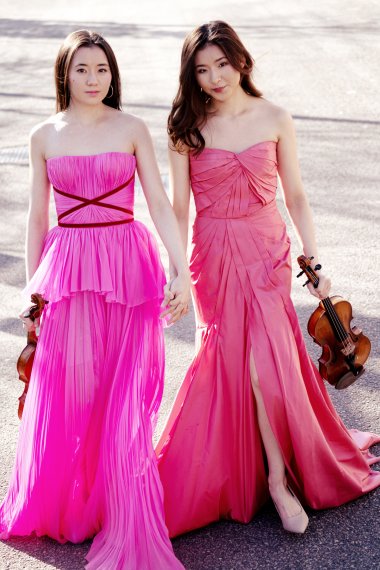
SF Classical Voice recently spoke with the siblings. Topics discussed included the Corigliano premiere, their relationship both on and off stage and how they imagine their partnership evolving over the next decade.
First of all, what was it like growing up as two violinists under the same roof – supportive, competitive, inspiring?
Hina: All of the above! Just because it's something we both started when we were so young - I was five and Fiona was three - and were passionate about, I never really felt any competition. I think it's more when we work together, we can really push each other to be better. She’s my sister first and foremost, and I like her to do well.
I don’t think there was animosity or anything of that sort. Luckily, that happens more when we rehearse together and have to perform something where we have differing opinions. Obviously, we have very strong instincts and kind of butt heads sometimes, but it’s all to push each other to find a different and better interpretation that works for us. But it was definitely inspired, because we have different strengths as people, as well as musicians, [and] I get to see music through a different lens that she sees.
Fiona: For me, the whole reason I started was because my sister was playing the violin, and when I was three, I looked up to her. I still do now, but less so. But she was the whole reason I started playing. It was never a competition thing, but rather an excitement of sharing the same passion.
We enjoy working together, although it’s hard to come to an agreement sometimes in rehearsals. But in the end, it’s all about having fun together and enjoying making music and inspiring each other to be better and the best versions of ourselves.
Hina: It’s been great that we were able to pursue our own paths, and then, we [also] get to converge at times. I remember when we had an important competition we were doing together, and we’d been fighting so much over this piece, [Pablo de] Sarasate’s “Navarra.” It’s one of the pieces we’ll be playing at our recital, but that’s a piece where you need to be in sync and you almost become one person, because everything is so meticulously written.
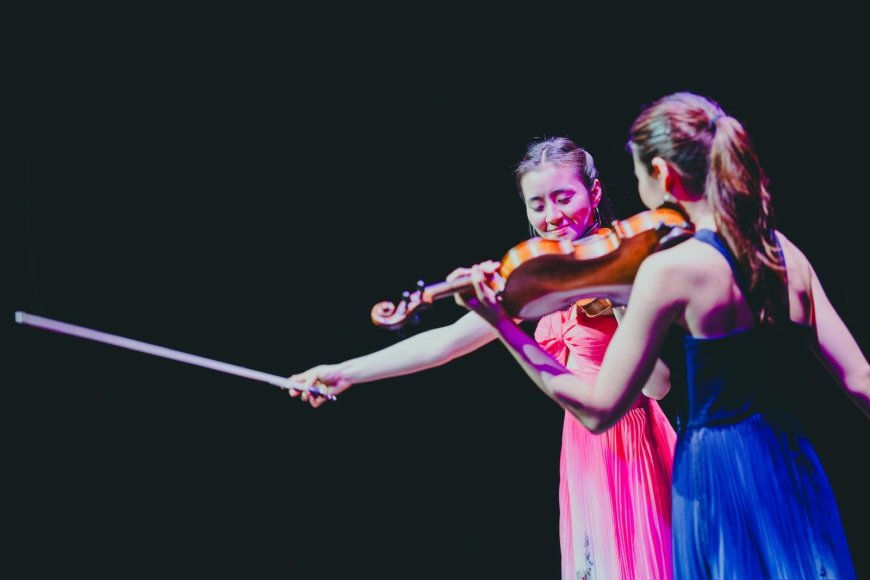
We were having so many arguments, even up until the moment where we had to be on stage, and that was definitely scary. But I think we had a kind of unspoken agreement, that no matter how much we were fighting before, even in the wings, we would trust each other in the moment on stage and listen to each other. So, even if we didn't agree verbally, we would have somehow compromised when we were onstage.
Fiona: I also think it's important to remember that conflict is not a bad thing, and that helps us find a better solution and get to know the work deeper.
That’s so cool! Let’s talk about “The Red Violin.” What was the genesis of the Corigliano Suite for Two Violins, and what did it mean to each of you to be entrusted with premiering it?
Hina: The genesis is Charles Letourneau, the artistic director of the Festival Napa Valley. We’ve worked with him a lot over the years, and he had this vision [that] he wanted to work with Mr. Corigliano [who] won an Oscar for the score. We were down with that, and didn’t think it would be possible, but was a dream that was looming.
The film traverses the journey of a violin across different generations and places in the world, so you hear all those different influences in the music. It’s a huge responsibility getting to play this, but I guess the original responsibility was Joshua Bell. He played on the soundtrack, so he originally premiered it. All we have to do is play it in the best way possible, [because Joshua] has alleviated a bit of that pressure for us.
In adding a second violin voice, [there’s] a diverse dialogue, and it becomes a little more theatrical because you have two voices conversing. It brings it to life in a way that makes it fun.
Fiona: It’s a huge honor to carry this message of the film and how much history and stories a violin holds. It’s not just a wooden instrument. You can hear influences from Shanghai and eastern Europe in different sections of the piece. That’s a message we want to carry, and we're really happy to do so.
Did you meet Corigliano?
Hina: We got to meet him recently and he was amazing. He gave us some feedback and [answered] different questions we had. He was like a debate moderator, because, like I said before, we have many arguments based on our different interpretations, but when you have a living composer who can actually deny something or say, “That's right,” to you, that's really helpful.
How would you describe your relationship offstage, and how does that translate into your musical partnership?
Hina: Because we’re sisters, we know each other really well, and that makes it easier in a way, and also harder. It makes it easier, because you know how the other person works and thinks. You also know who they are as an artist, because I've seen her grow as a performer. So, you have a lot more knowledge to work with than if you just were paired up with anybody else.
On the flip side, it makes it harder because you have insults you can use against each other. But again, it also becomes a plus, because you lose all of the talking around [something], and you can just say it right away and very directly. So, in a way, it saves time.
Fiona: It’s something unique being able to work with your sister, because you can be direct. You can tackle problems that you might hesitate to bring up with other people. The fact that we’ve known each other for so long, we’ve built a certain trust. No matter what, we’ll always have each other’s backs. It’s also comforting to be onstage with your sister.
How do you imagine your partnership evolving in the next decade – musically, personally, creatively?
Hina: I hope it keeps growing in all facets of life. As we get older, time being what it is, we’ll also develop in different ways as individuals, and that’s what makes the duo interesting. We’re not twins or carbon copies of the same person, but because we are different, we can bring two sides of that to our playing. At the end of the day, we get our ideas across.
I also hope to discover new pieces, and that we commission our own pieces. It feels like when we’re a duo, we have more artistic freedom. When you’re just a soloist, it’s what you can and can’t do in the repertory, and that’s a very traditional path.
Since there aren’t that many violin duos, we can create the type of repertory we want to play, and we can handcraft that in a way that I think is good. Having a collaboration that’s not just on stage, but also behind the scenes on choosing pieces and having a vision, as well, is what I hope for our future…and that we get to continue working together.
Fiona: Only time will tell.