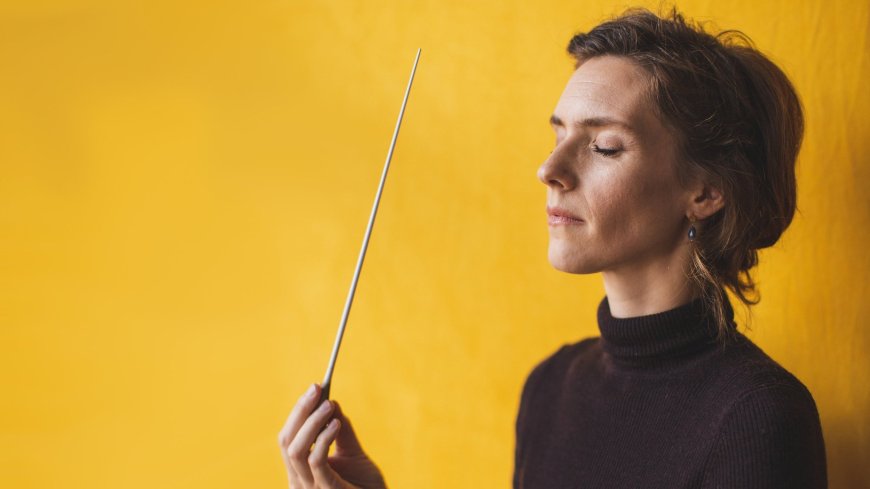
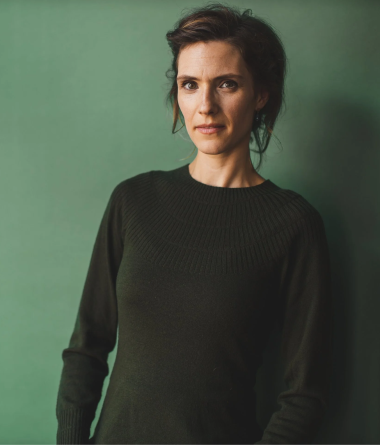
Chloé Van Soeterstède is attracting the attention of orchestras around the globe for her commanding presence on the podium, as well as her instinctual and expressive music-making.
The principal guest conductor of the Bournemouth Symphony Orchestra will make her debut with the San Francisco Symphony on July 1 in a Romantic program capped with Mendelssohn’s “Reformation” Symphony.
Born in France in 1988, the conductor studied viola in Paris before moving to London where she continued her studies at the Royal Academy of Music. She then took up conducting at the Royal Northern College of Music in Manchester from 2015-2017, where she was awarded the Kennedy Scholarship and the Derek Hill Foundation ConductIT.
In addition, the maestra was appointed the Taki Alsop Conducting Fellow 2019-2021 by Marin Alsop and was a Dudamel Fellow with the Los Angeles Philharmonic in the 2021-2022 season. In 2023, Van Soeterstède became an Associate Member of the Royal Northern College of Music.
Recent highlights included gigs with the Norwegian Radio Symphony, London Philharmonic, and Orchestre National de Lille. In 2023, the musician made successful debuts in Australia and New Zealand with the Melbourne Symphony, Adelaide Symphony, and Auckland Philharmonia. In 2024, she bowed with the Vancouver Symphony.
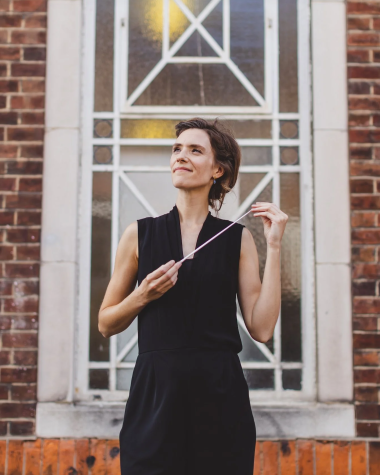
Upcoming performances for Van Soeterstède include two concerts with the Festival Orchestra of Lincoln Center at David Geffen Hall from July 17-18.
SF Classical Voice caught up with Van Soeterstède by Zoom. The conversation ranged from her thoughts on scheduling and how she defines her conducting style, to what changes she has seen in the landscape for women conductors during the last decade.
Your debut with SF Symphony is a Romantic concert featuring Elfrida Andrée’s Overture in D Major, Max Bruch’s First Violin Concerto, and Felix Mendelssohn’s “Reformation” Symphony? How did you decide on that program?
When I have a debut with such a prestigious orchestra, I need a strong program that fits me. I think, “What can I bring, what can I do well?” You want to be at the top of your game… the Mendelssohn 5, was one of my choices that I offered to the artistic committee, because he is a composer that I really understand his language.
I feel that I have a clear vision of what I would like to achieve, what I want to hear. As soon as the Mendelssohn was decided, Paul [Huang] suggested the Bruch… it’s nice to have a piece you’ve done several times and everything is so clear, so I was very happy to have the Bruch there.
I also wanted to stay within the kind of brassy sound that Mendelssohn offers, so I thought about bringing something a little more unusual: a female composer that can be related to the brass and the romantic colors that Bruch offers — Elfrida also offers that.
Her writing is very interesting and fits well for the first half. After the interval are the different colors and textures with the Mendelssohn. I often talk about textures and colors in music, because this, to me, is what it’s all about.
What do you think makes for good chemistry between a conductor and an orchestra?
For me, the ultimate goal would be to rehearse without talking. This means that chemistry needs to come from gestures the conductor offers, and that the orchestra can read, but also [respond to] my gestures. Again, it’s about the colors and textures. I think chemistry comes from trying to show everything with my hands, my face, [because] I’m expressive.
I like to make sure that rehearsal is structured. When I conduct here or in the U.S., I [generally] just have a day and then the concert, so I need to be quick. But chemistry can really come from efficiency in rehearsals — showing everything [that] I want the musicians and myself to play, and [we] are all going in one direction. I also put my own vision on pieces.
What qualities do you think define your conducting style at this stage of your career?
I’m quite expressive in my whole body. When you see me conduct, I don’t only conduct with my arms; I’m putting my brain into the composer’s intentions. From my feet to my head, literally, I go there. [And] I make sure the orchestra knows exactly where I’m going... that we’re connected to the intention of the music and, again, the textures.
I use a lot of my fingertips, even when I use a baton. I make sure they’re on the end of the baton to show the sound — not just to beat the beat, but to think in long lines, to show where the climaxes are… when you see me on the podium, you can feel the music. It’s not about showing off. It’s really feeling what the composer wants to get to.
You’ve become known for championing underrepresented composers while also excelling in core repertory. How do you balance advocacy with tradition in your programming?
I always think about the audience and the musicians, because the musicians play the works [and] the audiences listen. It’s important to balance, so I’m not all the time performing the core repertory — [I] put them a little bit on edge with a piece they might not have heard before, [such as] Elfrida Andrée’s.
I like contemporary music as well, especially female contemporary composers. We need to advocate for all these composers who deserve to be heard. It doesn’t [necessarily] have to be female, but we need to support each other. I was a viola player in an orchestra, and I loved when I saw in the program a new piece alongside something that I played more regularly.
What’s the most challenging aspect of being a conductor, and what is the most fulfilling?
The fulfilling part would be the journey between the first rehearsal to the end. Of course, you’re so excited to bring something different, keeping everyone on their toes. I like researching with musicians about the different sounds, textures. I don’t impose, but of course, I’m bringing my vision.
The challenge can be going from one orchestra to another, butterflying around. You need to quickly adapt to what the orchestra offers you. It’s not only you bringing something to the orchestra, but also listening to what are the qualities of the orchestra and what you can work with. I’m excited to work with San Francisco Symphony to see what they can offer me in terms of sound and what I can shape, so it’s both a challenge and a fulfillment.
Travel is difficult. I have two girls: a 6-month-old and a 3-year old, it’s difficult to balance. We try to travel together. For San Francisco, it’s a bit far for them, so it’s the challenge of the travel and pacing.
It’s also a discussion to have early on with your agent, because we plan so far ahead. I have a wonderful manager [who’s] very attentive to the wishes of mine. Before, I was all the time on the road.
When I make a debut with such a great orchestra, I need to be even stronger — mentally, and even in my program. Hence, that’s why choosing a very strong program for me is very important.
What meaningful changes have you seen for women conductors in the last decade or so?
There are a lot more opportunities. The Marin Alsop Fellowship opened a lot of doors. When you sit on a panel or if you look at competitions and the conducting scene, you see a lot more females. I feel there is a way, that a path has been open[ed], that we dare more to inspire the next generation.
When I give a master class in London, it’s great to take a bit of time and say, “Yes, we can do that.” It’s wonderful to have a woman leader in San Francisco, and I’m hopeful that we program more and more female composers. I would not say it’s 50- 50 yet. We are far from that, but it’s great to have this positivity.
What I don’t enjoy is when I look at data and orchestras who say, “We need to tick boxes to have some funding: X amount of female conductors; X amount of female composers.” It’s a bit sad to see this, but we have to have this, because we need funding.
The past 10 years have been great for opening doors. They’re very small doors, but hopefully, lots of small doors will open a big door later.