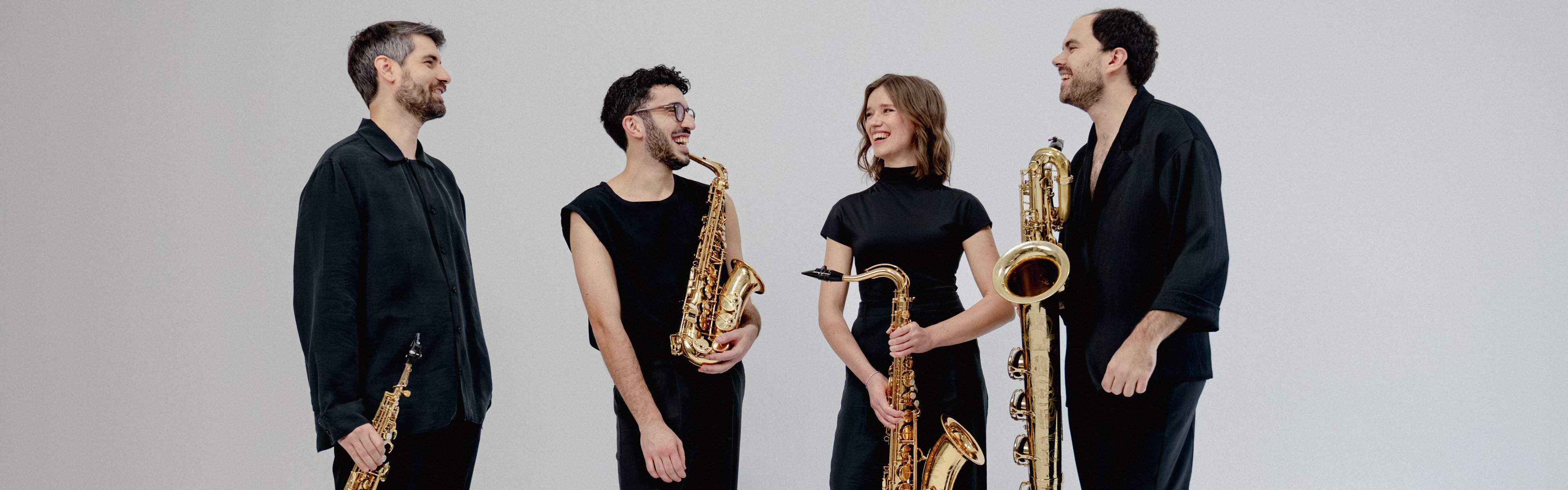
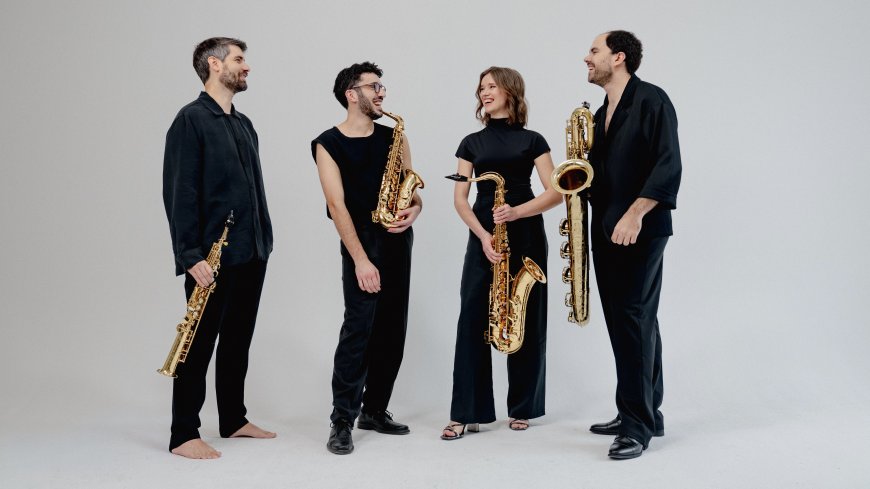
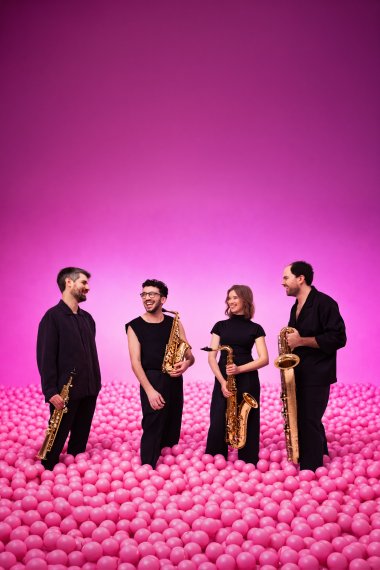
"For us, music is an endless playground," the Arcis Saxophone Quartet declares on its website. This is an apt description of the ensemble's latest album, Quirky Nightclub Chronicles, released last month on the ensemble's own Arcis records.
Claus Hierluksch (soprano saxophone), Ricarda Fuss (alto), Anne-Marie Schäfer (tenor), and Jure Knez (baritone) draw the listener in with a sense of wonder and play, matched by perfect ensemble cohesion and phenomenal technique in a program of beautiful, approachable works.
Quirky Nightclub Chronicles opens with a whisper and a sigh, the rich timbres of saxophones resonating deeply as individual voices grow into a quiet chorale. Shuteen Erdenebaatar’s Echoes of Life is perfect music for waking to a foggy morning.
The suite of five all-too-brief pieces is a gentle massage for the brain, with echoes, at turns, of Philip Glass’s pop sensibility, György Ligeti’s twinkle-in-the-eye tonality (think his Six Bagatelles for Wind Quintet), lamenting Bachian counterpoint, and jazz grooves a la Herbie Hancock. This delightful work feels both wonderfully varied and subtly cohesive. The quartet handles it gently, crafting each line, chord, and ostinato with a cultivated sensitivity that balances lyricism with a head-nodding groove.
Tapas, Marc Mellits's String Quartet No. 3 in a saxophone-quartet arrangement, is an amuse-bouche of etudes that explores specific compositional conceits or performance techniques. The individual movements don’t so much develop as they unfold, giving the listener new perspectives on the weaving lines and sparkling harmonies.
Intricate textures and technical precision do the heavy lifting in this coolly intimate work, which opens with a tutti groove that fractally iterates. The repetitions dance and melt into one another, setting a minimalist tone that carries through the first two movements. From there, the music wends its way through eight miniature movements, at times incandescently bright, at others lyrically nostalgic. The sixth movement is a standout, its slap-tongue lines conjuring the sound of an incisive electric guitar, highlighting both the technical prowess of the ensemble and the power and versatility of the saxophone.
Emma O’Halloran’s Night Music unfolds as a single, longer span — a satisfying contrast to the vignettes of the first two pieces. It's still episodic, though: the brief set pieces are composed to overlap and crossfade one into the next.
It opens with mysteriously sparse filigrees that slowly coalesce into a flashy, joyful groove. Then, the groove begins to melt and fall apart, as if the wax cylinder on which it was recorded had been left out in the sun a bit too long. It’s a humorous non sequitur that demands the listener sit up and consider that this is not your average work for saxophone quartet. The piece addresses the wide sonic possibilities of the saxophone quartet, and takes delight in acoustically imitating the kind of effects more readily produced with electronic processing and synthesizers.
Moments with Piazzolla, Sylvain Dedenon's five-tango suite, closes the album with straightforward, tasteful arrangements built to carry Astor Piazzolla's trademark dancing, lyrical romanticism intact into the saxophone quartet. Knez's baritone gets the spotlight: his cadenza at the end of "Oblivion" is gorgeously compelling, and it segues smoothly into "Contrabajeando," which gives him room to stretch out melodically. "Libertango" is the star, the ensemble building to an ever-growing intensity, and "Tango del Ángel" sends the album out with a celebratory lift.
The “endless playground” metaphor is easy to claim and hard to earn. Across the fifty-one minutes of Quirky Nightclub Chronicles — the foggy-morning chorales, tapas-sized etudes, a melting groove, and five glorious tangos — Arcis earns it with wonder, cohesion, and technique to burn.