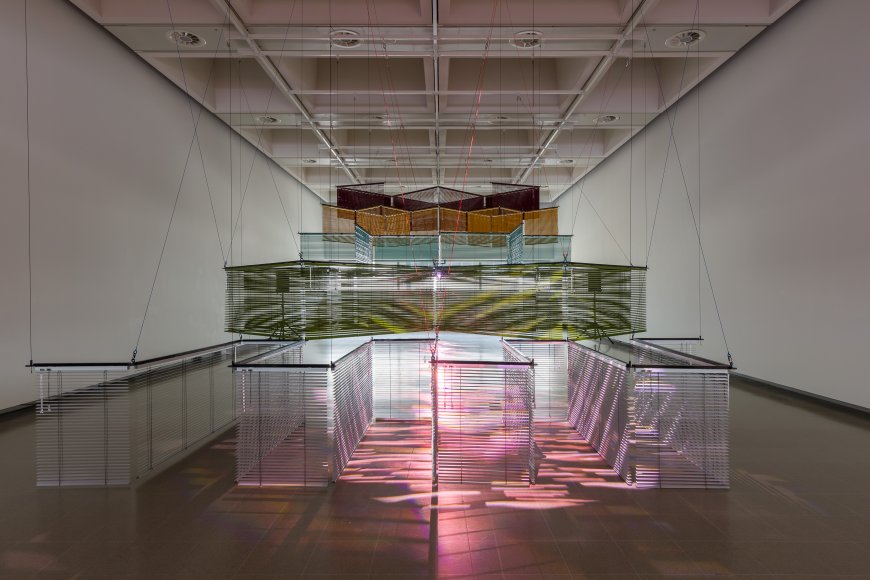
Growing up in South Korea, internationally acclaimed visual artist Haegue Yang knew of composer and political dissident Isang Yun (1917-1995). But recently, Yang realized she wanted to think about Yun’s music “in a more engaged way.”
And thus, Yang’s Star-Crossed Rendezvous was born.
Part of the LA Philharmonic’s 2025–2026 Body and Sound festival and taking place on March 10, the evening “aims to activate audiences’ senses, to travel across disparate places and time and to create an immersive sonic and visual journey that will unfold across the partner institutions’ unique architectural sites,” according to a press release.
In the dual-site collaboration between LA Phil Insight and The Museum of Contemporary Art (MOCA), visitors will first experience a sprawling installation by Yang at MOCA, then make their way across Grand Avenue to take in the music of Yun, as played by the LA Phil New Music Group and conducted by Earl Lee.
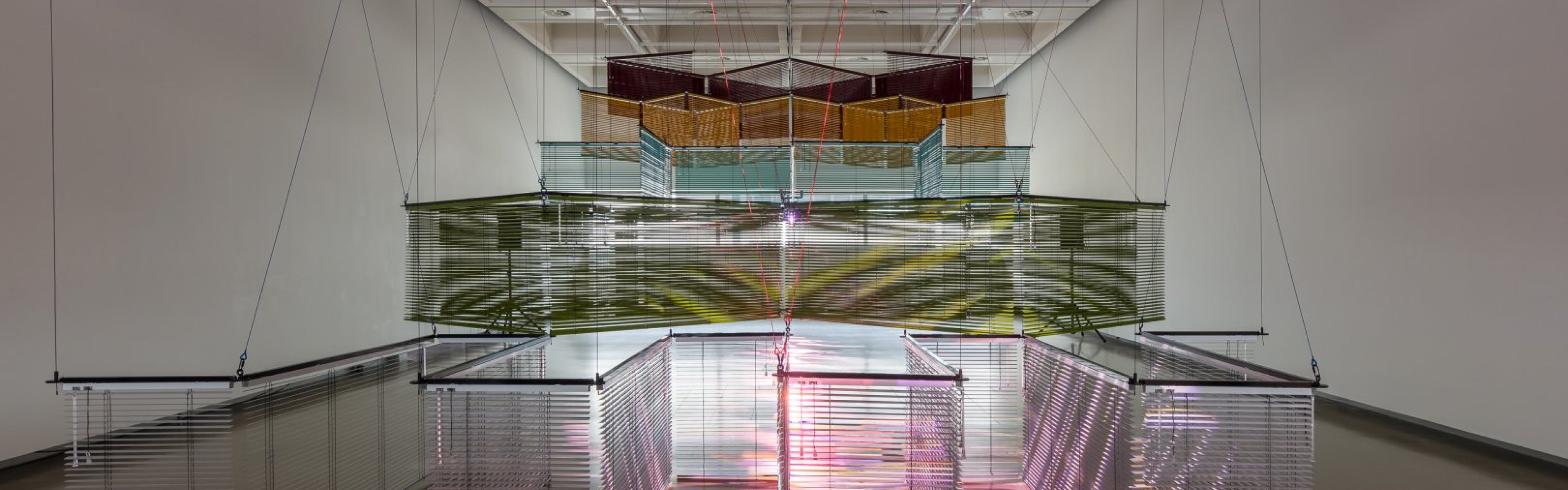
Star-Crossed Rendezvous centers Yun’s Double Concerto for oboe, harp, and small orchestra, which he wrote in 1977 for oboist Hans Holiger and his wife, Ursula, a harpist. The project began as part of Yang’s 2024 installation, Star-Crossed Rendezvous after Yun, at London’s Hayward Gallery.
MOCA curator Clara Kim traveled to the UK in 2024 to see Yang’s sculpture: a staircase-like structure of ascending Venetian blinds and two moving spotlights set to Yun’s music. It was Kim’s idea to collaborate with the LA Phil.
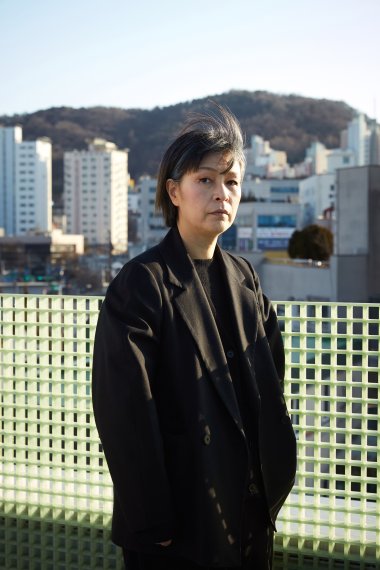
“It was [Kim’s] initiative and idea to take this as the centerpiece for collaborating between two institutions” Yang said. “However, I couldn’t really picture what [that] could be. For me, the piece was conceived and realized already. [But] I knew my engagement with [Yun’s] body of work would be long-term, [because] it has been over 10 years that I constantly build his music as [a] program for my exhibition.”
Yang also pointed out that she had doubts about the “so-called interdisciplinary collaboration.”
“I’m someone who is concerned about those figures in history, and I often found that our contemporary reception of those histories [is] too superficial or one-dimensional,” Yang said. “My concern is how to approach this history again in a more holistic way.”
But the Berlin- and Seoul-based artist overcame those apprehensions. Despite her inexperience working in concert halls, she realized the partner institutions could do something meaningful with the art.
Yun lived much of his life in Germany, and at one point was kidnapped and jailed due to alleged acts of espionage. But his music, which hasn’t been performed much in the United States, lives on. To that end, MOCA held a symposium last November titled “Star-Crossed Rendezvous: The Musical Legacy of Isang Yun.”
According to Yang, the title “Star-Crossed Rendezvous” originated from mythology, “which is kind of a leitmotif [for Yun] to compose the Double Concerto,” she said. “On one hand, it was fascinating for me how he worked with ancient mythology and then connect[ed] with contemporary politics in his time. He was, like many other composers, very keen about what was going on around him. He had a political consciousness, but also was very aware of what kind of musical history he was in.”
Yang wanted to translate Yun’s legacy into a visual and curatorial language. “After I studied what the LA Phil has done under Green Umbrella, reaching out to communities and audiences [through various activities], I realized that, for someone like Isang Yun, we had to bring something very proper. [We] decided to play [up] the analogy of the Double Concerto with two solo instruments — [representing] the separation, division and conflict that he experienced. It’s a conceptual idea.”
Ultimately, one wonders if Yang sees Star-Crossed Rendezvous as part of a broader conversation about Korean modernity and transnational identity.

As an artist, you are driven by curiosity. This desire to know and take in. It’s hard for me to grasp what would be the impact or significance [of Star-Crossed Rendezvous] in a broader sense, [but] I have aspirations. Just as Yun brought mythology to understand his own time, I wish Yun [himself] to become another analogy to understand our time, [which] is so diverse and full of diaspora.
While I do sense that the significance of art, or the role of art, has to be constantly redefined and reinvestigated, I think Yun is maybe a metaphor to revisit all those topics around us. He’s like an alibi. Good art always has an amplifying impact, [and] it looks as if, [when] one sees or listens to that story, this grandness has resonance.