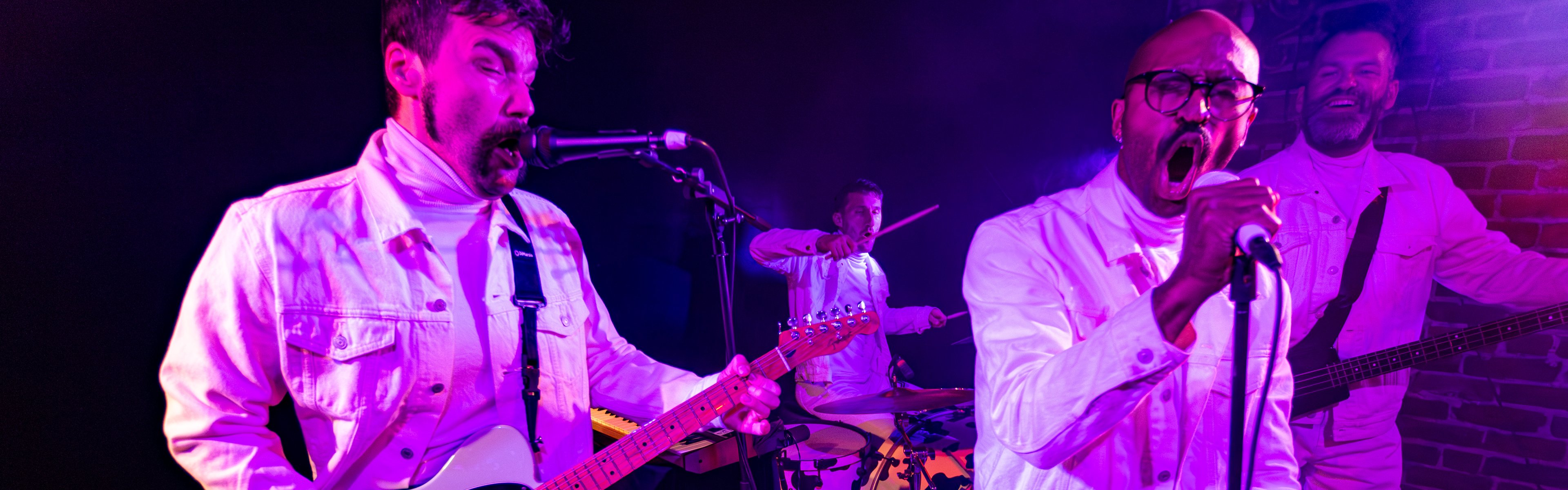
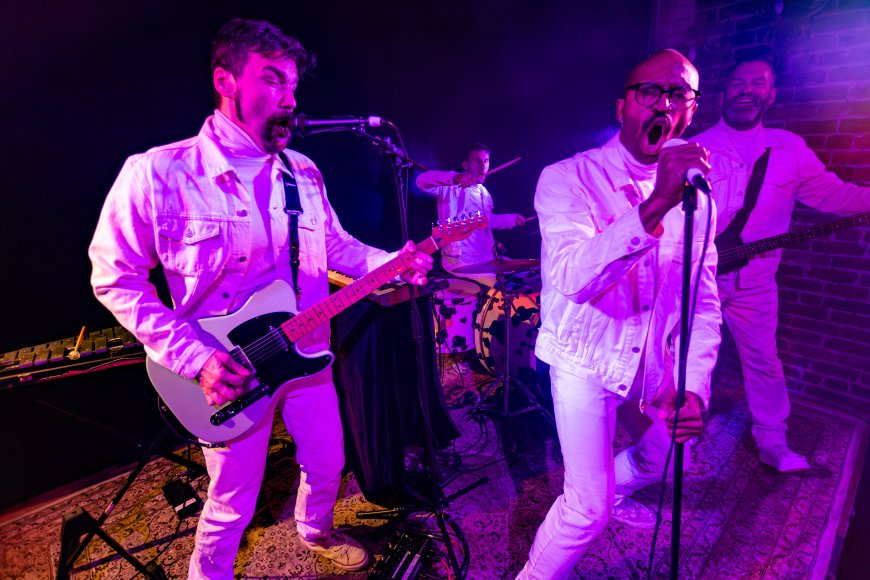
With all the flashing colored stage lights, vocal effects processing, and more electric guitars than musicians on stage, anyone arriving late to the Herbst Theater on Friday expecting a typical evening of contemporary classical music could have assumed they walked into the wrong concert.
San Francisco Performances’ 11th PIVOT Festival was curated by Andy Meyerson. The percussionist based his curatorial decisions around the question, "what is the future of our art form?" One answer to this question was clear: gone are the formalities of classical concert ritual.
Opening night, Jan. 30, featured the vocals of composer-performer Tanner Porter in a set of new songs composed by members of the Sleeping Giant Composers Collective (Timo Andres, Cristopher Cerrone, Jacob Cooper, Ted Hearne, Robert Honstein, and Andrew Norman) as well as by a former student of each member. Porter was joined onstage by members of The Living Earth Show, guitarist Travis Andrews and Meyerson.
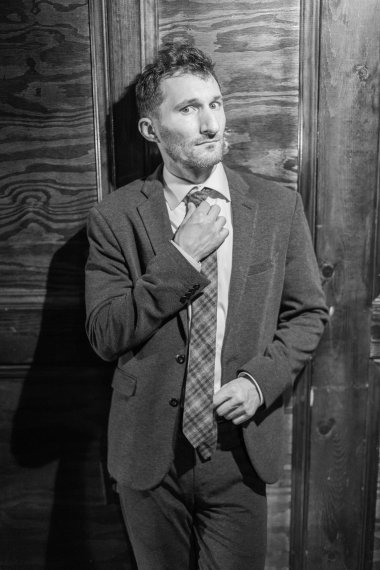
The performance closely resembled that of an eclectic and hyper-literate indie rock band. Beyond the art pop instrumentation and professional visual production, the energetic onstage activities did not align with classical conventions. The songs were not announced from stage and sometimes flowed into each other without pause. The music was memorized, with music stands used only to hold instruments.
Nevertheless, there was something uncanny in the air as two opposing social scripts of concert etiquette butted heads. When Porter, onstage, danced to the hardcore opening of Rohan Chander's song "stones don't lie," a few audience members timidly shouted and wooed from the hall, but most sat quietly in their red velvet seats, unsure whether to join in or to attentively contemplate the music.
Throughout the evening, Meyerson's versatility and virtuosity as a percussionist were on full display as he fluidly moved between the drum set and four-mallet vibraphone. Porter boasted a similarly broad palette, drawing on a wide range of vocal styles and shifting with ease between a full, woody straight tone and an intimate, breathy lilt that was particularly striking in her upper register. Few of the songs gave Andrews the opportunity to exhibit his guitar technique in a similar capacity, but this is no condemnation of his playing — he brought nuanced phrasing to each of his accompaniments that animated the ostinato patterns.
Each of the twelve composers on the program was asked to respond to the idea of “legacies” in their songs. The first composer on the program, Andrew Norman, took this quite literally. In "CA AB1780," the LA-based composer sets to music the text of California’s state bill prohibiting legacy admissions in higher education; the in-your-face slamming of drums and fragmented text-setting of legalese created an uneasy, tonally ambiguous dark comedy.
Following Norman’s piece, the program sometimes felt bogged down by a fatalism of genre and medium, as composers ordinarily in possession of a distinct voice tried to write art pop and indie rock songs.
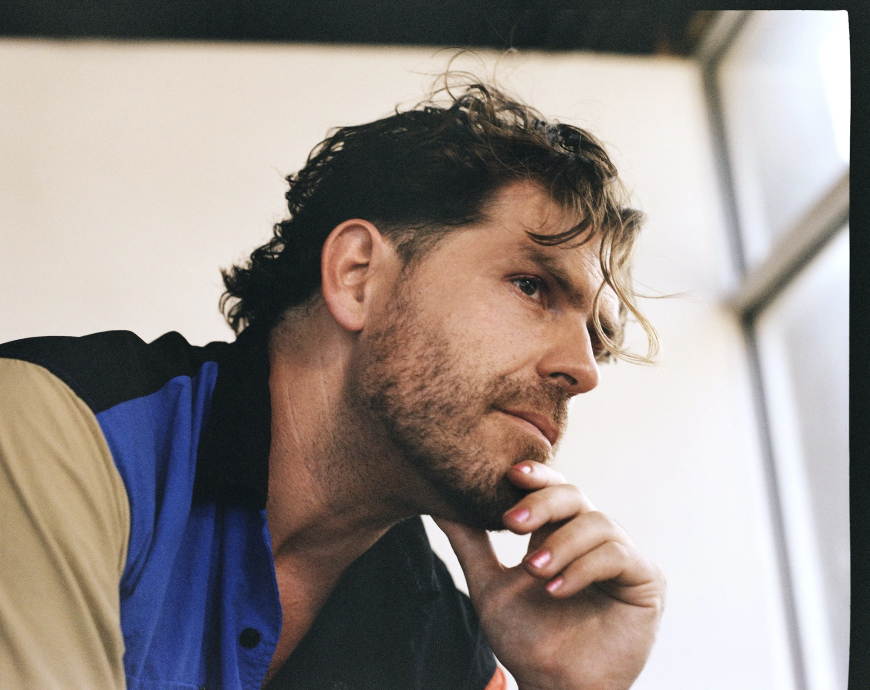
At the opposite end of this spectrum, however, was Ted Hearne's contribution. With his characteristically cerebral, off-kilter groove, "Mother's Mouth" is unmistakably Hearne — it was one of the highlights of the show. If this program was in search of the "future of the art form," Hearne's genuine and personal engagement with the aesthetics of alternative music was far more promising than genre-crossing alone.
The same promise could be found in Christina George's song "Erasing the Edges," which seemed so fluent in its looping modal pop idiom that the strange, sensuous moments of chromaticism —which in other hands might have seemed consciously intellectual — here read poignantly as part and parcel of the song itself.
Earnest compositions such as Hearne’s and George’s suited this unique concert environment the most. But the reverse holds just as well. The evening’s ultraviolet production value had a way of undercutting the more-classically conceived and inward-looking art songs of Robert Honstein and Timo Andres, which, in this context, went against the grain.