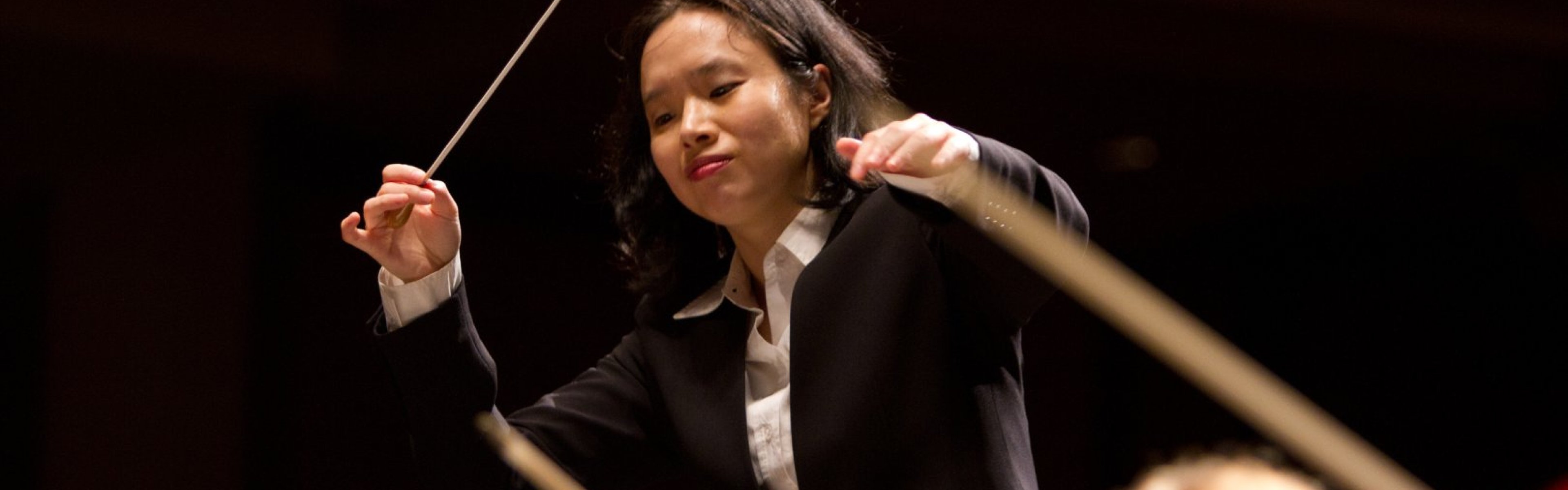
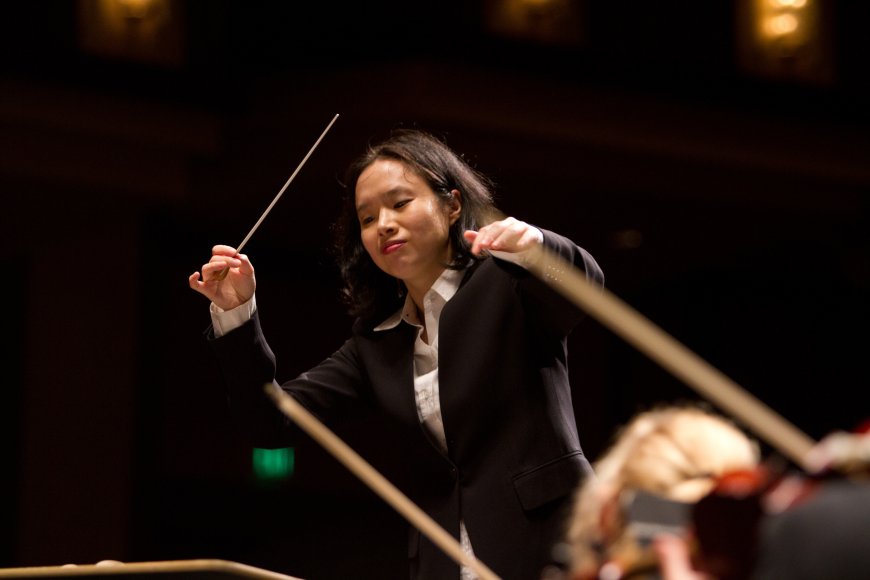
Carolyn Kuan never saw herself as a conductor.
The artist said she had intended to pursue a career in investment banking but ultimately chose to follow her heart instead. Recognized for her versatility, innovative programming, and commitment to contemporary music, she’s since wowed critics and audiences alike with her presence on the podium for over two decades.
Kuan’s recent operatic triumphs include conducting the world premiere of San Francisco Opera’s The Monkey King last November —Joshua Barone of The New York Times wrote that the production was “led with dynamism by the Huang specialist Carolyn Kuan.” For those Bay Area denizens who were unable to catch a performance, Kuan will wield her baton on Jan. 25 to close Berkeley Symphony’s 2025–2026 Symphonic Series at the First Congregational Church of Berkeley.
Born in 1977 in Taipei to a family originally from China, Kuan moved to the U.S. at age 14 to pursue her musical studies. After graduating cum laude from Smith College, she earned a Master of Music from the University of Illinois, and a Performance Diploma from the Peabody Conservatory. Since then, she’s developed strong relationships with leading orchestras, opera and ballet companies, and music festivals worldwide.
Music director of the Hartford Symphony Orchestra since 2011 (which she’ll leave in the spring of 2027), Kuan has also led acclaimed ensembles such as the Baltimore Symphony, San Francisco Symphony, and the Hong Kong Philharmonic, as well as the critically acclaimed New York premiere of Huang Ruo’s An American Soldier (2024).
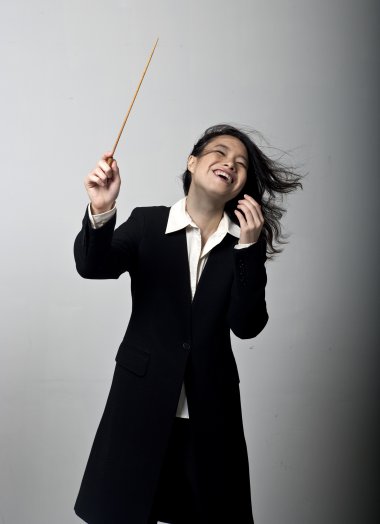
Kuan was the first woman to receive the Herbert von Karajan Conducting Fellowship in 2003, leading to her residency at the 2004 Salzburg Festival. In addition, she was the inaugural winner of the Taki Concordia Fellowship, and has also received honors from the Women’s Philharmonic, Conductors Guild, and Susan W. Rose Fund for Music.
SF Classical Voice chatted with Kuan about the Berkeley Symphony program, her longstanding musical relationship with Huang Ruo, and representation in classical music.
Your family’s intention was for you to come home after college and work in the banking industry. But since you’d studied piano as a child, with music always having been part of your life, you eventually ended up at Smith College.
My first love was ballet, [and] I wanted to be a ballerina. But if you’re a ballerina, you have to start really young. I was seven or eight, and my teacher told my father to move to the United States [so I could] study ballet, and my dad said, “No, that’s not a good idea. My daughter really should not be in the arts.”
So, I came to America when I was 14 [and went] to high school in Massachusetts for a few years. I was blown away [because] I was free to ask questions. Since I was a very rebellious girl, the idea that I could ask questions and think differently was very appealing.
In college, my focus was on economics for business and computer science, and music was what I did for love.
Lucky for us, then, you received a scholarship to Peabody, where a conductor was born.
It was really one of the best conducting schools in the country, possibly in the world, because they actually give you an orchestra to practice with.
I got my very first job, so to speak. It was called Artist-in-Residence, [and] it was with the New York City Ballet, conducting my first Nutcracker without any rehearsal at Lincoln Center.
Wow, so you’re the fearless type, as well. Let’s fast forward to 2011 when you became Music Director of the Hartford Symphony.
I finally called dad and said, “I don’t think I’m coming home. This is what I’m going to do.”
And so, it came to pass. What are your thoughts on making your debut with Berkeley Symphony?
Berkeley Symphony was one of those orchestra that I kind of romanticized for a long time. Kent Nagano, of course, is one of the few Asian conductors actively working. He had a fantastic reputation when I was learning about conducting. I remember following what he was doing, [including] all sorts of new music. I thought that was incredibly exciting, and I think the fact that he was Asian was really an inspiration.
So, when they contacted me to see if I was interested in coming for a week, I thought, “Of course.” [Berkeley Symphony] is known for new music, and I wanted to get to know the orchestra. I also spent 10 years with the Cabrillo Festival of Contemporary Music in Santa Cruz, which is not that far away.
Can you talk about the program, “Fables & Folklore,” which features Huang Ruo’s “Folk Songs for Orchestra” (a work that weaves traditional Chinese folk melodies with modern orchestral colors and was inspired by regional songs sung across generations). Also on the program is Clarice Assad’s “O Saci-Pererê,” which draws on Brazilian folklore with Marc Teicholz on guitar, before you conclude with Antonín Dvořák’s Symphony No. 8.
We definitely wanted some newer pieces, so it’s a combination of the new and old. Huang is obviously a composer I’ve known for a long time, [and] whose music I love. Clarice I’ve also known for a long time. We met at Cabrillo when we were both very young.
There were a lot of conversations back and forth, [because] programming is a collaborative process for me. Because I was doing The Monkey King, to include a piece by Huang made sense.
We also wanted something with soloists, and Marc is local. For me, it's always very special to do a piece with the original soloist — I believe the piece was dedicated to him. It all came together very naturally.
Let’s talk about The Monkey King. What first drew you to the opera, both as a musical and cultural project? I’m also wondering if the story has any meaning for you personally?
It’s a story I grew up with, and a lot of Asians grew up with. It's one of the four major [works of] literature in the Chinese culture. So, it's a character I know well.
Huang and I have known each other for a very long time. I believe this is our fourth major opera together. I did the American premiere of his first opera, Dr. Sun Yat-Sen (2014) at Santa Fe. I also did the world premiere of M. Butterfly (2022). Then, I did his An American Soldier, which is up for a Grammy [for Best Opera Recording].
It's very special to develop a deep relationship with any composer. Imagine if you could have a deep relationship with Mahler, with any of the composers we know well. For me, that trust in that relationship is something I really value. In fact, the “Folk Songs” we’re playing, I premiered with the San Francisco Symphony back in 2012. So, when San Francisco Opera contacted me to see if I was interested in doing The Monkey King, the answer was, “Of course,” and it turned out to be a tremendous experience. It was just a really outstanding piece of art.
What questions do you ask yourself before you tackle a work rooted in such a foundational myth?
When it comes to The Monkey King, and as a conductor, my job is first and foremost to serve the composer. It’s rarely about me. Obviously, when it’s a piece like the Dvořák Symphony No. 8, he’s not around for me to ask questions. The job is [that] I try to get into his head, what was happening in his life? I try to read what he says about his piece, what contemporaries said about the piece.
That’s why I love contemporary music, I can literally call up the composer and say, “Hey, what was happening at this time?” When I see things in the music, I can ask questions, or even better when it comes to a piece like The Monkey King, you have the composer and librettist [David Henry Hwang], right there, and you literally can converse with them together. You’re giving birth to this new opera together with the director [Diane Paulus], with the choreographer [Ann Yee], with the puppeteer [Basil Twist].
That’s why I personally love working with new music and a new production, because it’s a group effort. You really create something special together, and as a conductor, you become the glue in some way. But mostly, it’s the process that’s especially rewarding.
How do you mentor the next generation of conductors and musicians?
Being available! I'm slowly getting to that point of feeling like I have something to offer. When people ask for time, I try to be as available as I can. I [also] want to make sure when I offer something to someone, that it really is of value, [because] I feel like there's so much I still don't understand or don't know.

As one of the few Asian women leading major orchestras, how do you navigate visibility, expectation, and responsibility?
I really don’t know. To be honest, I don’t think about it. I actually don’t think I’m Asian, female, or whatever — gay — unless what I’m doing is actually connected to my experience. For The Monkey King, I happened to have a lot of experience with the subject and composer. None of that has to do with whether I am Asian, female, tall, or short.
I suppose when it comes to opera or ballet, I’m a very collaborative person. One could say that’s a female characteristic, but not necessarily. I know plenty of females who aren’t very collaborative. I think of myself first and foremost as an artist with integrity, somebody who really cares. How much comes from my background as female, Asian, or gay — who knows?
I come to it as a human being trying to make a small difference in the world through music.