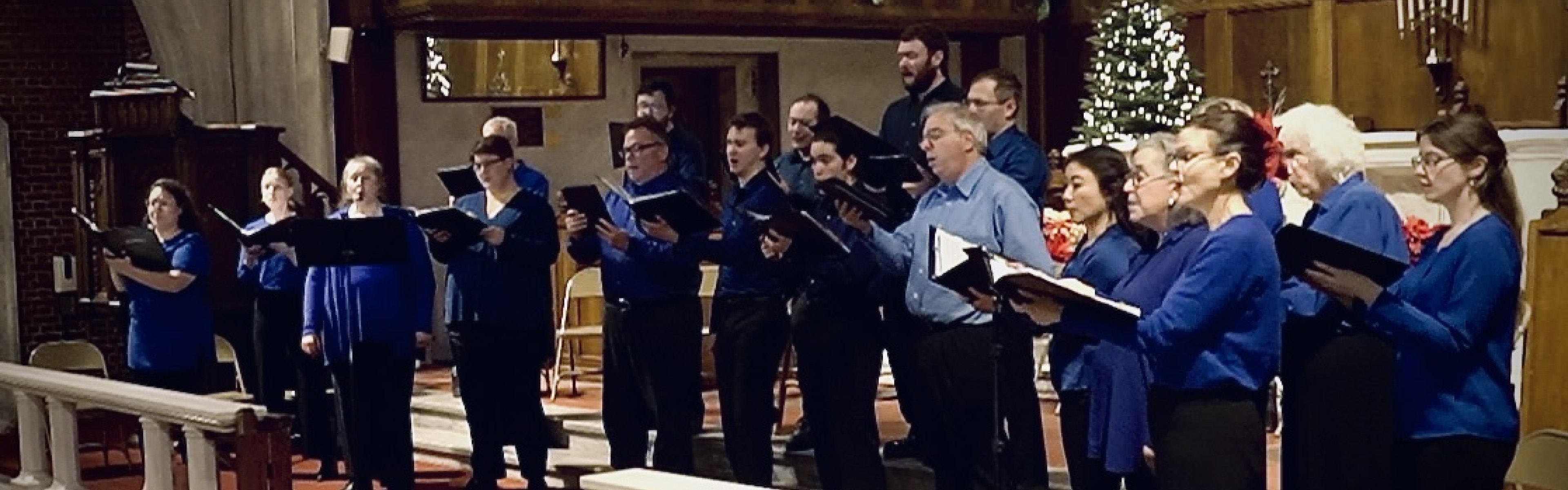
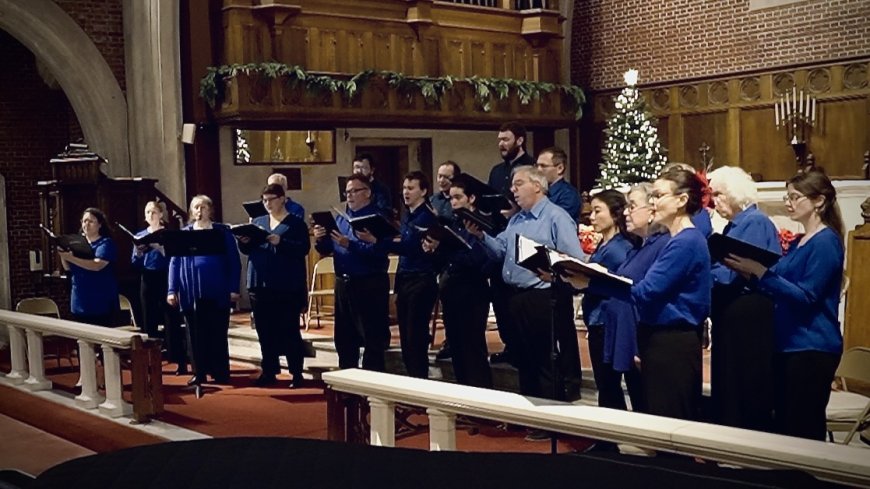
For its “Mystery, Magi, and Mittens” concert, San Francisco Choral Artists (SFCA) portrayed various facets of the Advent and Christmas seasons in choral song.
The Dec. 21 program opened SFCA’s 2025-26 season at St. Paul’s Episcopal Church in Oakland. Works spanned from the 15th century to the 21st century and included two world premieres — the most recent fruit of the chorus’s long commitment to commissioning new works.
Artistic director Magen Solomon built the 19-work program around Francis Poulenc’s Quatre Motets pour le temps de Noël (Four motets for Christmastime). Rather than being sung together, the four motets were placed within groups of works on similar themes. The works within each group varied in mood and style, and the program flowed beautifully.
The fourth group, “Mystery,” offered the rare opportunity to hear four composers’ settings of the text “O magnum mysterium” (Oh great mystery), the responsorial chant which celebrates the mystery of animals seeing the newborn Jesus. Settings by William Byrd (Tomás Luis de Victoria’s English contemporary), Francis Poulenc, Alessandro Scarlatti, and Bay Area composer David Conte were included. Notably, Victoria’s famous setting was not.
Byrd’s polyphonic setting neatly filled the stylistic slot where Victoria’s would have been. Poulenc’s opened with a chantlike passage, voices moving in parallel motion, before blossoming into a richer, yet still austere, harmony, typical of the composer.

Scarlatti took the grandest approach of the composers, dividing the chorus into eight parts. The motet worked well even with SFCA’s twenty singers, who rose to produce the biggest sound of the program. Conte’s setting took the chorus through multiple changes of meter and tempo, concluding with a majestic Alleluia.
The first of the new works, Max Marcus’s beautiful setting of “The Star-Song: A Carol to the King,” by 17th-century poet Robert Herrick. The poem tells of how the three kings search for the newborn Jesus; they query the star of Bethlehem and hear its response, then go to the baby with their offerings.
Marcus assigns each verse to a different subset of the chorus, while the remaining voices gently rock under the leading subset. One of the kings is sung by the tenors, another by the baritones and basses. The women sing the star’s verse. The composer builds through the last verses, then has the chorus fade away into the night.
The second of the new works, Peter Hilliard’s gorgeous “O Orient Light,” was in the “Prophecy” group. Hilliard sets a text mixing Old English and Latin that was compiled in the late 15th-century by James Ryman. He varies the choral texture considerably over the course of the motet, from the marvelously transparent opening through the heavier middle, calling for, and getting, a big sound from the chorus toward the close.
The “Prophecy” group also included Maia Aprahamian’s modern setting of the “Coventry Carol,” which takes the original 16th-century setting of Robert Croo’s poem about Herod’s murder of young male babies and reharmonizes it in a beautifully sustained style. In the “Celebration” group, Steven Sametz uses a similar strategy in an update to the vigorous carol “Gaudete.”
Other standout works on this intricate program included Gregory Rose’s cheery contrapuntal version of the Puerto Rican hymn “Los pastores a Belén” (The shepherds go to Bethlehem), Alice Parker’s bouncy setting of the Spanish carol “Ya viene la vieja” (Here comes the old lady), accompanied by finger-snapping, and a warm rendition of Brahms’s “O Heiland, reiß die Himmel auf” (O Saviour, tear open the heavens).
The choristers sang, and Solomon conducted, with intense commitment and focus, encompassing the stylistic variety with aplomb, producing a sound that ranged from translucent to richly mellow as required. Tuning issues on high attacks early in the concert vanished along the way. All in all, it was a satisfying ninety minutes of seasonal music, enjoyed in the fine acoustics of St. Paul’s.