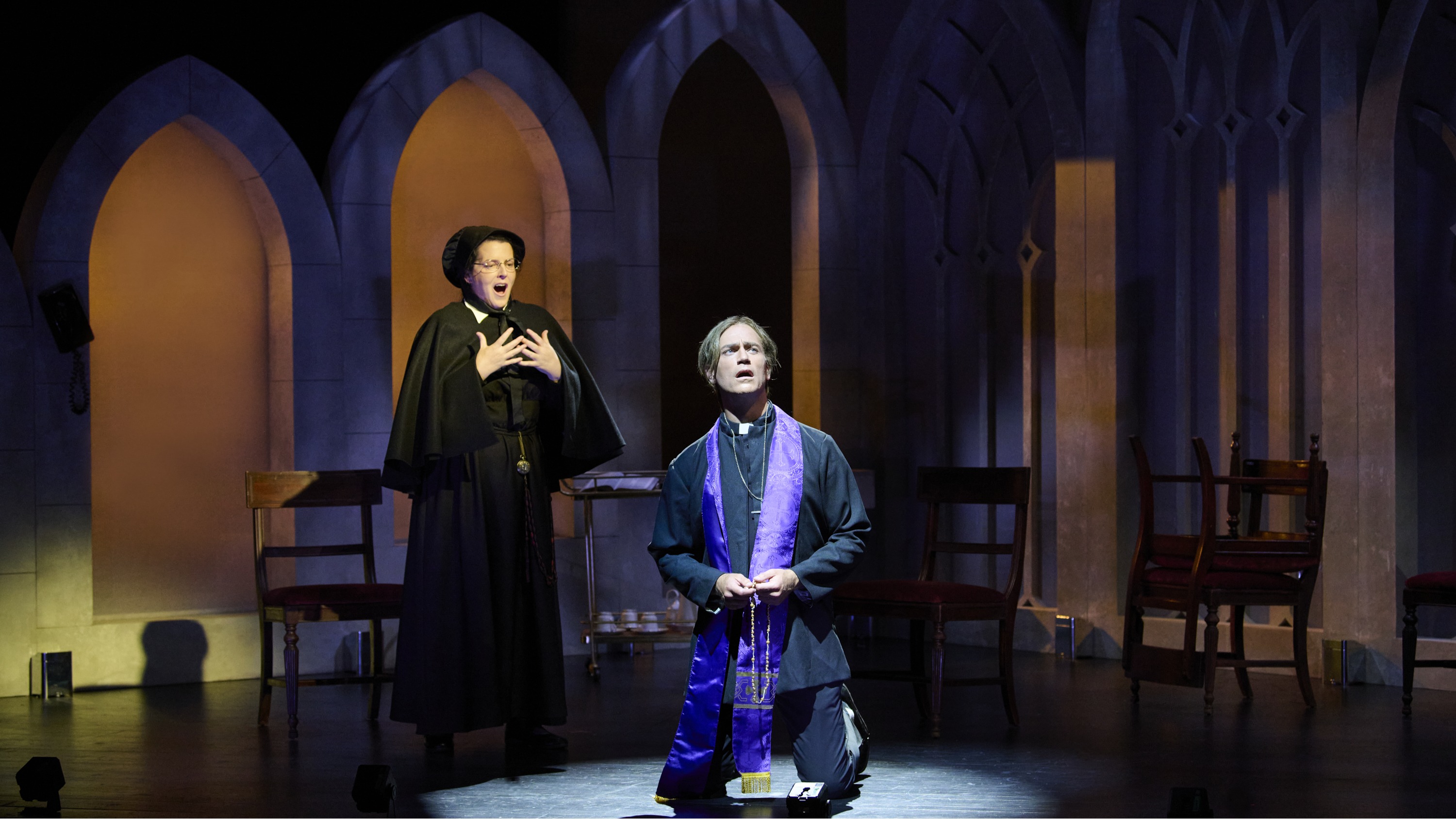
Did he or didn’t he? And if he did, what exactly was it that he did?
Those are the questions you’ll ask yourself at the end of Douglas J. Cuomo and John Patrick Shanley’s opera Doubt, based on Shanley’s Pulitzer Prize- and Tony Award-winning play of the same name.
In the opera as in the play — and the 2008 film directed by Shanley himself — Sister Aloysius, a nun who teaches at St. Nicholas Church and School in the Bronx, is convinced that Father Flynn, the church’s priest, is having an improper relationship with an eighth-grade student and altar boy.
Sister James, a younger, less experienced teacher, isn’t convinced. And the boy’s mother is grateful for Father Flynn’s interest in and support of her son.
Doubt, premiered by the Minnesota Opera in 2013 and seen on PBS in 2019 (a performance that can no longer be streamed), has had only a few productions since its premiere. It’s difficult to know why it’s been neglected.
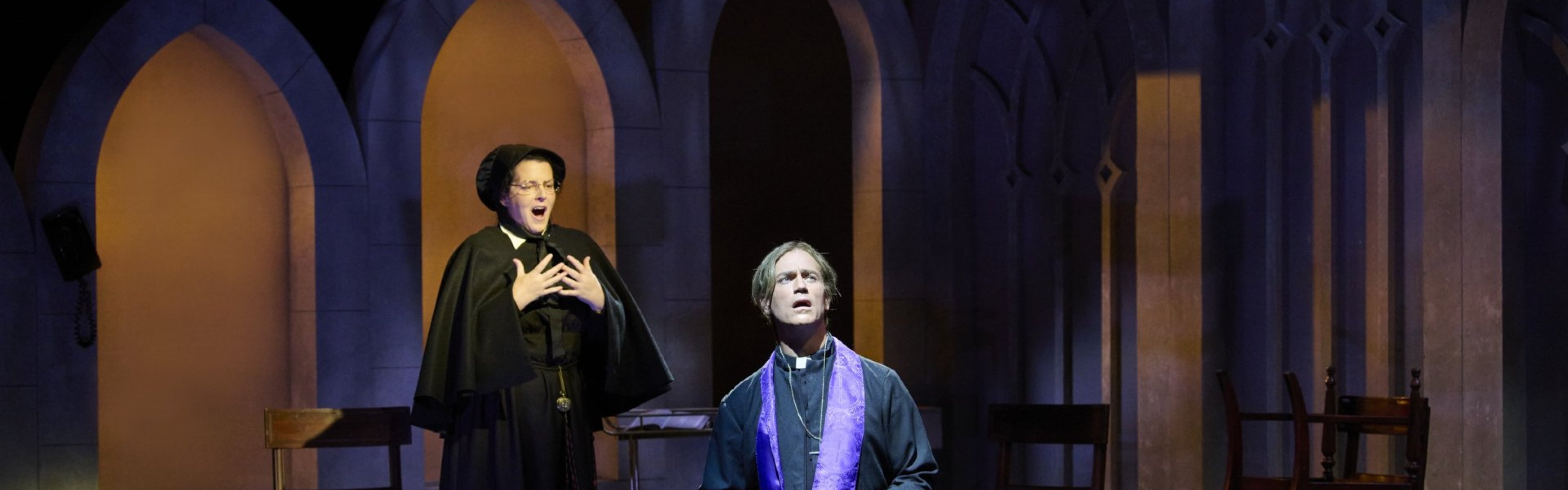
But the superb new chamber version of the opera, commissioned by Opera Parallèle and given a stellar performance by the company on Friday, May 30, at San Francisco’s Presidio Theater could easily propel the opera to more productions. It pares Doubt down to just the four central characters and an orchestra of 14, eliminating one character and the adult and children’s choruses.
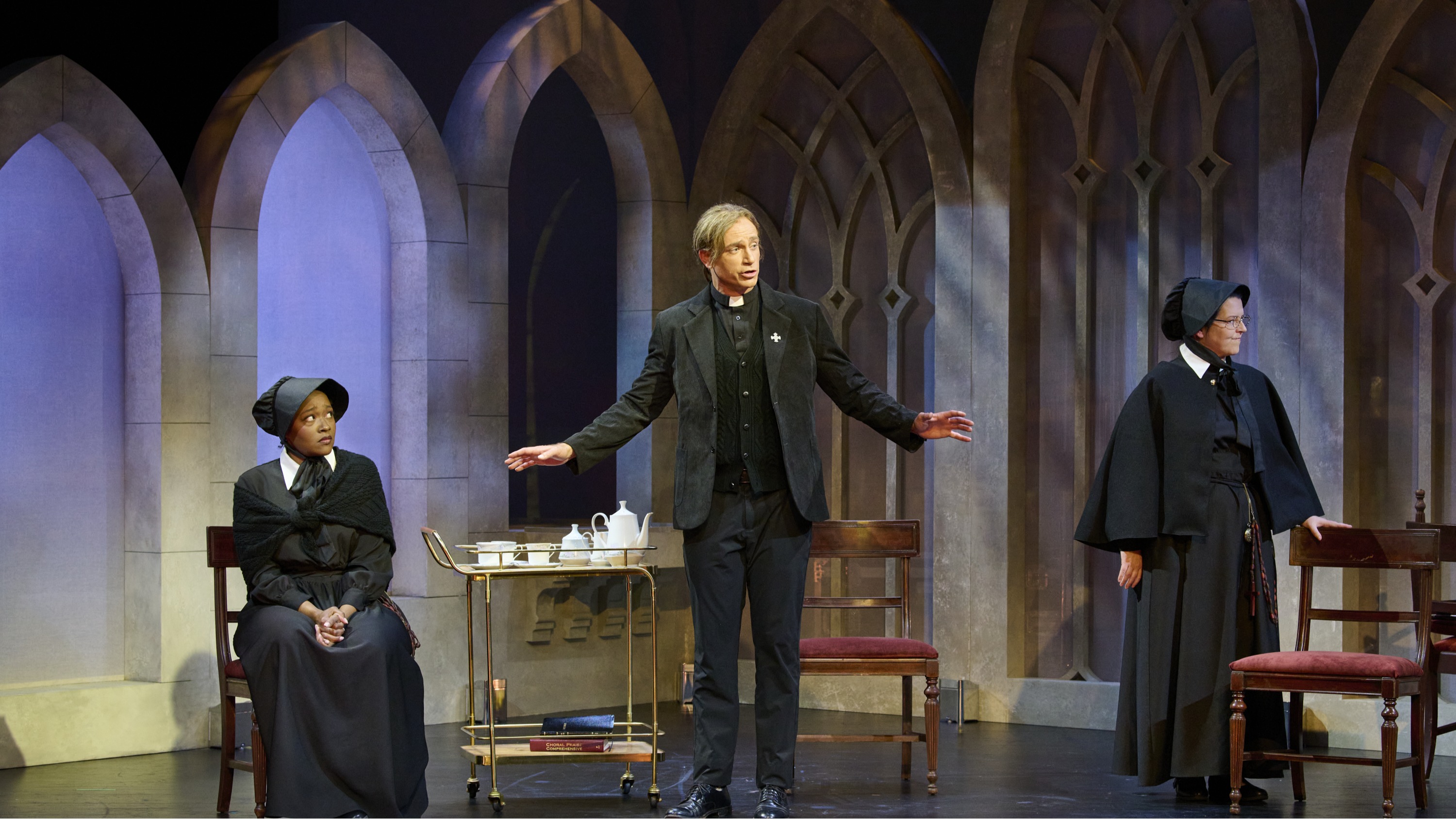
The result is a taut, focused, intense work, delineating the main conflicts. Sister Aloysius, the principal of the school, presses Father Flynn about his actions and criticizes Sister James for not being strict enough with her students. Father Flynn defends himself and tries to talk Sister James over to his side. Mrs. Miller, the mother of the altar boy, defends Father Flynn.
Cuomo’s vocal writing helps to establish the characters’ personalities. Sister Aloysius’s spiky vocal lines make her sound suspicious. That soprano Rhoslyn Jones’s voice has a slightly tart edge added to the nun’s fanatical nature.
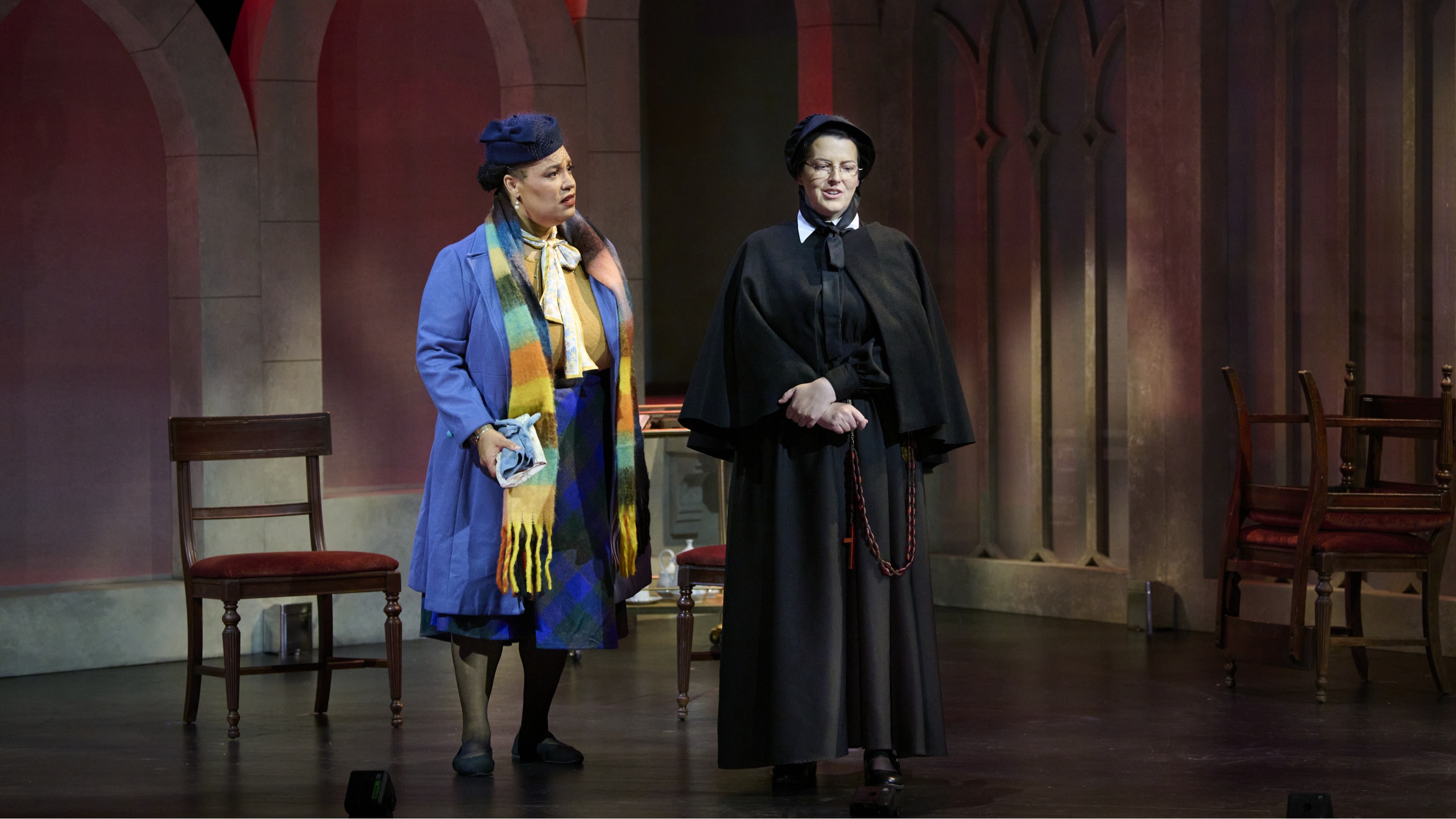
Matthew Worth’s forthright, handsome baritone lent Father Flynn’s claims of innocence credibility even as Sister Aloysius accused him of … something. For Sister James (the charming soprano Naomi Steele) and Mrs. Miller (mezzo-soprano Deborah Nansteel, who projected quiet strength), Cuomo provides straightforwardly lyrical lines.
The beautifully orchestrated score is in a style best described as modern eclectic. It’s largely consonant but sprinkled with dissonance as appropriate to the text at hand. Cuomo makes great use of the double reeds and celesta, in particular, to establish mood and color. Tubular bells masquerade as church bells at the opening of each of the two acts, setting the stage aurally.
The libretto, which Kevin Newbury adapted for the chamber version, is a bit talky, drawn as it is from a stage play, but Cuomo’s score puts the spotlight on humor and wit where you wouldn’t necessarily expect it in a play about suspected child abuse.
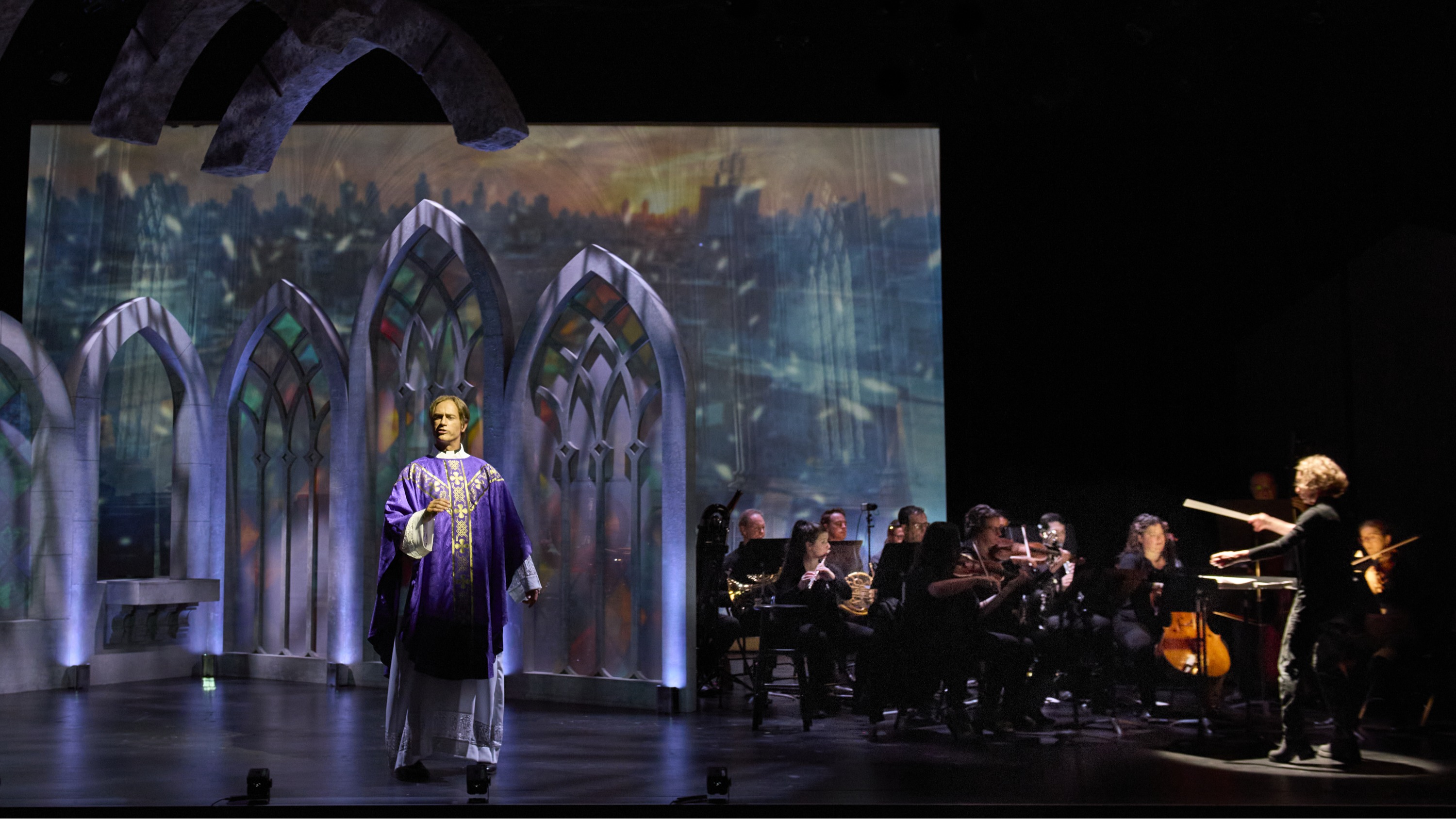
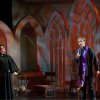
Jacqueline Scott’s scenic design — a set of pointed Gothic arches and hanging elements representing a roofline — puts you right inside the church. The opera’s action extended to the walkways and doors against the walls of the theater.
Those walls and a backdrop behind the set were used to project images or video related to the text: bare trees or snow denoting the season, a stormy sea when Father Flynn’s sermon recounts the story of a sailor lost at sea.
The cast was uniformly strong, all giving committed and beautifully sung performances. Their enunciation of the text was nothing short of miraculous, even though English is a notoriously difficult language to sing clearly. You could understand nearly every word without reference to the supertitles.
Brian Staufenbiel directed unobtrusively yet persuasively, focusing on naturalistic acting. Nicole Paiement’s conducting was, by turns, propulsive and tender, with top-notch playing by the chamber orchestra.