The Los Angeles Philharmonic New Music Group lived up to the letter of its name Tuesday night, Feb. 3. Each of the five pieces on their Green Umbrella program at Disney Hall was a world premiere.
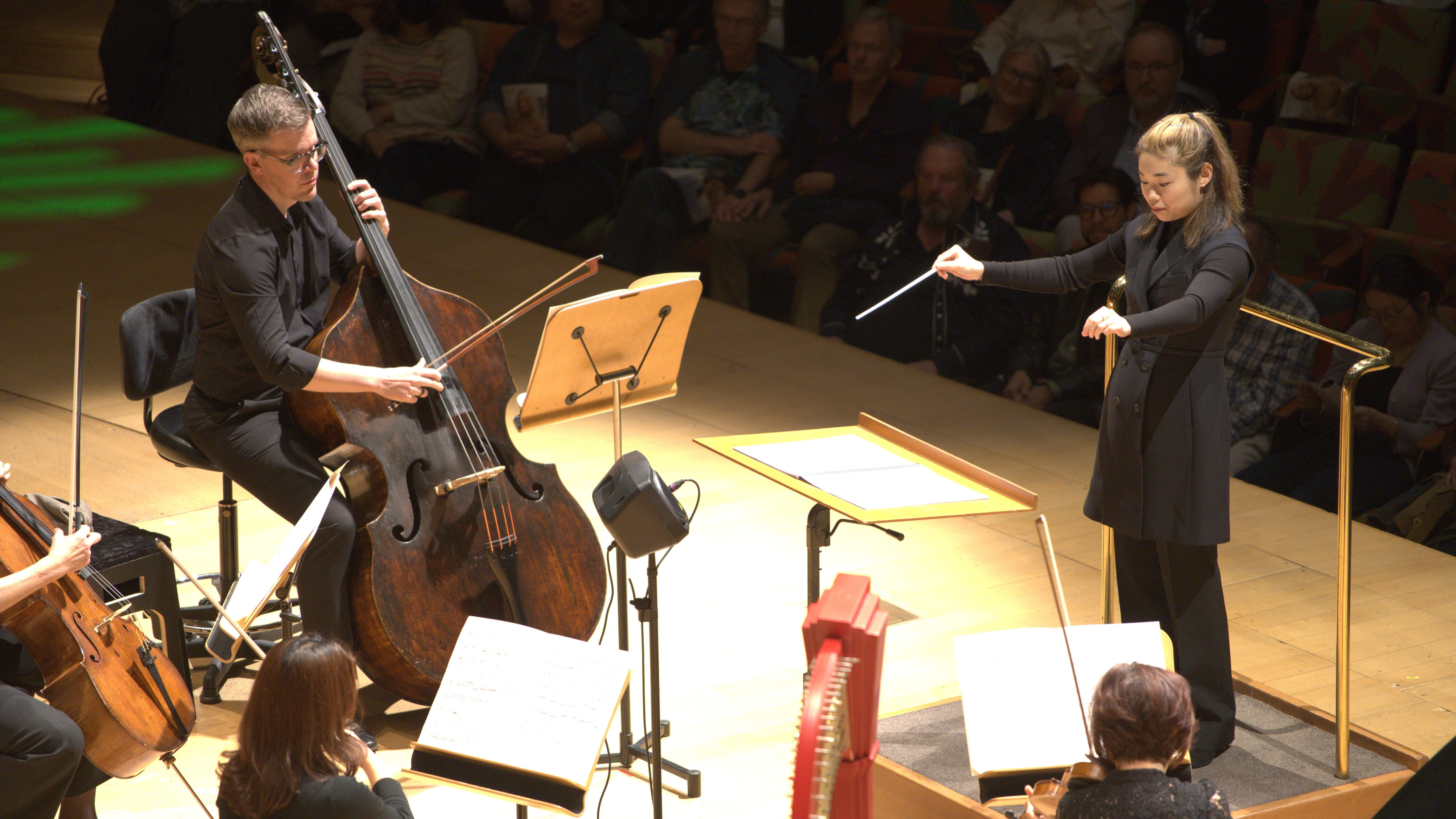
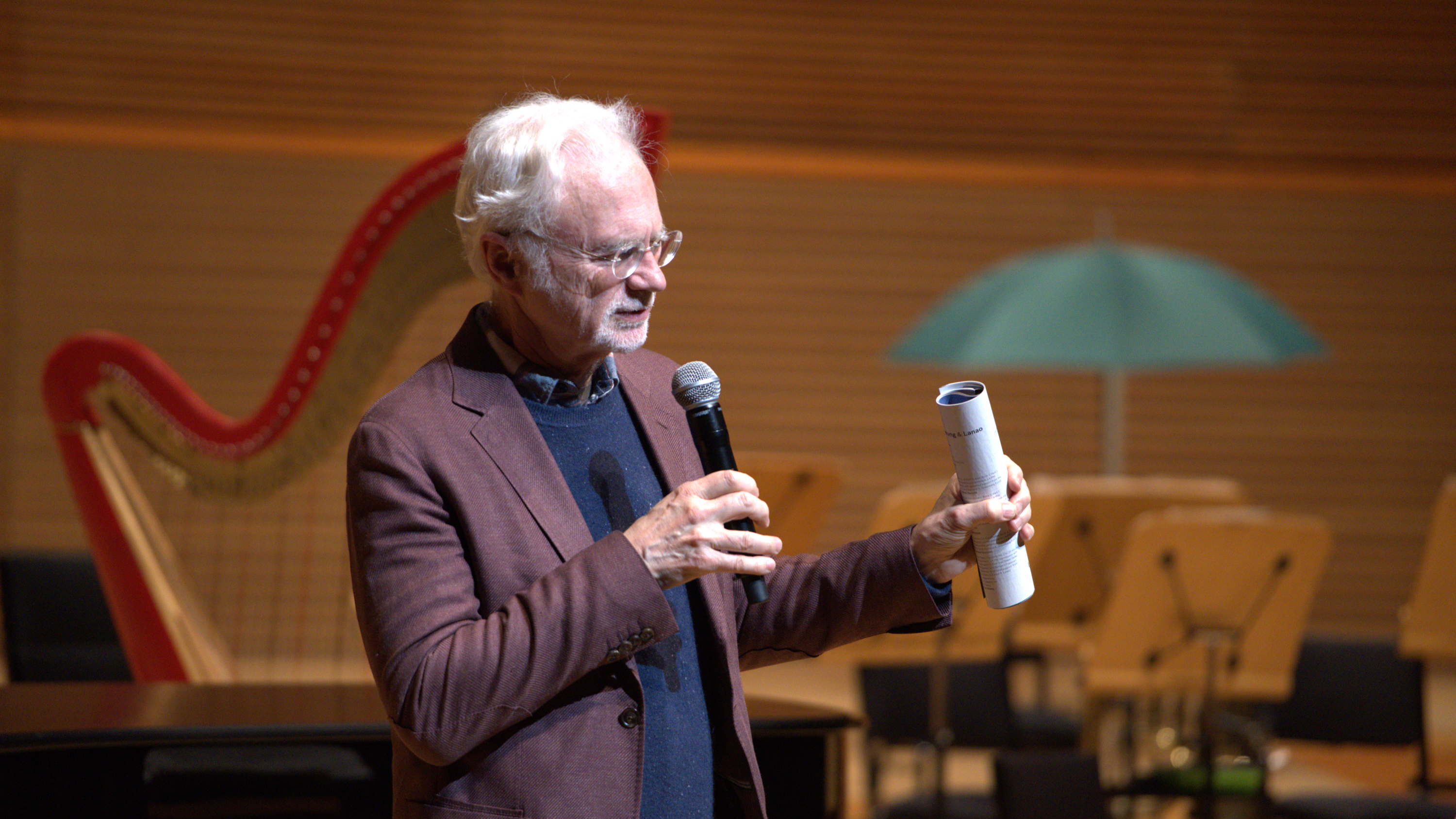
Two were conducted by Elim Chan, who stayed in town after her gigs with the full orchestra over the previous weekend. The entire program was curated by the orchestra’s creative chair John Adams, who gave a short introductory talk in lieu of conducting. The stems of the green umbrellas spread around the hall were lit up in high-tech green for an extra jolt of visual pizzazz.
Adams noted that the audiences for the Green Umbrella series — a long-running tradition that highlights new compositions — have been the biggest in the world for new classical music year in and year out. That’s believable; composer Brett Dean once remarked that he was stunned by the size of the turnout here for one of his pieces years ago in comparison to what he was used to elsewhere.
Sprinkled throughout the program were three more installments from the LA Phil Etudes series — tiny solo pieces written especially for the principal players within the orchestra. 16 pieces had been commissioned by Adams, and nine had been presented from 2024 up until now.
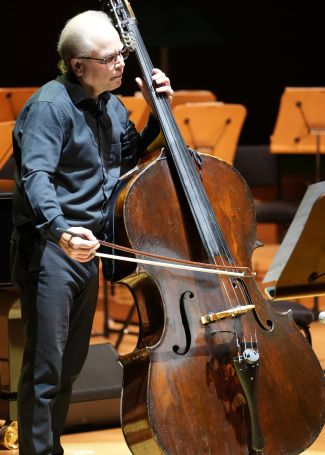
Adams’s son, Samuel, was up first. with an amusing composition for a sometimes-amusing instrument: “Heartwood” for double bass, performed by LA Phil’s Christopher Hanulik. The piece’s novelty mostly comes from the alternate tuning of the low E string of the bass down to a B, bringing the loosened string to the verge of flapping around in the breeze.
The first part of the piece consisted of repetitive two-note patterns on the upper strings accented by growling, low-pitched booms from the detuned string. (Being a jazz bass player himself, Samuel Adams might have had fun sending his instrument up). That led to a smorgasbord of effects – fuzzy tremolos, grinding sounds, and a quiet ending.
Next came an over-three-minute-long mini-sonata for solo trombone by Francisco Coll, “Partita 1,” with David Rejano Cantero wielding the slide on his brass instrument. Two episodes of jagged sounds served as bookending scherzos to a mellow lyrical center.
After intermission, Nico Muhly’s “Unison Spans,” performed by Emmanuel Ceysson on harp, offered more minimalism before developing into a rapid-fire bit of conflict, and eventually calming down. Maybe all the études will be served in one gulp on a program someday, but I prefer to hear them distributed piecemeal like this, concentrating one’s attention.
That left two major works to be conducted by Chan. First came Spanish composer Silvia Lanao’s Desert Bloom, a tone poem meant to depict the desert regions north and east of Los Angeles after a rainstorm, although Lanao has never visited Los Angeles. Written for 11 instruments, the music sparkles brightly at first, with tinkling piano and glittering harp heightening the effect. The profusion of musical flowers gets chaotic before the texture gradually thins as the blooms inevitably wilt and disappear. Not a bad try at painting local landscapes for someone just imagining them.
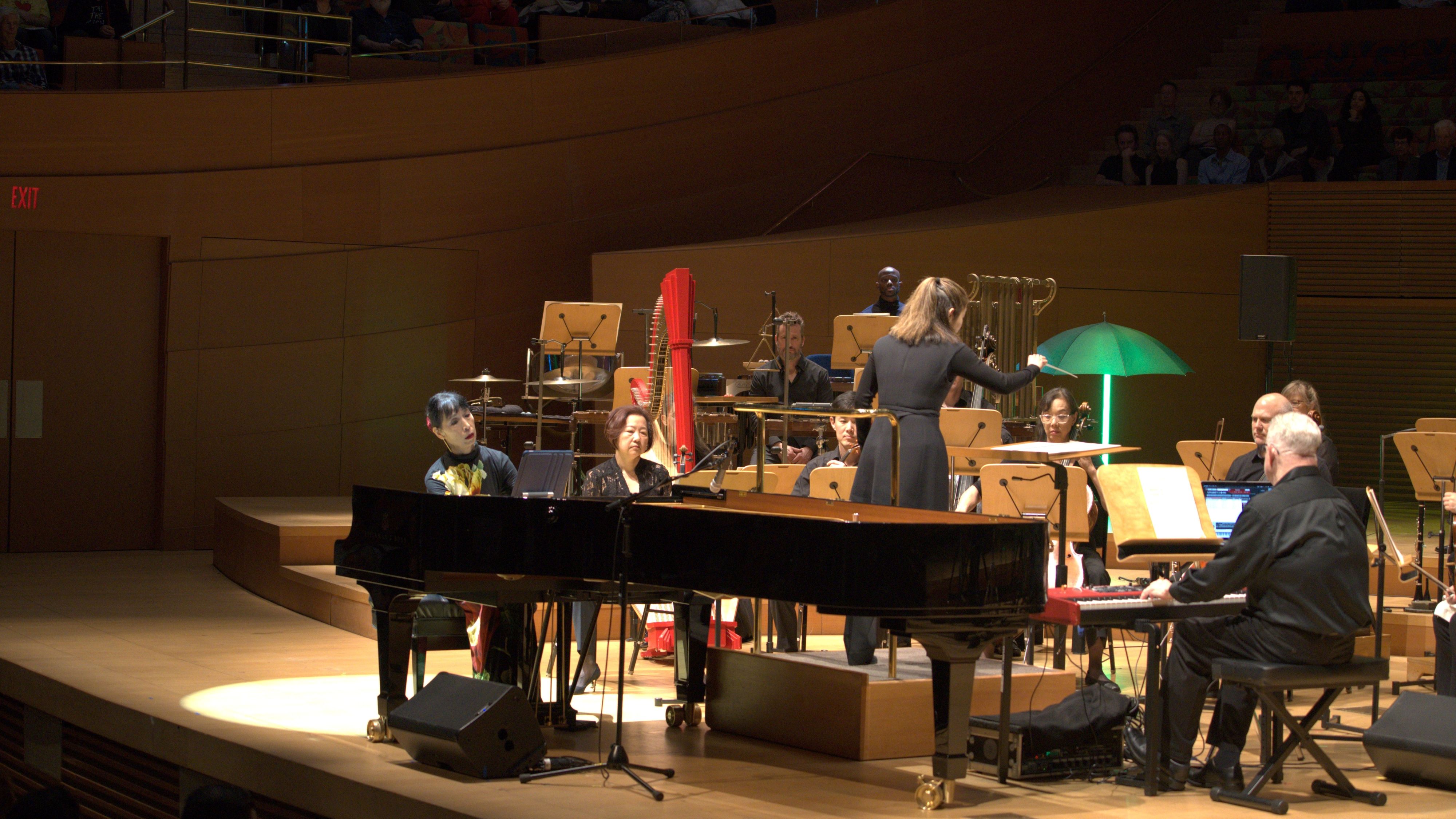
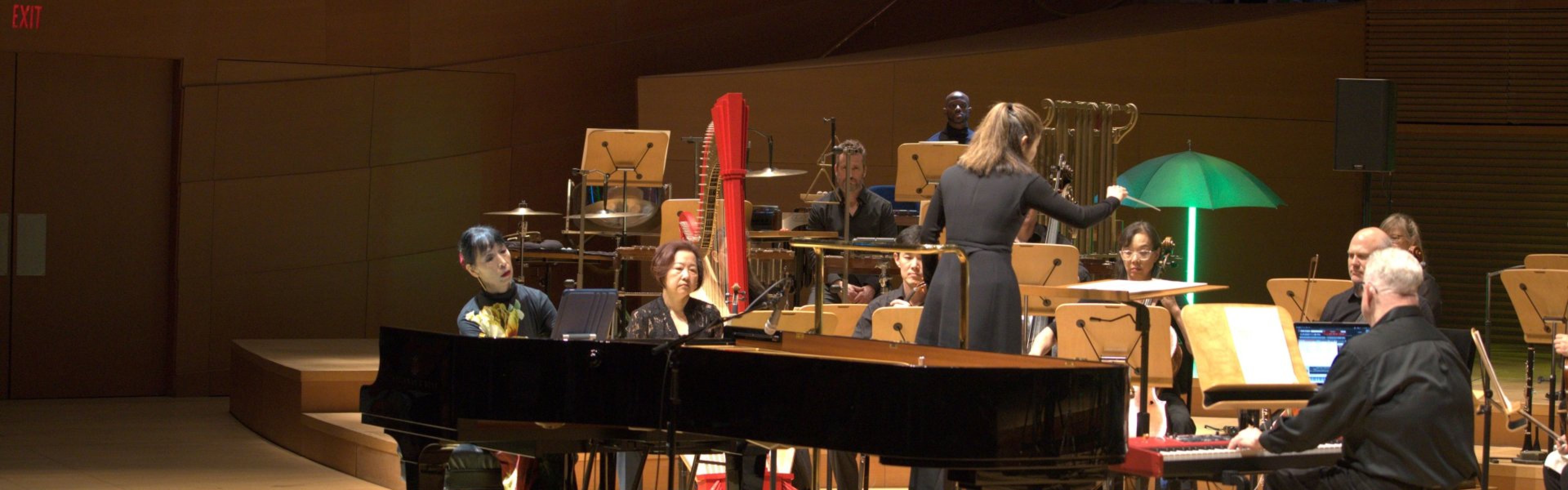
San Francisco-born composer Anthony Cheung’s Respire: Piano Concerto No. 2 was performed by the ever-intrepid new music voyager Gloria Cheng. It started simply but soon became an impressionistic wash with rippling upward scales from the piano. Gradually, things got busier and stranger, with microtones creeping into the texture as the piano somewhat receded from the spotlight and a Nord synthesizer, played by Mark Robson and detuned to as many as eight different scales, filled out the sound. As Cheng’s touch turned ever more exquisite, the overall texture became slipperier, all abstract color.
Eventually, Cheng stopped playing for a bit. Over the audio system, a 1926 recording of the great pianist Alfred Cortot playing Chopin’s sometimes tonally-ambiguous Prelude in A Minor played among the live microtones. It was not so much a ghostly apparition as it was a sound-warping experience. Everything came to an Ivesian cacophony at the close of the finale. All of that in a traditional concerto format and length, suggesting there are still new things to be squeezed out of the old templates