Nomadic by nature and ever-adventurous with its programming, Wild Up set its latest performance amid the galleries of The Broad in downtown Los Angeles.
Described as “A ritual of gathering in community through sound,” the Saturday, Feb. 7 concert featured participatory performances of “Paragraphs 2 and 7” from Cornelius Cardew’s epic composition, The Great Learning.
The performance was staged in conjunction with and to accentuate the museum’s current exhibition, “Robert Therrien: This is a Story.” Therrien is best known for recreating everyday objects on a monumental scale: a platter of white porcelain dishes that teeters like the Leaning Tower of Pisa; a room filled with folding chairs and a table big enough for a family of giants; an assortment of wigs tumbling from the ceiling. In the performance, ensembles meandered around Therrien’s sculptures, producing a series of curious Alice-in0Wonderland encounters.
A contemporary of John Cage and Pauline Oliveros, Cardew’s music relies heavily on chance elements, ensuring that no two performances can ever be alike. Minimal scores lay out parameters: melodic, harmonic, rhythmic, and text-driven. The duration of each section and the interplay of the participants become a free-flowing process as each performer makes choices based on listening and response.
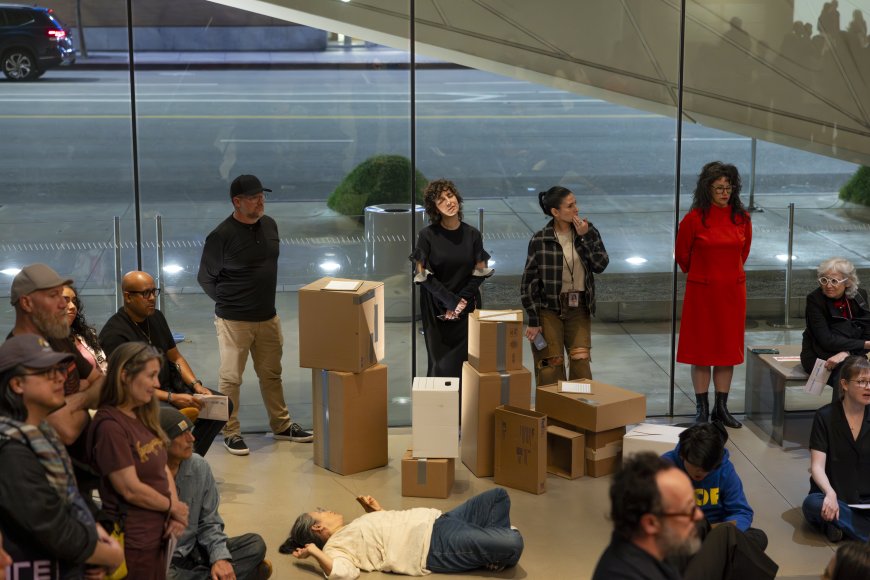
The work’s poetry is drawn from The Great Learning, a Confucian text, as translated by Ezra Pound. Cardew’s goal is to create a melding of professional singer-musicians and (in this case, 30) pre-selected amateur ones to form a harmonious community. Each ensemble includes a Wild Up member to indicate tonal starting points and key moments of emphasis and transition. Christopher Rountree, Wild Up’s artistic director, served as conductor and vocalist in the finale.
The experience of wandering the galleries and listening to the ensembles watched over by Therrien’s mega-objects was decidedly playful, despite the impossibility of deciphering the text as it was sung. “The point where the rest being known, the object of pursuit is then determined,” they sang — a line I only know from consulting the program notes.
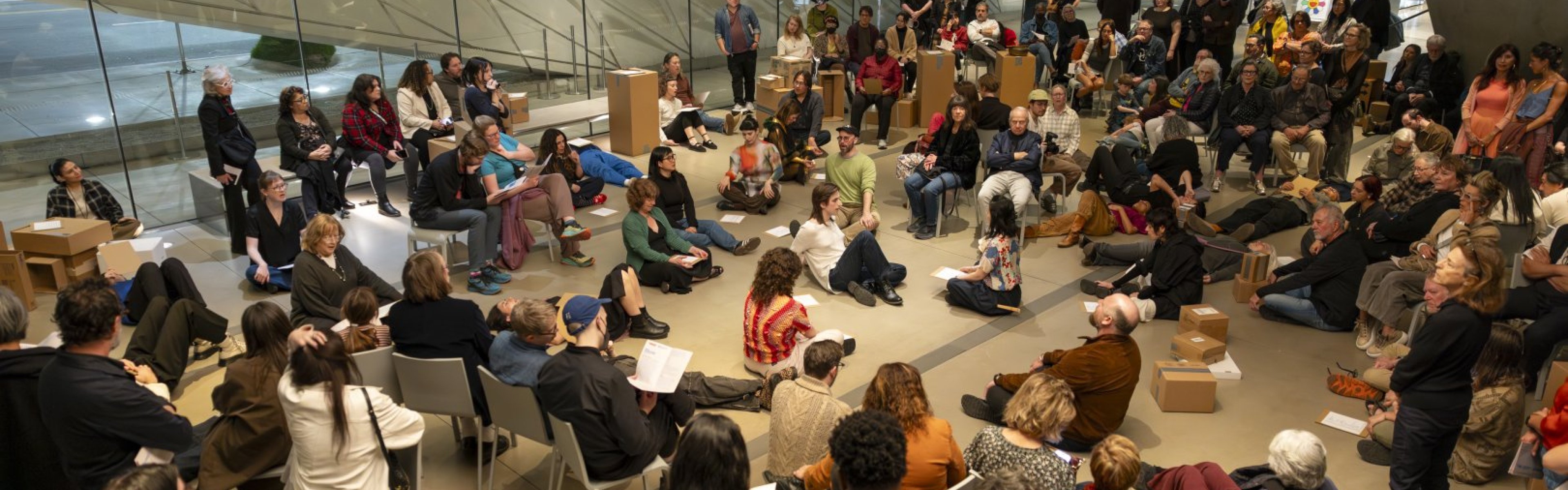
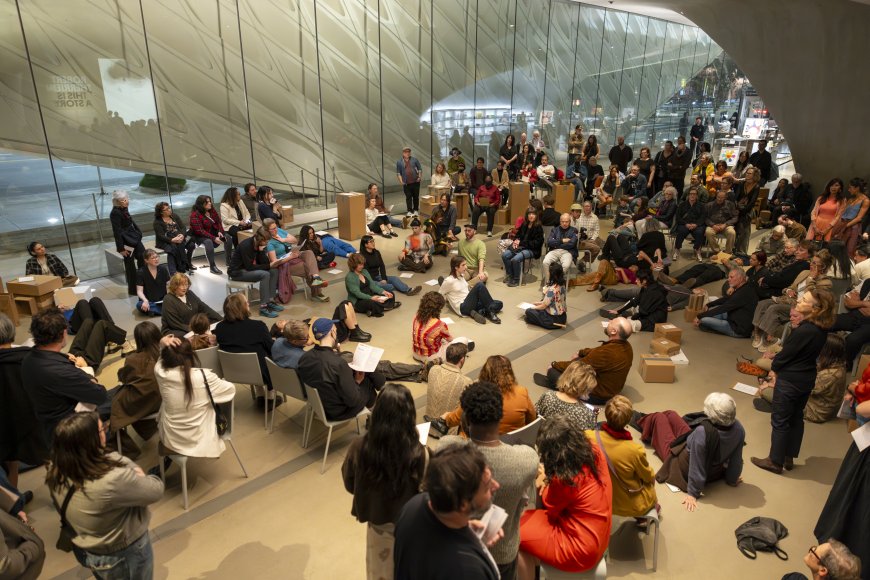
While the Broad’s gallery spaces are traditionally configured, the lobby area’s concrete walls and ceiling bring to mind the softly flowing seashell-like undulations of the Catalan architect Antonio Gaudí. The reverberant characteristics of the space proved ideal for the finale, featuring the full ensemble (and anyone wishing to hum along). “Paragraph 7” combines choral chanting accompanied by a rolling thunder of various sizes of cardboard boxes used as percussion.
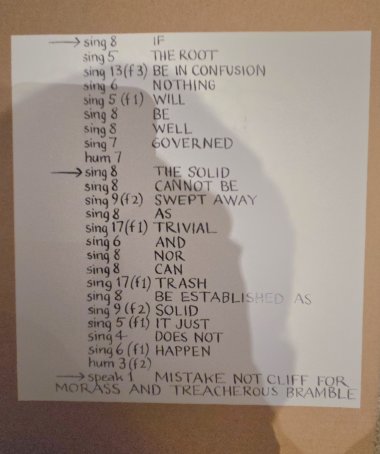
This led to the most complex and sonically enveloping part of the performance, written for “any number of untrained voices.” In the score, each word is followed by a number. For example, “Sing 8. IF.” With a specific pitch shared as a communal starting point, each singer (with no time requirement) is required to repeat the word “IF” 8 times. As this transpires, the once perfect pitch invariably widens, wobbles, and multiplies into microtones, producing wonderfully unpredictable harmonies.
When a singer has completed the specified number of repetitions, they move on to the next word or words. But each singer then has the option to extract any pitch they choose from all the pitches produced by the ensemble.
The result is an ever-swirling, ever-modulating, tonally drifting chant. At times the words are crystal clear, while at other times they become glittering harmonic fractals that hang like ice crystals in the air.
Time lost all meaning. People (as well as performers) lay on the floor. Some words were even specified to be hummed. And when it all came to an end, Rountree recited the final sentence: “Mistake not cliff for morass and treacherous bramble.”
Our bonding experience complete, our little community went its separate ways.