Anyone who approached Joyce DiDonato’s performance of Emily — No Prisoner Be expecting a conventional song cycle recital was quickly and powerfully disabused.
Yes, the typical framework was there. For 75 minutes at Berkeley’s Zellerbach Hall on Saturday, Feb. 7, the celebrated mezzo-soprano sang a program of Emily Dickinson verses, set to music by Kevin Puts. DiDonato stars in this production alongside the genre defying string trio Time for Three (Charles Yang, Nicolas Kendall, and Ranaan Meyer) for this production co-commissioned by Cal Performances.
Yes, DiDonato sang as she always does, with peerless technique, a captivatingly mobile voice, burnished amber tone and seemingly depthless resources of emotional nuance, fervor, fearless line readings, rapture, and interpretive acuity. Every syllable got full attention from her and the audience.
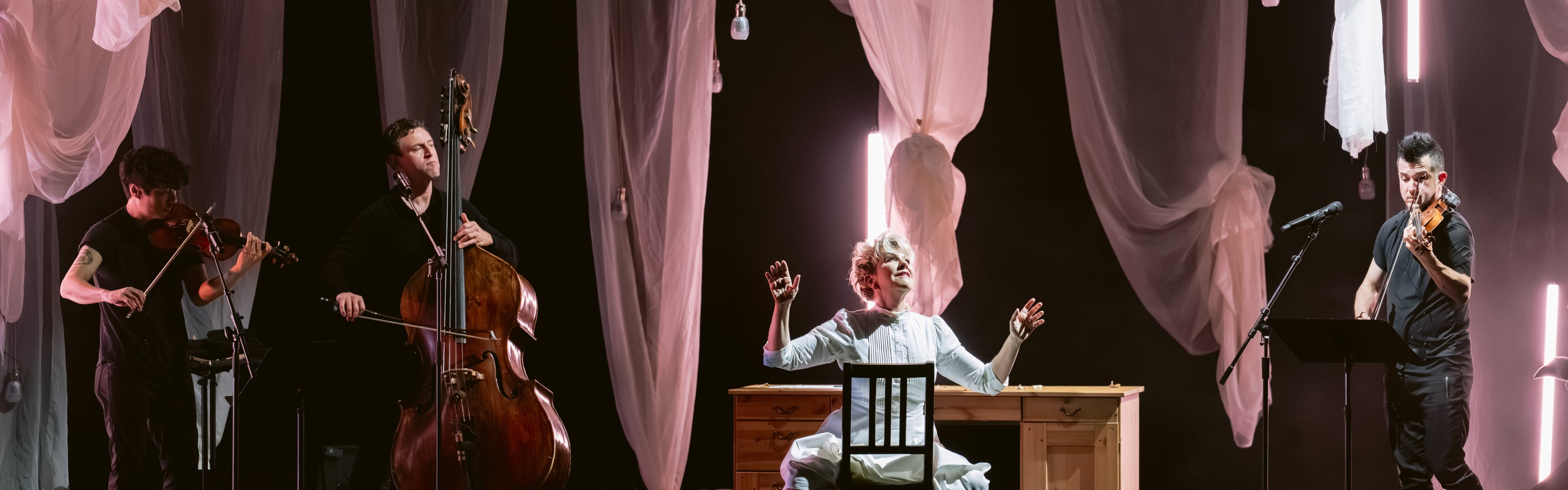
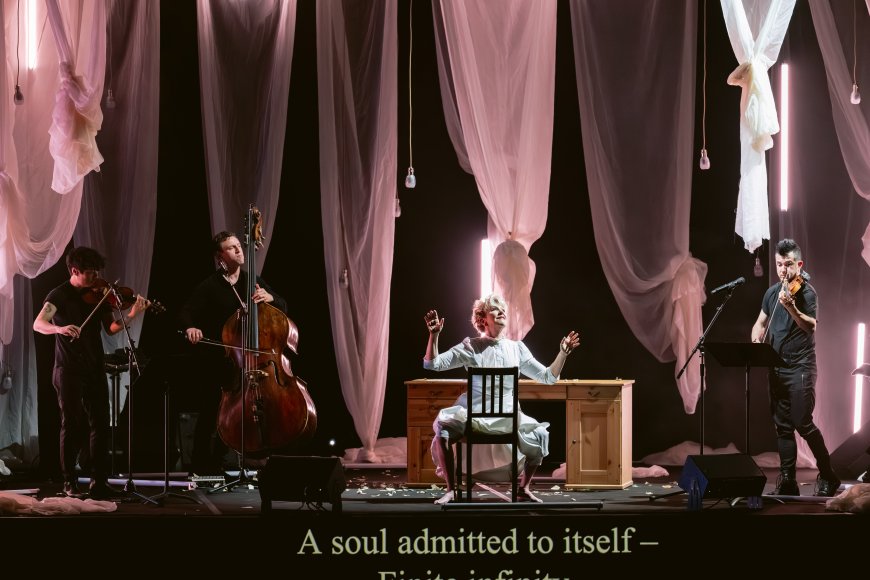
But shining musicianship was only part of what made Emily — No Prisoner Be such a dramatically embodied evening. Wandering an elevated stage hung with swag-style drapes that suggested shawls, shrouds, or even the sprawling fleece of a poetic imagination, DiDonato was a restless presence. Adorned in a virginal white dress, but with no attempt to mimic the reclusive poet’s appearance or presumed modest demeanor, she clambered on and off a desk, set some hanging lights swinging, and sidled up to the three musicians from time to time.
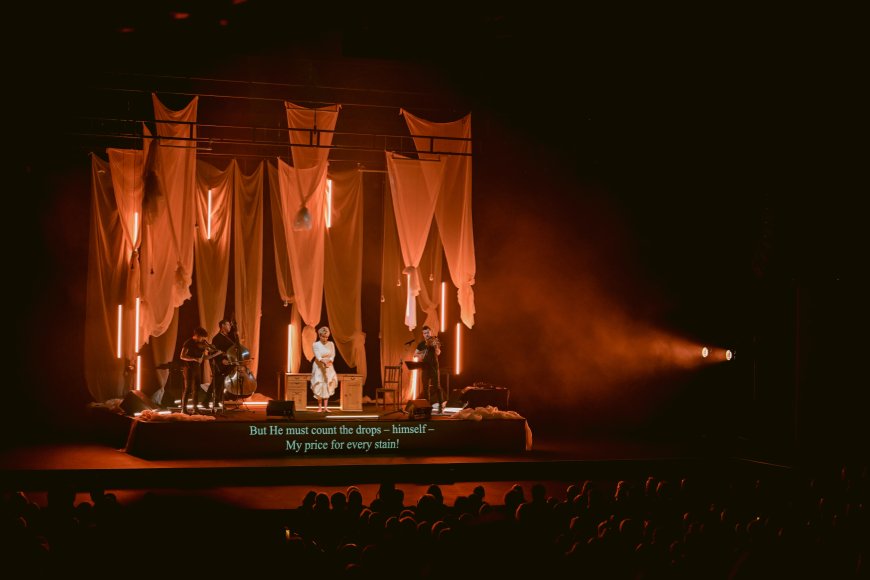
Only once, near the end, did she pick up a piece of paper, as Dickinson would have done to inscribe her largely secret stash of poems. Here, DiDonato operated as a medium through which the great 19th century American poet’s passions and preoccupations manifested — the word became flesh. One of the atmospherically shadowy scenes (lighting design by director Andrew Staples and William Reynolds) suggested a séance. Another, performed in glaring white light, could have been an interrogation.
Musically, the piece has its roots in The Hours, Puts’s 2022 opera based on the Michael Cunningham novel, which was itself inspired by Virginia Woolf’s Mrs. Dalloway. DiDonato played the Woolf character in that Metropolitan Opera premiere.
In Emily, Puts, a Pulitzer Prize-winning composer, has given DiDonato and the trio a stylistically wide range, from soaring operatic arias and Schubertian art songs to fiddle-and-pluck pop tunes and sweetly harmonized lyrics. There were also three whirring “Bee Scherzos” for the furiously bowing trio of Ranaan Meyer, Nicolas Kendall and Charles Yang.
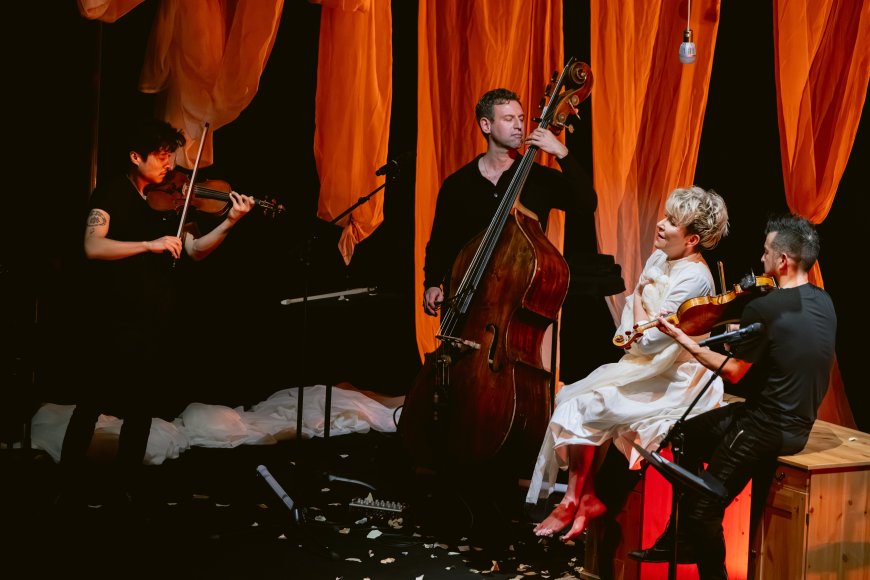
Through it all, her voice tactfully amplified, DiDonato excavated the ardor and paradoxes, the self-reflection and vivid flights of language in Dickinson’s elliptical, sometimes gnomic and singular poetry. Phrases such as “finite infinity,” “I dwell in possibility,” “The props assist the House/Until the House is built,” and “I felt a Funeral in my Brain” have an alluring inherent musicality. It’s no wonder so many composers have been drawn to her work.
Emily was full of darkness, images of confinement and apprehensions of death. “They shut me up in Prose,” went an early, perseverating line. But even the bleakest lines had a luminous intensity and fierce sense of felt life. When DiDonato stretched the word “Hope” out over many measures, the audience was left to complete the famous line in their minds: “Hope is the thing with feathers.”
As she did here with the enthralling 2023 “Eden,” a work about the natural world and the threat of climate change, DiDonato made her belief in art’s power to engage and connect explicit. On Saturday, for Emily, a program insert invited audience members to respond in writing, and ushers collected the cards in the lobby.
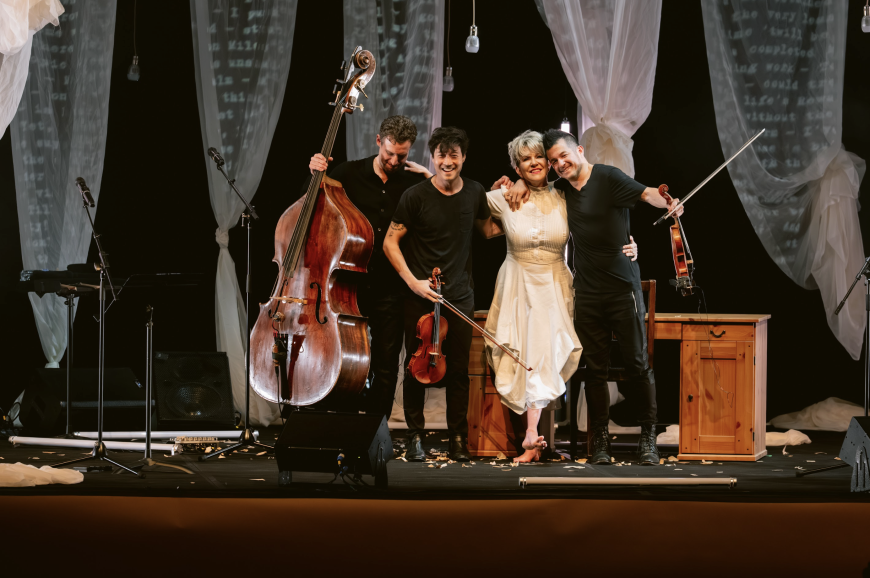
Returning to the stage after several curtain calls, DiDonato and the musicians reprised a line from the last song, “No Prisoner Be,” gradually drawing the audience to sing along.
It was, in this period of deep dismay and division in this country and beyond, a communal reverberation — even the thing with feathers.