In an era of debased and divisive politics, Jon Batiste is putting the pop back into populism.
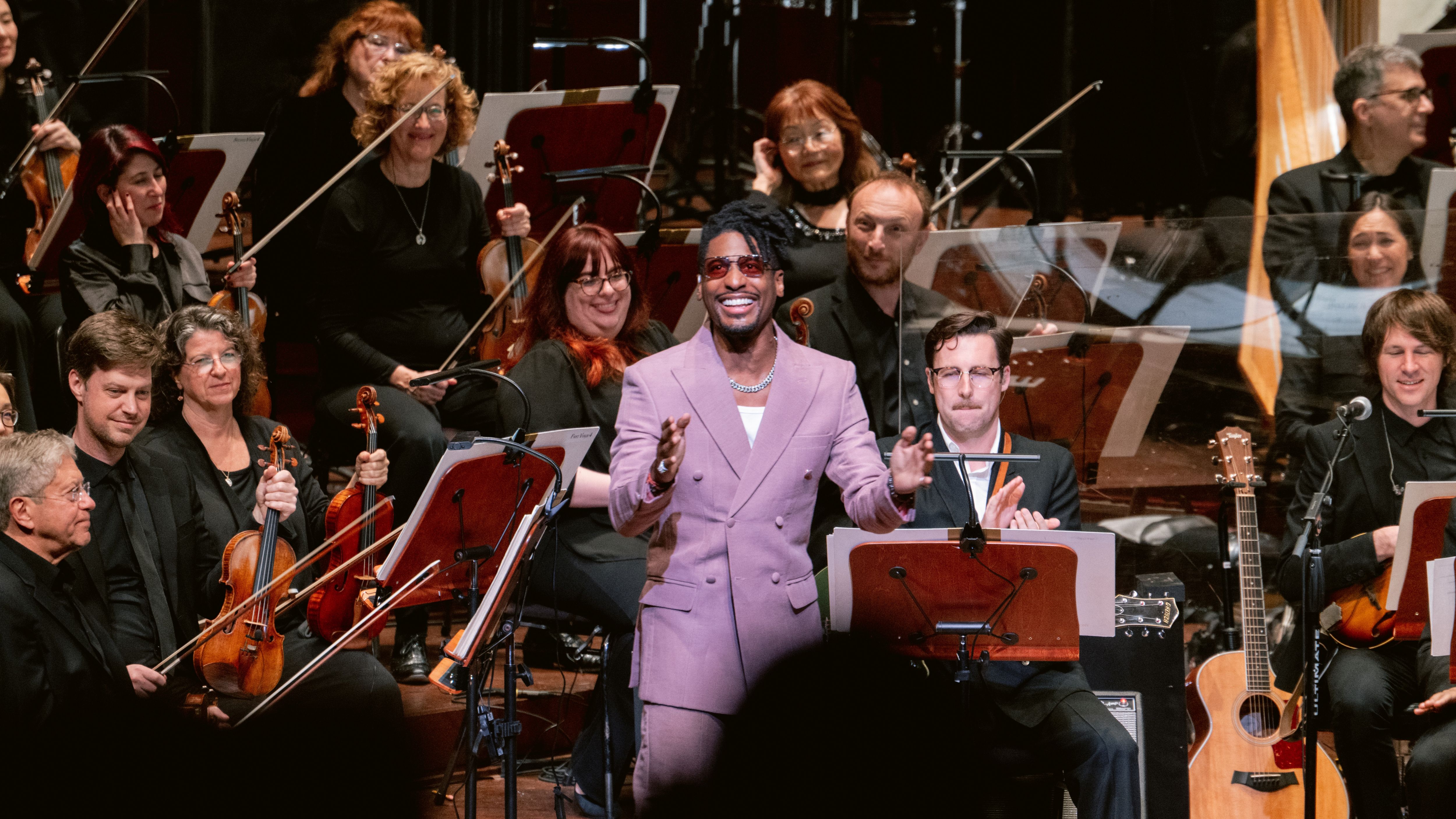
The New Orleans pianist, vocalist, and melodica maestro met the San Francisco Symphony on its home turf at Davies Symphony Hall on Friday, Dec. 12, and while he didn’t utter a single statement about the state of the union, his far-ranging program offered a road map for national reconciliation.
Encompassing blues and Beethoven, soul and Christmas carols, jazz, gospel and standards, the sold-out show was a joyous encounter that embodied Batiste’s vision of music as a unifying force.
“We play all the different types of music for an allegory of how we can all be together,” he told the crowd, turning the program’s subtext into a platform.

Greeted by a standing ovation as he took the stage, the seven-time Grammy winner didn’t have to make an explicit political statement. He opened with a section from his American Symphony that transformed “America the Beautiful” into an ominous film noir soundscape marked by growling brass and skittering strings. As the timpani chimed thrice at the movement’s conclusion, it seemed clear for whom the bell tolled.
Subtlety isn’t Batiste’s forte. Similarly accomplished jazz pianists of his generation pride themselves on interpreting little-known gems by neglected composers and tunes from the forgotten back pages of the American Songbook. But Batiste focuses on popular songs that have never gone out of circulation.
Unafraid of sentimentality or comparisons, he crooned Hoagy Carmichael’s “Georgia” and “What a Wonderful World,” interpreting signature songs by two of the 20th century’s most iconic voices (Ray Charles and Louis Armstrong, respectively). His original songs, like “Freedom,” are often sing-along anthems, and he coaxed the audience to join in the choruses throughout the night.
A solo piano medley started with Scott Joplin’s most familiar rag “The Entertainer,” then nimbly sashayed into “Hark! The Herald Angels Sing.” Sitting out for long stretches with nothing to do but watch, the Symphony musicians had some of the best seats in the house. They eventually came back in on Batiste’s original “Cry,” a song that cries out for background vocalists.
While effectively deployed when integrated into an arrangement, the orchestra, conducted by Jonathan Taylor Rush, was under-utilized. The program didn’t provide an opportunity for even one of them to step out of the ranks and shine.
“We put this show together a few hours ago,” Batiste said in acknowledging the concert’s minimal preparation. “That’s not typical for this format.”
Instead, Batiste leaned on his own sextet, particularly bassist Phil Kuehn and drummer Joe Saylor, longtime members of his Stay Human band. For long stretches, Saylor’s revival-meeting tambourine beat was Batiste’s primary foil.

An unnecessary intermission derailed the concert’s momentum. The second set, however, picked up immediately with Saylor’s tambourine and Batiste on melodica blowing a swinging medley of “God Rest Ye Merry Gentlemen” and “When the Saints Go Marching In,” a song that sets the low water mark in the crowd-pleasing populist canon.
His rapport with the Symphony worked best on Bill Withers’ “Ain’t No Sunshine,” though Batiste landed the piece abruptly when there was plenty of room to soar higher. With the Symphony musicians filing off stage to an ovation, the sextet returned for an encore that suggested different directions the evening could have taken.
As Batiste played “My Favorite Things” on melodica, the audience spontaneously joined in to sing the chorus.
His extended quote of Suzanne Vega’s “Tom’s Diner” was the evening’s most unexpected turn. Less surprising was Batiste joining the brief percussion workout that ended the concert.
After covering so much musical terrain with generosity and panache, he gave the audience a final sure-fire benediction, with more cowbell.