Rarely has indignant defiance sounded so good.
The Julia Keefe Indigenous Big Band brought fierce musicianship and a fascinating repertoire to Zellerbach Playhouse on Mar. 6 that illuminated the experience of Native peoples across the Americas. If the Cal Performances presentation was part history lesson, the music found passionate beauty amidst the deep shadows.
In a post-concert conversation with UC Berkeley English professor Scott Saul, Keefe described the band’s mindset while interpreting Mali Obomsawin’s “Blood Quantum” (which refers to the contested use of genetic ancestry in determining indigeneity) — “indignant defiance” was the term she used.
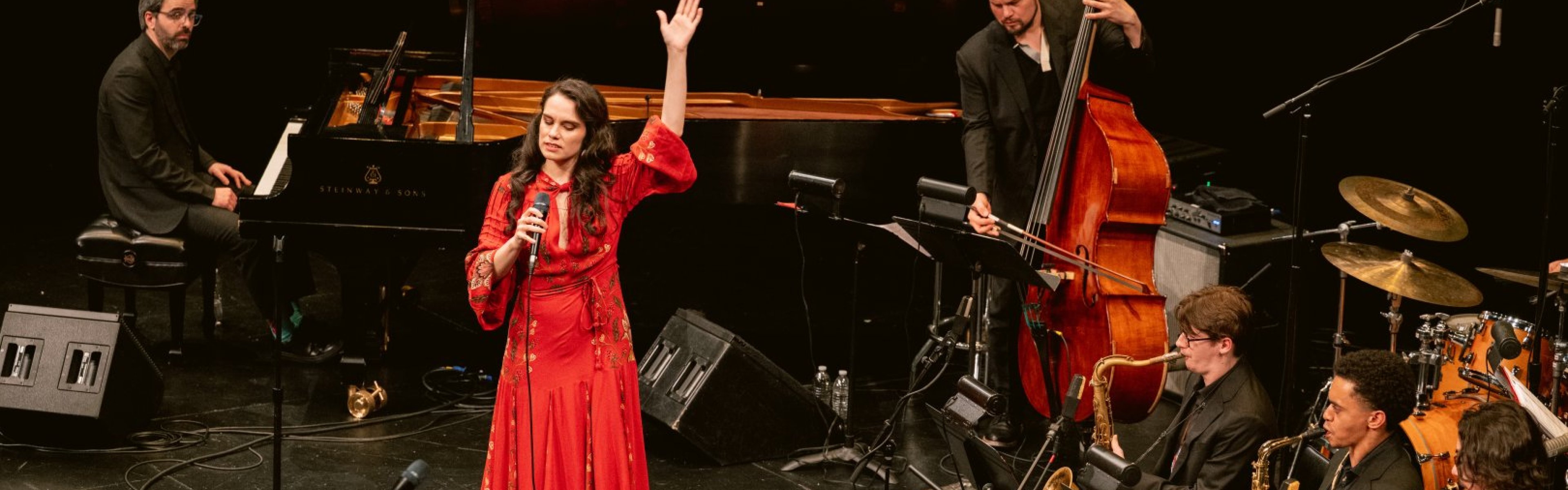
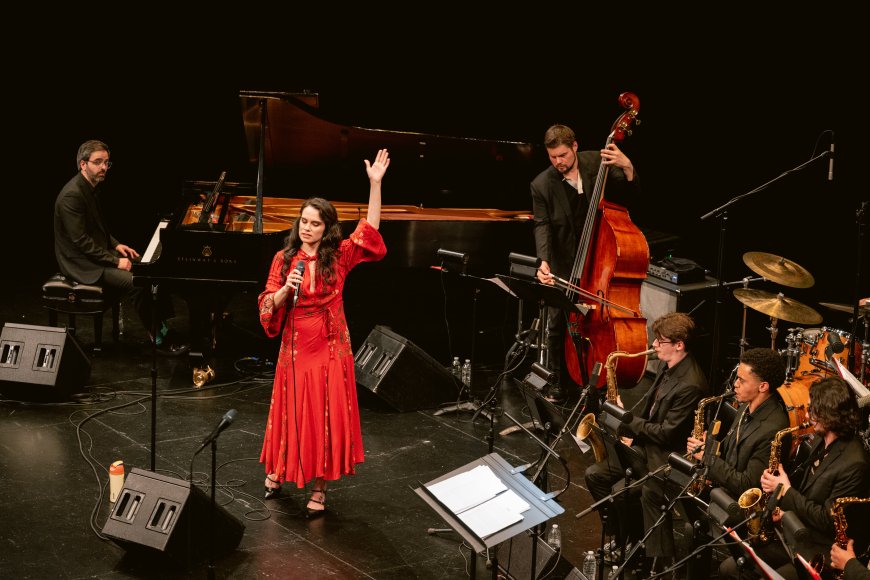
Keefe is a vivacious vocalist who gracefully moves between conducting the band’s instrumental pieces and fronting the orchestra as a singer. With spaces for improvisation, Keefe’s wordless vocal line, and a loose beat defined by bassist Marcos Varela and drummer Ed Littlefield, “Blood Quantum” built to a chant in Penobscot delivered by the entire band.
The piece exemplified the ensemble’s ethos of self-determination. Founded in 2022 by Keefe, a member of the Nez Perce tribe, and Diné trumpeter Delbert Anderson, the 16-piece group brings together jazz musicians from across North America and the Caribbean. The ensemble celebrates its Native American jazz forebears — many of whom played in bands connected to government-run boarding schools — and provides a vehicle for contemporary Native American musicians.

Keefe noted that “Blood Quantum” won’t be featured in the band’s upcoming album, Incarnadine (May 8), but most of the band’s original material will be included.
The concert opened with the solemn, ancestor-summoning processional “Creator.” The tune was composed by Ojibway musician Chuck Copenace and arranged by R. Gillis with a reverent fanfare by Anderson, his tone bright and self-possessed. Keefe duly credited the arranger of each piece on the program, which was more than appropriate. While the band features several standout soloists, including Anderson and tenor saxophonist Adam Lamoureux, the orchestra itself is the primary expressive instrument, effectively shaping each piece with a specific set of goals
Guitarist Jhoely Garay, a friend of the band, contributed a sinuous version of “Water” by saxophonist Jim Pepper (1941–1992), the best-known Native American jazz artist of the modern jazz era. The extended melodic line of Keefe’s original setting for a verse by Chilean poet Pablo Neruda made me want to hear more from her in this direction.

Similarly tantalizing, Anderson’s three-part “DDAT Suite” demonstrated his gift for quick-sketch characterization, establishing a mood and concept with a few notes and a rhythmic motif (it helps when there’s a drummer as resourceful as Littlefield on hand).
For an encore, Keefe delivered Hoagy Carmichael’s “Rockin’ Chair,” a song she’s adopted as her own. Swinging with authority, Keefe is a straight-ahead jazz musician at heart, but her passion for Native American peoples has manifested in an ensemble that creates music equal to its community-mending mission