When the curtain went up at Berkeley’s Zellerbach Hall on Sunday afternoon, Feb. 22, there were only four dancers onstage. With their kinetic, liberating moves, the quartet filled the big space with the high-voltage, full-body engagement of a troupe three times their size.
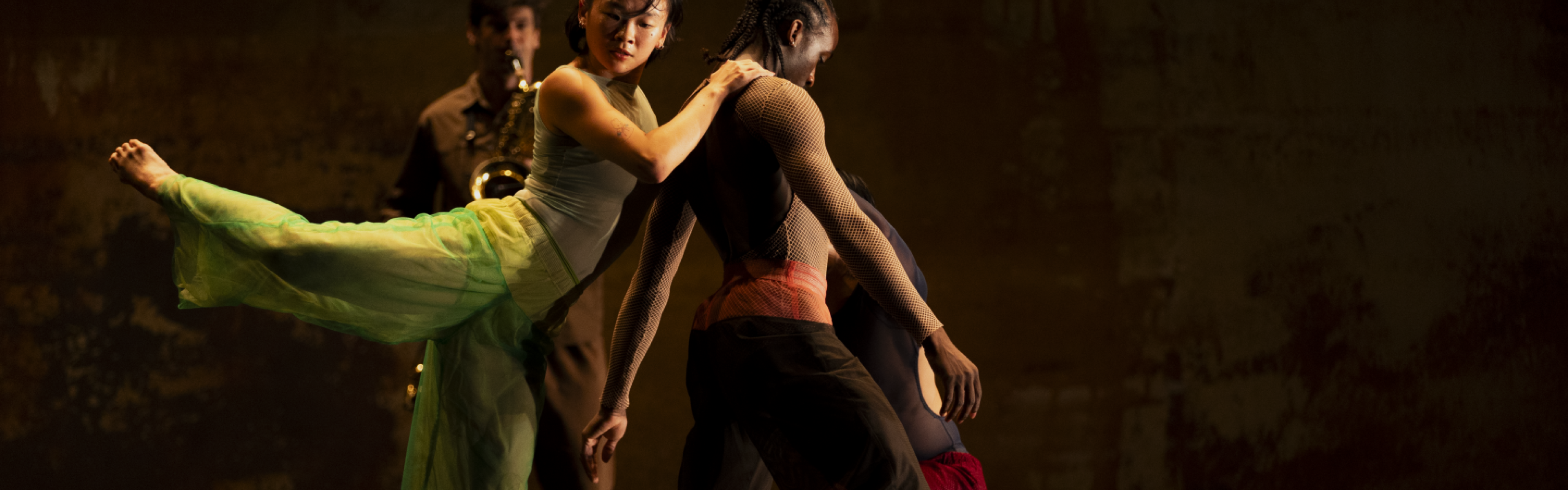
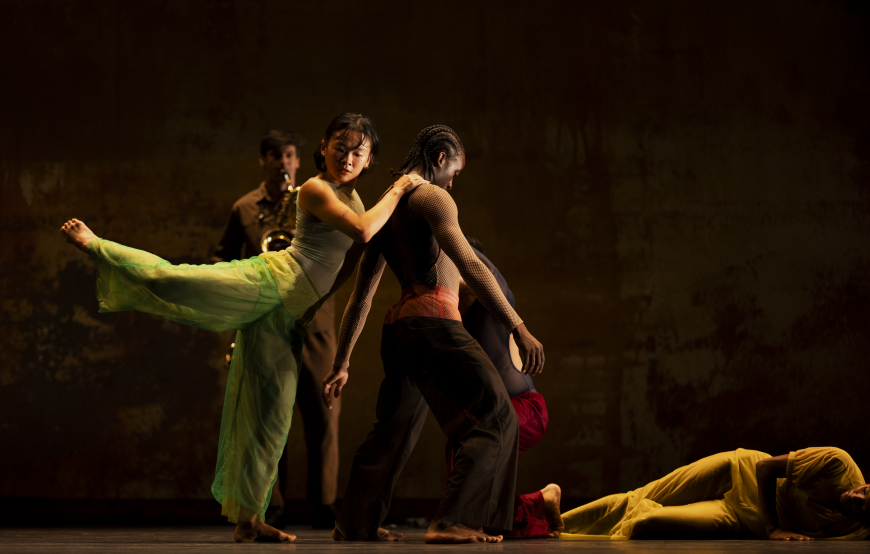
In 2x4 — two pieces by four dancers — the first of three works presented by the 20-year-old company A.I.M by Kyle Abraham in its Cal Performances debut, Mykiah Goree, Alysia Johnson, William Okajima, and Niya Smith used their limbs to carve out great swoops of space. For a while, it was all about extension, arms flung up, one leg stretched out straight and hoisted high. Everything felt bigger than it was, as if the dancers’ bodies had somehow expanded beyond their own height and reach,
With the first of two onstage saxophonists rambling through Shelley Washington’s original jazz score and stomping out the beat from time to time, the dancers vaulted and jogged and strutted about with hands on hips. It had the feel of free-form improvisation. At one point, Okajima sprinted across the stage and slid like a giddy baseball player into home. Guy Dellacave and Thomas Giles were the assertive musicians.
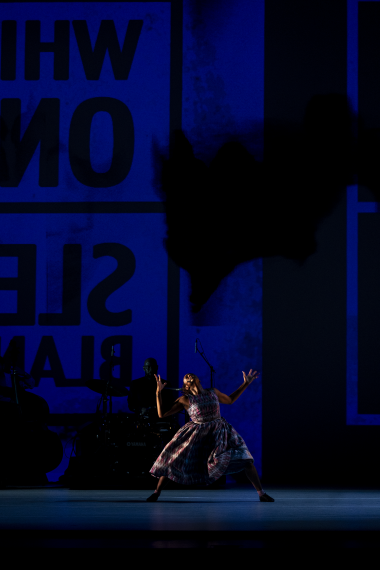
But it wasn’t all fun and games. Artistic Director Kyle Abraham, whose company was originally called “Abraham.In.Motion,” now shortened to “A.I.M,” assembled the dancers into taut parallel formations from time to time, their bodies bent at the waist and hands thrust down in hammer blows. Later on, a lighting cue (lighting design by Dan Scully) converted the dancers into flat silhouettes. In a gorgeous conclusion of tension and control, two of the dancers joined their quivering hands, while the other two spun about them like electrons around a palpitating nucleus.
The sense of freedom and order springs from choreography credited to Abraham in collaboration with the company. That partnership came to full fruition in If We Were a Love Song, the highlight of the program.
Set to music by Nina Simone, sung with caressing warmth and depth by Crystal Monee Hall backed by an instrumental trio, the piece opened with an ensemble of six dancers tightly clustered together stage left. As they slowly unfurled and then retracted their gracefully arched arms, they suggested shorebirds testing out their wings for flight.
And indeed, they did take off, one by one, in a series of transporting solos, each different from the last, all fully realized. Jayden Williams was all sulky, sinuous curves in “Keeper of the Flame.” Suzy Mondesir turned “Little Girl Blue” into an Olympic-caliber floor exercise, both enacting the pull of gravity and defying it with cartwheels and other upside-down maneuvers. Alysia Johnson and Niya Smith turned in a layered female pas de deux in “Don’t Explain.”
A propulsive William Okajima took “Wild Is The Wind” to heart, powering across the stage, arms flung wide or battered into his tight torso, spinning and torquing. It was a stunning display of bravura potency in the service of wind-whipped lightness. Faith Joy Mondesire, all but motionless in a plain gray smock, was the stifled embodiment of the girl in “Images,” who thinks “her brown body has no glory.”
If audiences had kept “Images” in mind through the intermission, the end of Love Song segued into The Gettin’, the Civil Rights protest piece that closed the show. With music from We Insist! — Max Roach’s Freedom Now Suite of 1960, interpreted by Robert Glasper and sung by Charnee Wade, The Gettin’ undermined its intentions with some slack choreography and distracting projected still and moving footage from the ‘60s.
The piece opened with a potent image, as the seven ebullient dancers charged onto the stage in costumes (by Karen Young) of ruffled bright red for the women, and white shirts and black pants for the men. Soon enough, what seemed like a slyly dark riff on a flag-waving red-white-and-blue gave way, in quick offstage changes, to ordinary costumes of the era.
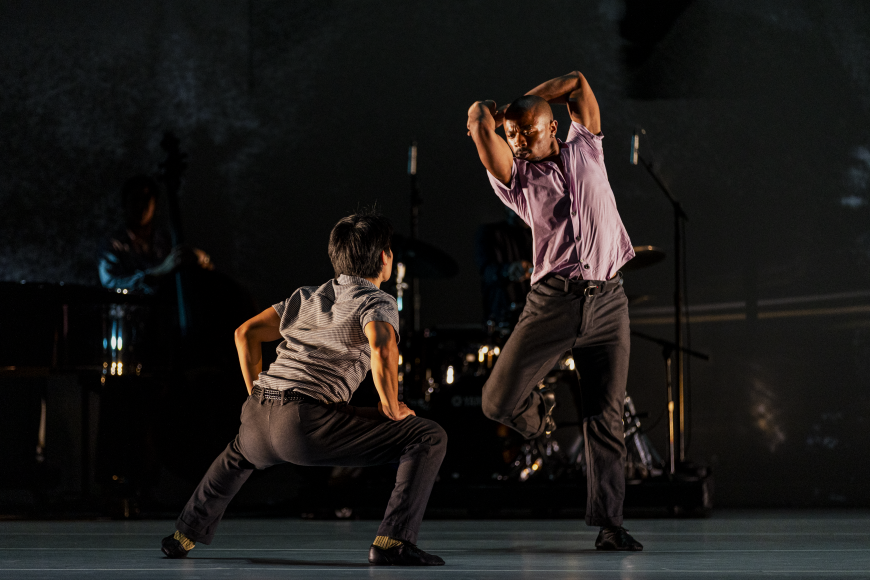
There were face-offs and brawls onstage, exuberance and embraces, moments of promise and pain. But if The Gettin’ (created in 2014) was getting at something more than a cautionary evocation of an era, it had to compete too hard with the disjointed and sometimes perplexing archival mix of faces and bodies on the screen.
If A.I.M by Kyle Abraham was finally more memorable for the individual performers than it was for the sum of its choreographic parts, that was more than enough. The dancers — and oh, what deeply skilled and expressive dancers they are! — looked gratefully overwhelmed by the ovation they got. They’d earned every second of it.