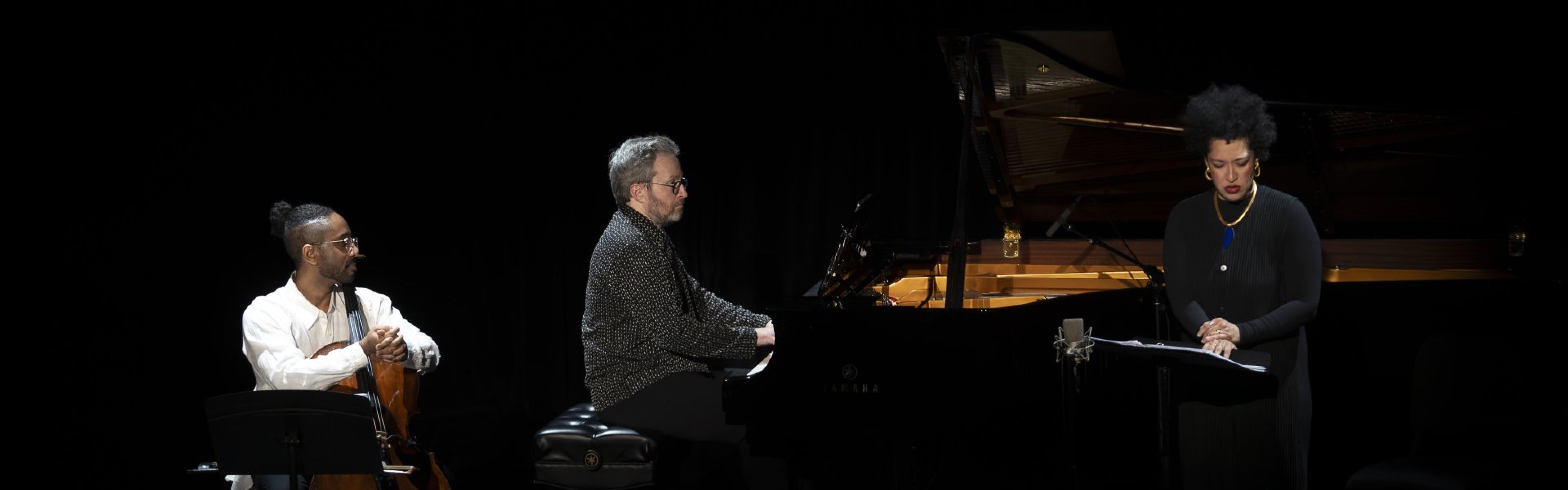
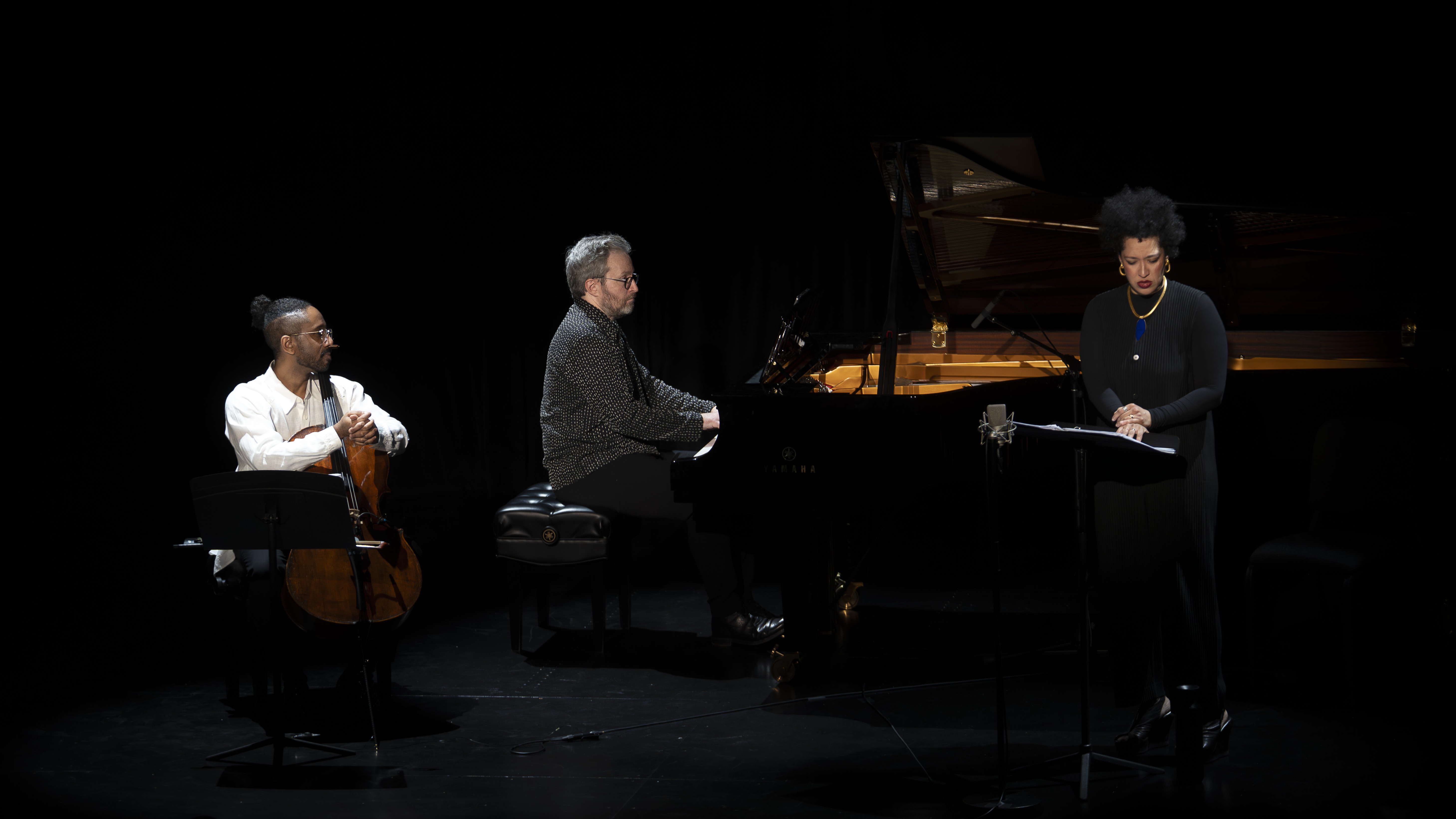
On Jan. 15, soprano Julia Bullock, cellist Seth Parker Woods, and pianist Conor Hanick presented the recital, “From Ordinary Things,” at UCLA’s Nimoy Theater. Their vast technical prowess and deep musical sensibilities were palpable from the first note to the last.
The wide-ranging program moved fluidly among art song, modernism, and the American songbook, opening with Nina Simone’s “Images.” The haunting resonance of Bullock’s a cappella voice segued seamlessly into the trio’s offering of Maurice Ravel’s “Nahandove” from his Chansons madécasses. The deft juxtaposition of these two works rarified the atmosphere, a spell that would remain unbroken throughout the evening.
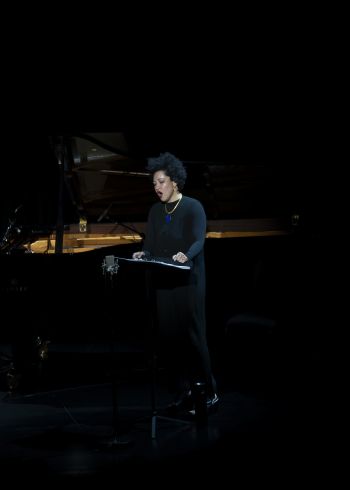
Julia Bullock’s command of vocal technique is indisputable. Her vocal range, intonation, phrasing, and coloristic choices provided exactly what the music required at every turn. She displayed the kind of vocal agility that could cause one to forgive an emotionally tepid performance on its pyrotechnic merits. No such forbearance was needed, however, since she imbued every note with a vulnerability and intimacy that stirred the audience to audible exhalations of approval on more than one occasion.
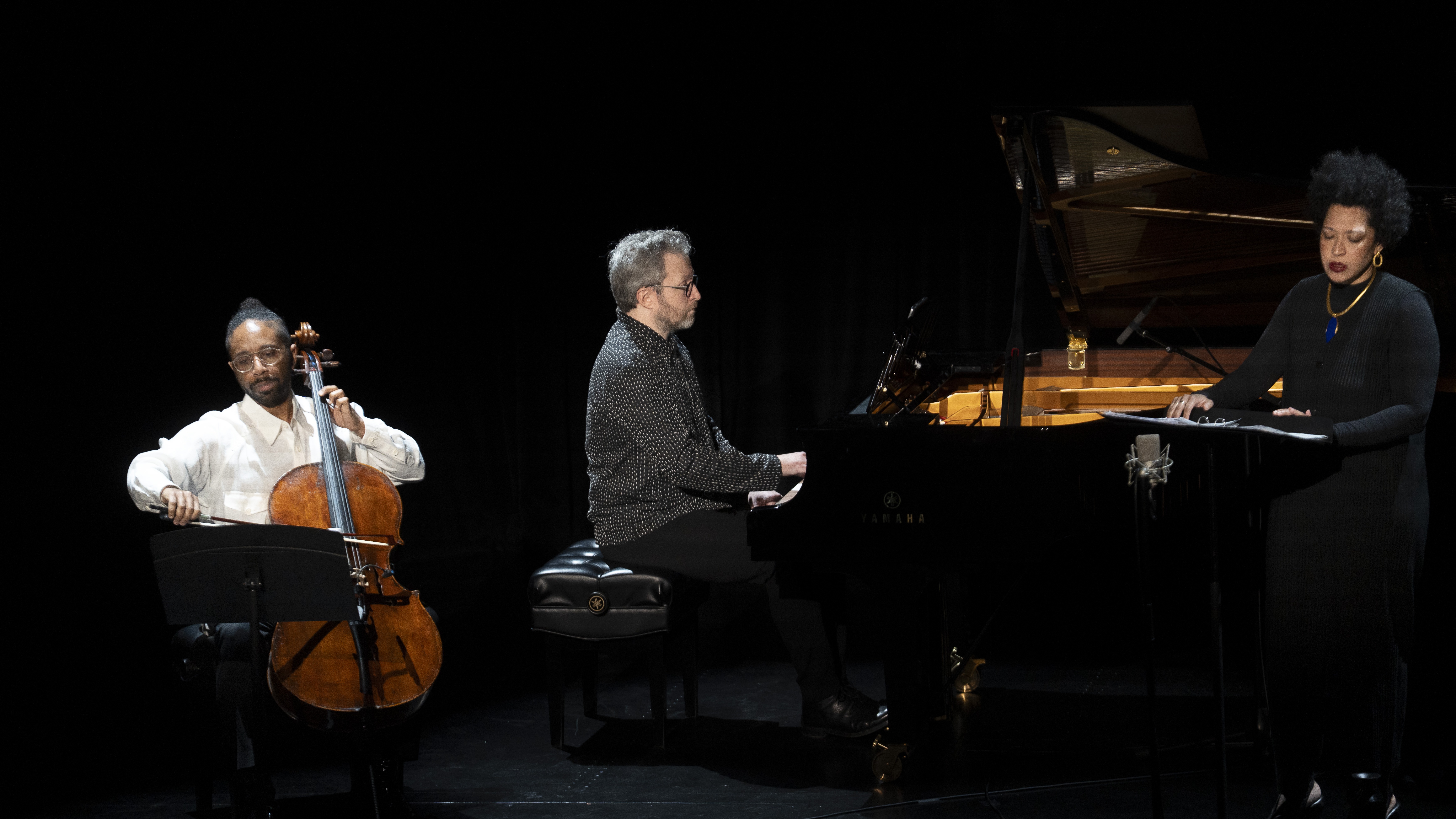
Nowhere was this clearer than in her interpretation of Tania León’s “Oh Yemanja (Mother’s Prayer)” from Scourge of Hyacinths. Bullock delivered the melodies with warm and larger-than-life clarity, projecting even the most subtle nuances straight to the back row of the packed theater.
Similarly, Seth Parker Woods’s command of the cello seemed to know no bounds. The range of colors he conjured from his instrument was astonishing in its variety. At times his sound was lyrical and weightless, at others stentorian and lively. His take on George Walker’s Sonata for Cello and Piano was energetic and propulsive when it needed to be, and also met the work’s tender passages with eloquence. His purity of tone was the perfect counterpoint to Bullock’s voice.
Continuing the trend, Conor Hanick’s piano playing was crystal clear and nothing short of virtuosic. However, he seemed perfectly content to simply lend support to his fellow performers instead of taking the spotlight, accompanying them with generous sensitivity. This is not to say that his performance was not equally dazzling; his touch and sense of meter revealed a musician whose virtuosity was inseparable from his attentiveness to the ensemble. His playing on Nina Simone’s “Four Women” demonstrated a mastery of color and pacing, without sacrificing the swing.
Whether playing the fragile, modernist textures of Salvatore Sciarrino’s “Ultime Rose” or the expressive art-song poetry of Robert Owens’s Drei Lieder, Op. 19, the rapport among the three performers was unmistakable. At times, they seemed to function as a single instrument, the boundaries between their sounds blurred. In other moments, they engaged in the kind of joyful interplay one would expect from musicians who have invested years playing together. The overarching sensation was of music shared among friends: warm and immediate.
After the recital concluded with a moving set of songs from André and Dory Previn, George Gershwin, and Richard Rodgers, the audience responded in kind with generous and appreciative applause. Ultimately, their technical command and responsiveness to one another made for a remarkably cohesive and exciting recital. But for all the technical mastery on display, the evening served as a reminder that music’s deepest power lies in the simple, unforced exchange between performers and listeners — an exchange this trio sustained with grace and warmth.