Opening night of the San Francisco International Piano Festival did what a well-programmed and well-performed concert should: it refreshed and enlarged a listener’s sense of the familiar while making a persuasive case for a composer new to many ears.
While Samuel Barber and Franz Liszt dominated the festival’s program on Friday, Aug. 21, it was a work by the lesser-known contemporary American composer Derek Bermel that captured the intersection of this unlikely pairing.
In six contrasting movements based on a hymn, Bermel’s “Turning” reflected Barber’s confiding intimacy and Liszt’s thundering pyrotechnics. By turns witty and weighty, playful and purposeful, the 1995 work made the character of the other pieces stand out in high relief. It led listeners to hear both contrasts and congruences among the pieces.
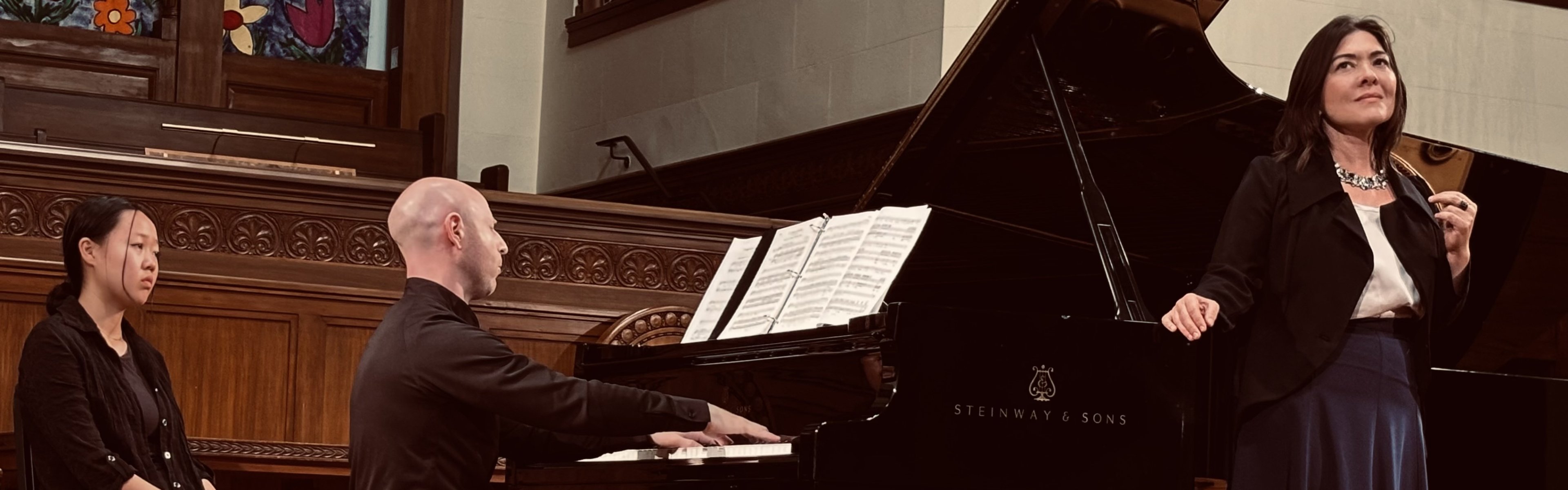
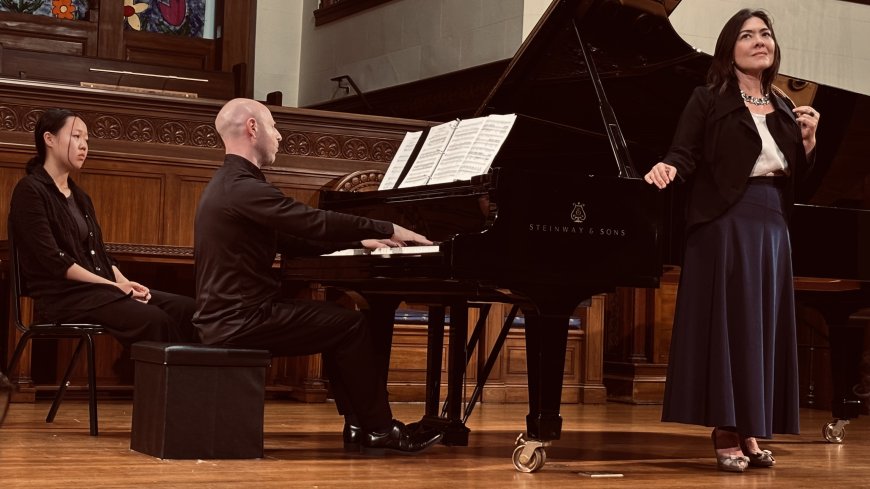
Presented by Old First Concerts at Old First Presbyterian Church, this was a gratifying start to the ninth annual festival, which runs through Aug. 30. The evening featured both solo and four-hand selections as well as the captivating mezzo-soprano Kindra Scharich in two song sets.
Dubbed “Postcards,” this bill of primarily short works opened with festival founder Jeffrey LaDeur and newcomer, Hungarian pianist Éva Polgár, performing side by side at the Steinway for three dances from Barber’s “Souvenirs.”

The first, a waltz, found its way to a tonic meander after an initial harmonic mashup. “Pas de deux” was indeed balletic, with LaDeur executing self-effacing lifts in the lower register as Polgár evoked melancholic arabesques, while “Gallop” did just that, complete with a couple of thumping chords that sounded like thwacks on a horse’s flank.
In three Barber songs, Scharich gave a master class in the art of inhabiting the music, both vocally and dramatically. After infusing the Christian imagery in “St. Ita’s Vision” with a hushed sense of wonder, she portrayed a manic seizure in “Bessy Bobtail.” Clutching her head in her hands, as if to squeeze out the torment, she sang with terse desperation. Polgár’s spare piano accompaniment added an echoing punctuation to the singer’s bleak lines. Flipping her hair back in place, Scharich’s temperament shifted as she rang out the bell tones in James Agee’s lyrics in “Sure on this shining night.”
A pair of Liszt “legends” (“Deux légendes”) devoted to two saints named Francis closed the concert’s first half. Liszt’s tendency to overplay his hand was evident in “La Prédication aux oiseaux,” dutifully filled with feathery trills and flutters by Polgár. Some heavy pedaling aside, LaDeur made a narrative feast of a piece about Francis crossing a dangerous river on his cloak. The heroic chromatic passagework was excellent.
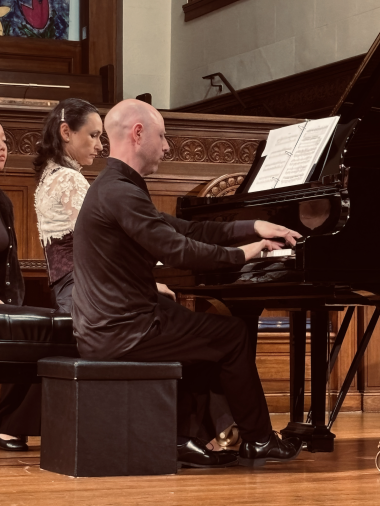
LaDeur returned after intermission to perform Bermel’s “Turning,” which sounded as if “Yes, Jesus Loves Me” got a glorious workout. Sneaking in under the radar in the opening measures, just as the theme was stated, dissonant pings slyly degraded it. LaDeur brought out all of the work’s permutations, from a haunting pentatonic scale and intense Stravinskyian rhythms to a jazz-inflected passage and a 12-tone romp in a section titled “Nightmares and Chickens.”
At one point, LaDeur stood up and leaned under the piano’s lid to pluck a few strings.
The kaleidoscopic range of “Turning” played out in Scharich’s set of Liszt songs, from the poignant Schubertian tint she brought to “Full of joy, and full of sorrow” to the fairy-tale enchantment of “The Three Gypsies” and a chiming sheen in “Bells of Marling.”
The concert ended where it began, with both pianists onstage. Fittingly, in a program that had centered on themes and variations, LaDeur and Polgár jollied their way through Liszt’s riff on a familiar rite-of-passage tune. “Gaudeamus igitur (Humoresque)” made an ideal sendoff.