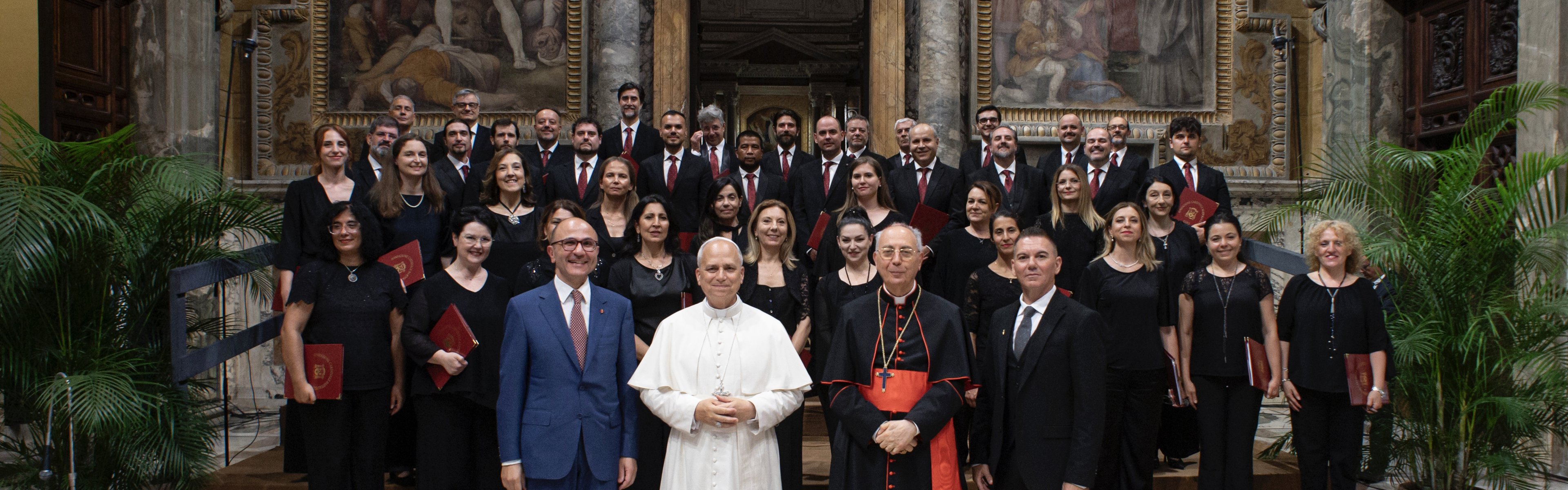
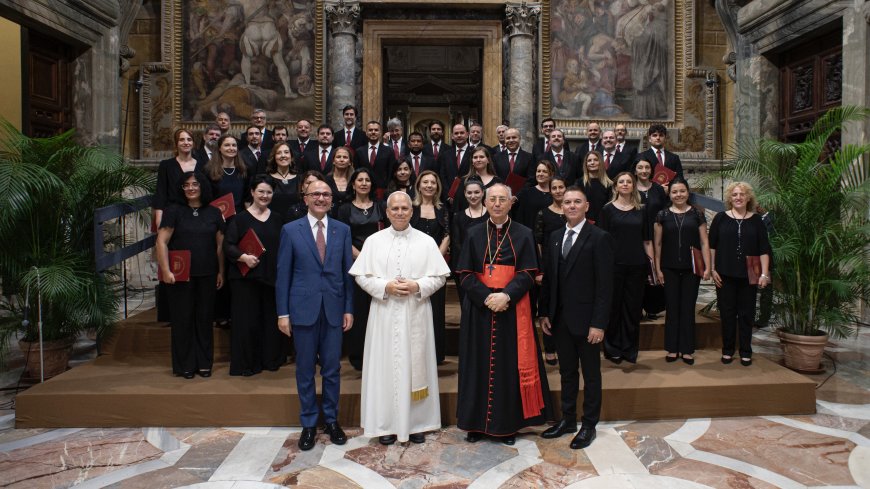
Last weekend, the Bay Area was graced with a rare visit from the Sacred Voices Choir of the Cardinal Domenico Bartolucci Foundation. The Foundation exists to preserve Bartolucci’s legacy as former choirmaster of the Sistine Chapel Choir and a prolific composer.
Created in 2004, the choir performs in services throughout the Vatican, principally at the Roman Shrine of San Salvatore in Lauro. On the heels of last year’s successful U.S. tour, the Sacred Voices Choir has returned stateside for a tour of California, with their San Francisco performance taking place on Aug. 25 at the Cathedral of St. Mary of the Assumption.
In accordance with the choir’s mission of preserving and promoting the works of the Sistine Chapel composers, the program consisted predominantly of works by Giovanni Palestrina (2026 is the 500th anniversary of his birth) and Bartolucci.
Now, the Romans do Renaissance polyphony their own way — anyone expecting crystalline straight tone and voices moving almost like synthesizers would be surprised. The singers opened with a powerful rendition of “Exaltabo te” by Palestrina, their rich, full-voiced, operatic sound offering a rousing, fresh take on this repertoire which so often is reduced to dry, pedantry. Dynamically, the choir was able to make a diminuendo on a dime, and the sections were well blended despite the heavy use of vibrato. With more male singers than female, they had an unusually strong, bottom-heavy sound.
Bartolucci’s “Quo abiit” takes its serenely romantic text from the Song of Songs: “Where has your beloved gone/most beautiful of women? This was the first work of the night showcasing one of the choir’s phenomenal soloists, with male soprano Gianluca Alonzi taking the stage. Alonzi’s voice was warm and strong, holding its own over the 40-person choir with soaring lines. It was delightfully surreal to see the legacy of Alessandro Moreschi (1858–1922), the last castrato and former Sistine Chapel chorister, preserved by one of his spiritual successors.
Another selection of Bartolucci’s, “Domine, Tu mihi lavas pedes” saw tenor Francescantonio Bille and bass David Maria Gentile sing an arresting dialogue between Christ and Simon Peter, depicting Christ’s fateful washing of Peter’s feet prior to his crucifixion. Bartolucci’s influence from the verismo composers was clear from both the choir’s vocal direction and his own dramatically charged compositions.
The first half closed with a joyous anthem, Cantate Domino by Valentino Miserachs Grau. Taking advantage of the homophonic texture, the singers’ true vocal power revealed itself as they forcefully cut through organist Davide Bucci’s powerful accompaniment.
That was swiftly followed by Davide playing Max Reger’s equally bombastic Te Deum. The work was economical, yet intensely dramatic —a fugue that reduced to a single pedal tone, then built back up through a second series of entrances toward an ecstatic, ear-splitting climax. Soprano Maria Tomassi then unexpectedly sang the Ave Maria from Pietro Mascagni’s opera Cavalleria Rusticana. Given the operatic flair of Bartolucci’s own compositions, this felt like a natural progression. Hearing such a quality soprano voice in such a fabulous acoustic was a delight, Tomassi’s classic Italian lyric sound bringing to mind greats like Renata Scotto. The choir finished with two more Bartolucci anthems plus another Bartolucci encore, bringing the concert to a strong, exultant finish.
Centuries of Vatican tradition need not be at odds with popular genres like opera — certainly, the Vatican’s own musicians see no such contradiction. This choir sang Palestrina with an intensity the felt modern, immediate, even raw. Their members are prodigious soloists in their own right, and Bartolucci’s love of opera allowed him to create uniquely stunning musical dramatizations of scripture. May we see this choir return to our shores much more often