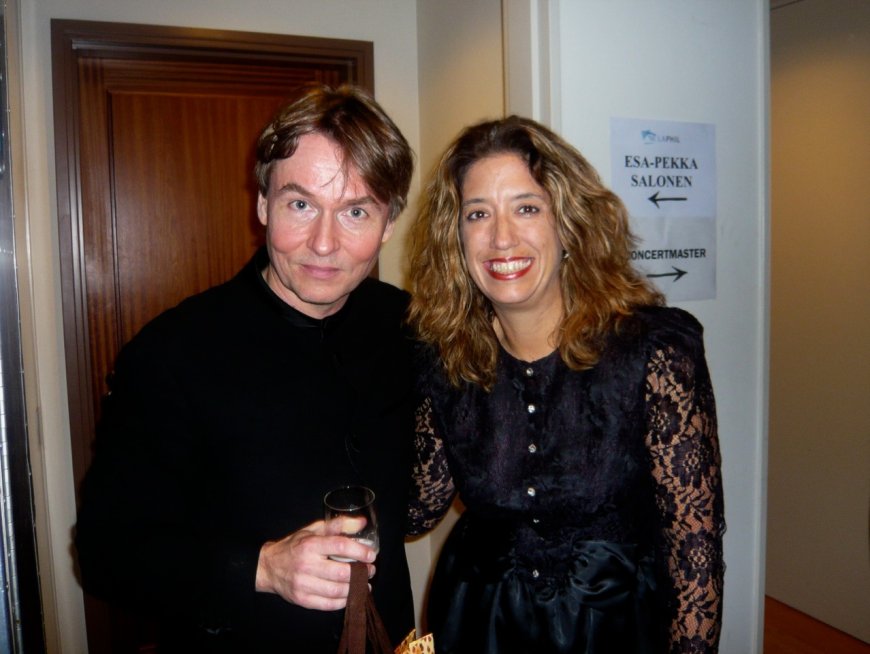
There was never much doubt as to whether Joanne Pearce Martin would become a musician.
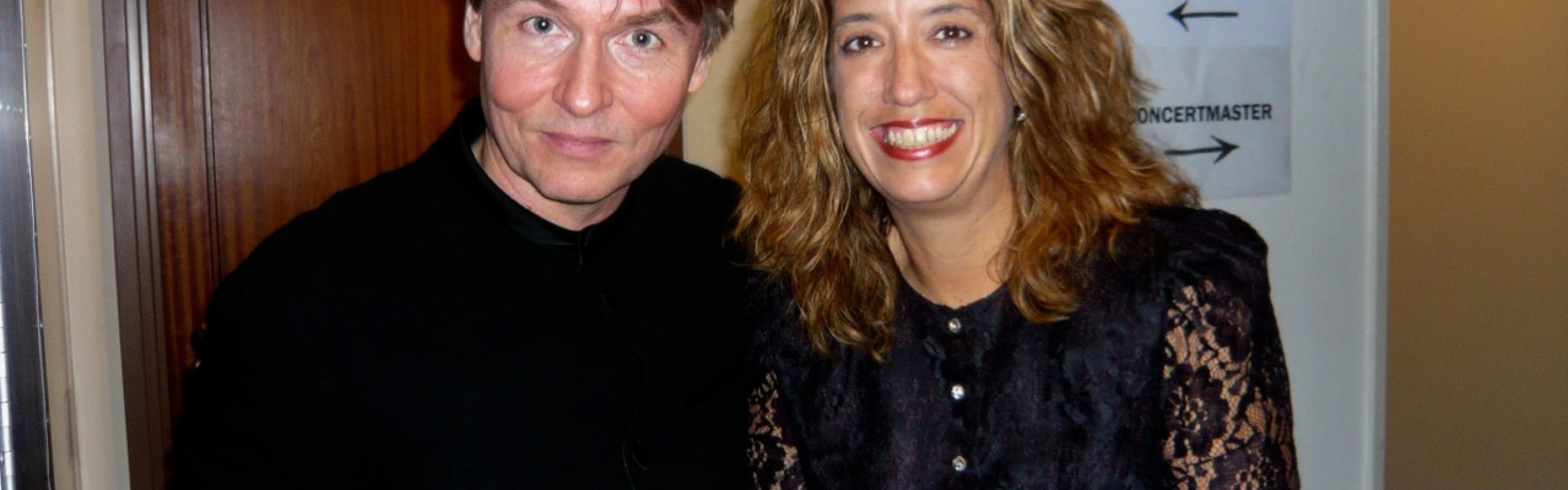
The keyboardist grew up in Allentown, PA, in a household with both a piano and an organ — her father was vice president of Allen Organ. After graduating from Philadelphia’s Curtis Institute, she was appointed to the Los Angeles Philharmonic by Esa-Pekka Salonen in 2001.
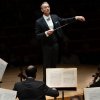
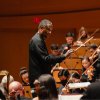
She has been featured with the LA Phil on multiple occasions at the Hollywood Bowl and Walt Disney Concert Hall. Notably, she was the piano soloist in a sold-out performance of Messiaen’s epic 100-minute work, “Des canyons aux étoiles,” at London’s Barbican Centre with the Phil and Gustavo Dudamel in 2016.
In addition, Pearce Martin has performed at dozens of festivals spanning four continents and guested with numerous orchestras in the U.S. and abroad, including The Philadelphia Orchestra and England’s Huddersfield Philharmonic.
Today, she juggles a career as soloist, chamber musician, and recording artist, and is still as passionate about the instrument, repertory, and job as ever. Up next, she can be heard on Jan. 17 when the Symphonies for Youth, under conductor Aleksandra Melaniuk, performs a mixed bag program, including the last movement of Saint Saëns' Symphony No. 3, "Organ."
Since the 1990s, she and her husband, Gavin Martin, have given concerts as a two-piano team. She has also collaborated with such artists as violinist Joshua Bell, cellist Steven Isserlis, and acclaimed keyboardist Jeffrey Kahane.
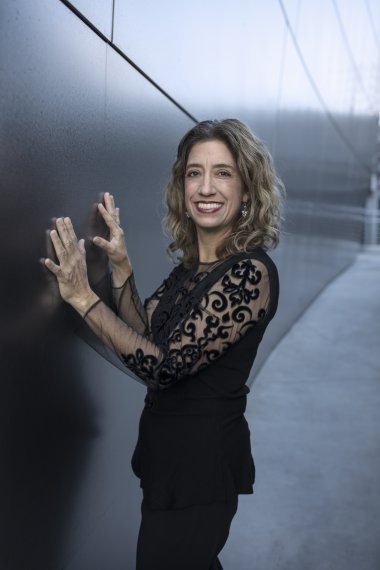
No stranger to contemporary music, Pearce Martin, along with Kahane, gave the world premiere of Andrew Norman’s “Frank’s House” (a 2015 work dedicated to the late architect Frank Gehry and his wife, Berta), as well as the West Coast premiere of John Adams’s “Roll Over Beethoven.” She also worked with composer John Williams on Steven Spielberg’s film The Fabelmans. For anyone attending the Phil’s trailblazing Green Umbrella series, Pearce Martin is a familiar figure.
SF Classical Voice recently caught up with Pearce Martin. The conversation ranged from her interest in new music and working with Salonen and Gustavo Dudamel, to her love of, well, aeronautics.
You’ve been with the LA Phil since 2001. How did joining the orchestra help shape your artistic identity?
As you know, these jobs are few and far between. Growing up as a kid as a solo pianist, we spend a lot of time alone practicing scales, arpeggios, and Chopin etudes — all the things that are supposed to make us better and technically proficient. Hopefully, we have the right guidance from teachers and coaches to develop us as a musician, as well. But I realize the more I opened myself up to all different types of music, the more it prepared me unknowingly.
For this job with the LA Phil, it helped add and really cement the kind of skills that are needed to play in a large ensemble, which you don’t learn as a young pianist alone in your room, and you don’t even learn playing chamber music. There are no shortcuts to learning in that department except by doing. Luckily, I kept my mind and ears open during my lifetime before the Phil, so kind of unknowingly, it prepared me in certain aspects for the job.
What do you find most rewarding about working with Gustavo Dudamel and Esa-Pekka Salonen, who is returning to the Phil as its newly established Creative Director?
These are two greats, and it’s rewarding to work with both of them. They have, obviously, very different styles, which we know from watching them. But it’s tough to say. Esa-Pekka is a composer, [and] he would be first to say, “Composer first, conductor later.” He’s a fantastic presence on the podium, and I absolutely love when the orchestra plays his music. We never really stopped [playing his music] when he left, and we look forward to a lot more of that.
Gustavo, when he arrived on our scene, was such a young, vibrant dynamo. I remember thinking, “who in the world is this guy?” We all heard Esa-Pekka’s comment when he first saw Gustavo conduct. He said something like, “this guy is some kind of conducting animal.” That’s just such a wonderful phrase. Gustavo, what he can do with one eyebrow, without even a hand, is something innate for him. You can’t put into words what it feels like on our receiving end.
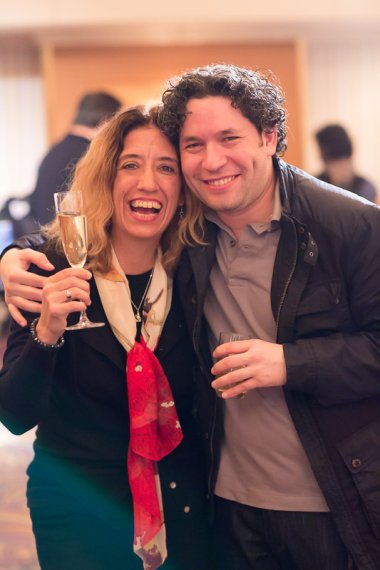
Each of them has their own unique style, and they are both so great at communicating exactly what they want, just in very different ways.
What is the draw of new music for you?
Wow, so many things. One is working with living composers; it’s wonderful. My favorite thing is to commission a work and know each other on a personal level. When a composer asks you what kind of music do you enjoy playing [or] listening to, I love that, because sometimes it informs their process. And even if it doesn’t, hopefully, it’s in the back of their head somewhere.
I love playing new music for the composers, hearing their firsthand impressions, and keeping myself open to not take any of it as criticism, but just another wonderful piece of the creative process. I love kind of bending myself to try to contribute to that whole process and give the composer what they’re looking for.
Which brings me to the theremin (a contactless musical instrument invented in the early-20th century) and Gernot Wolfgang’s work, “Theremin’s Journey,” a 16-minute piece you premiered at Zipper Hall in 2010. What was that like?
Under Esa-Pekka, we were playing all Russian 20th century music for a couple of weeks. A gentleman came in, Charles Lester, who plays a lot in the studios in Los Angeles, [including] commercial work on the theremin. It was the first time I had seen a theremin up close. Of course, I knew what it was, but I had never been exposed to one before, and [since] I like unusual instruments, I was instantly drawn to this.
Charles was great. He said, “do you want to try it?” That’s the worst thing to ask me with a new kind of instrument, because I get hooked on the strangest things, so I was immediately hooked. I went home and told my husband [that] I wanted to learn. Gavin started shopping around, and without me knowing, he got me a really nice instrument.
I already knew Gernot Wolfgang and had played some of his compositions. Wolfgang has a jazz background, and I love the jazz sensibilities in his music. I had this crazy idea to commission and play a work. During the piece I’d be able to walk across the stage a few feet and play a theremin, because it can’t have anything interfering in the field that surrounds it. So, Gernot wrote an electronica track to bridge those gaps, and I loved all of his ideas so much. He made this wonderful piece for me, “Theremin’s Journey,” which I also recorded.
Speaking of recordings, what was it like laying down tracks for John Williams’s score for Spielberg’s 2022 film, The Fabelmans?
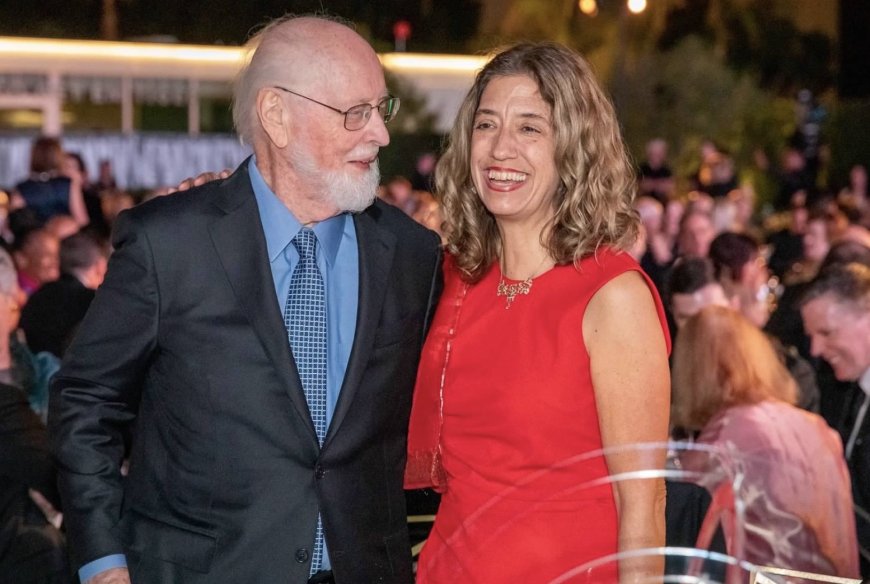
That was so special. It was during the COVID lockdown, and John told me that Steven was making this semi-autobiographical film. I knew a little about Steven’s mother, Leah Adler — that she played the piano quite well. I spoke to John at length, and all I knew was that it was going to feature a lot of piano playing, and a lot of the works that Steven grew up hearing his mother play — early classical works, [Friedrich] Kuhlau, [Muzio] Clementi, later Haydn. There’s some Beethoven in the movie, also Bach, the Marcello transcription of the Oboe Concerto.
I received a list of these pieces and was able to listen to some audio of Leah’s actual playing, which was incredibly spirited and just fantastic. You could feel the high energy and joy coming out of her. It really resonated with me, [since] it’s how I like to play and approach music. John said, “don’t try to imitate her. Just be yourself.” That was really neat to hear.
I understand that after the recording session, the engineer, Sean Murphy, asked Spielberg if he wanted to hear what you’d recorded, or hear you play something live?
Steven took my hand, we went out there, and he stood next to the piano. I started playing all the things that his mother played when he was young and [had] heard his whole life. I imagine it was very emotional for him. It felt very, very special to be able to do that. A lot of people who have worked with him have this story — that they’ll play for Steven, and then you realize he’s pulled out his phone and starts to film you.
You’re playing and your mind is concentrating on the music, but the other half of your brain is going, “Oh my God, Steven Spielberg is filming this with his iPhone.” I’ll never forget that. I’ve worked with John many times, but never Steven, and they were both wonderful to work with.
What do you think people would find most surprising about you?
I guess people who don’t know me might be surprised by my love of the aviation world. My dad, who’s still with us at 102, [is] incredible. He flew airplanes into his 90s, and my brother and I were flying in little airplanes with him from infancy, so it’s something that I got to really love early on.
My father was never a skydiver, but I’m an active person [with] over 500 jumps. At one point, my husband and I both did skydiving, but now we’re flying little airplanes more. That perspective of seeing the world from above, I think people would be surprised to know that’s how I relax.