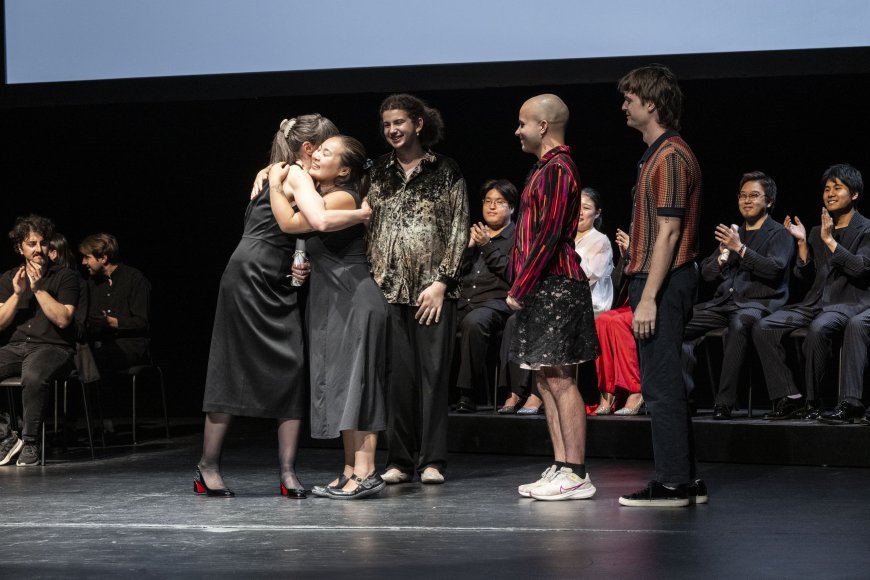
Like a victorious Olympic team, the Poiesis Quartet continues to rack up prizes.
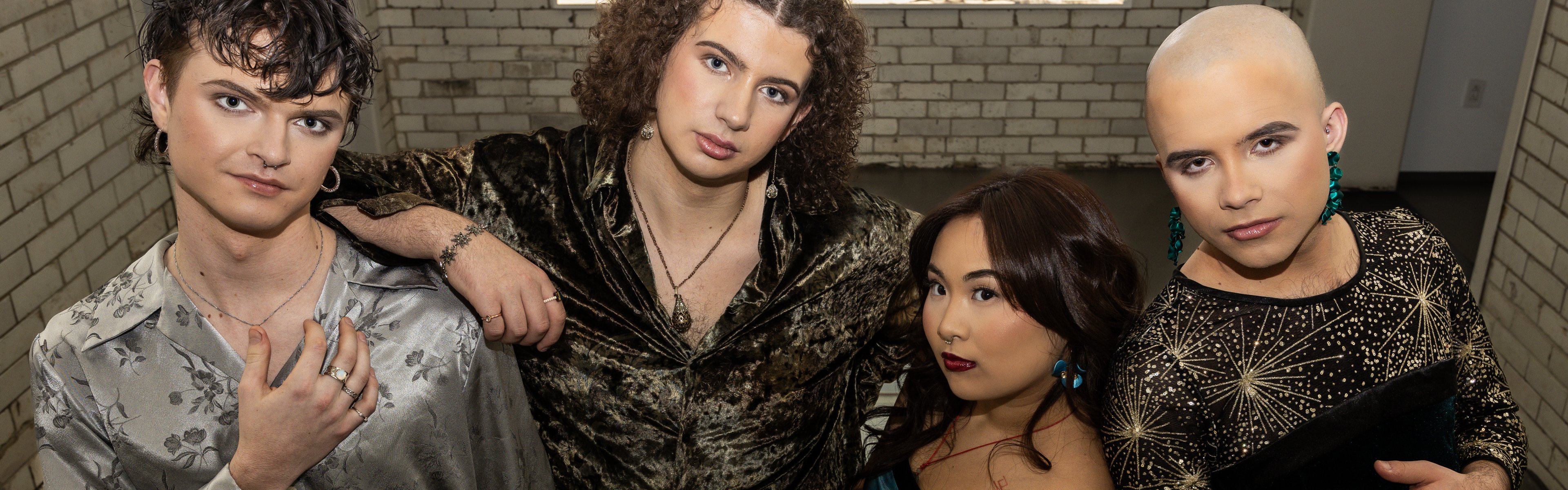
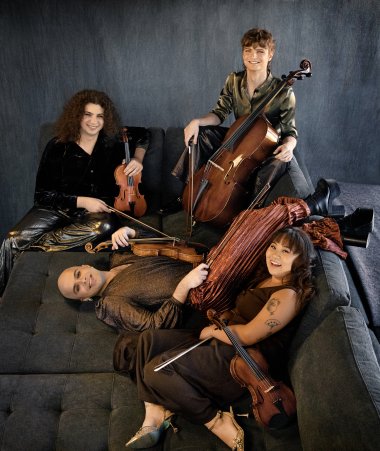
Founded in 2022, the Cincinnati-based ensemble took First Prize and Commission Prize at the 2025 Banff International String Quartet Competition and has been on a musical tear ever since. Its four musicians — violinists Sarah Ying Ma (they/she) and Max Ball (they/he), violist Jasper de Boor (any pronouns) and cellist Drew Dansby (he/him) — are at the forefront of a movement one might call “identity musicianship.”
“Being queer is a part of how we play, how we rehearse, and how we communicate,” explained Ma, 23. “I’m sure many others in the industry view us as a queer ensemble. For us, this is who we are.
“It gives us an insight and approach to the repertory that is unique and different. We don’t know how to play music any other way — authenticity is key.”
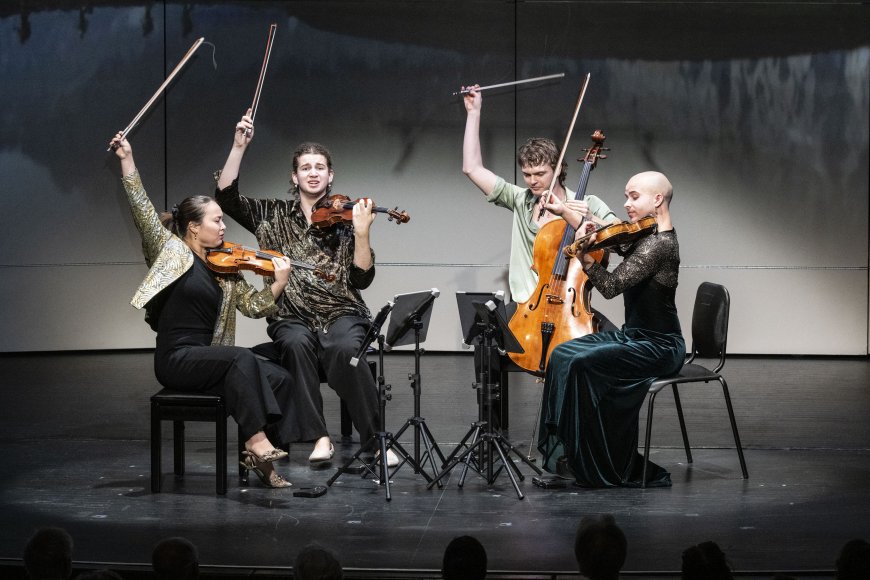
Critics agree on the quartet’s next-level playing. Having recently snagged the 2026 Chamber Music America’s Cleveland Quartet Award, Poiesis was described last December by The New York Times’ Joshua Barone as having “multifaceted artistry,” when he chose the foursome for one of the Best Classical Performances of 2025. Their debut recording “As We Are” (2024) with mezzo-soprano Nancy Maultsby was heralded by Cleveland Classical for the group’s “bottomless depth.”
Audiences will be privy to a Poiesis concert when the group performs at Bing Concert Hall on Mar. 8 as a string quartet in-residence through Stanford Live’s St. Lawrence Legacy Series. The concert includes a mix of old and new works — Sky Macklay’s “Many Many Cadences” (2016), Kevin Lau’s String Quartet No. 7 “Surfacing” (a 2025 Poiesis commission), along with music by Prokofiev and Haydn.
As for 25-year-old Dansby, he said the quartet’s queer-presentation goes “against normal classical music spaces.”
“Identity goes hand in hand with a non-normative repertory and the music we platform. Our philosophy is really about challenging those norms, because we believe that the chamber music scene is moving in that direction anyway,” the cellist said.
The group keeps a rock star-like schedule: its Stanford Live gig is part of a larger spring tour that will take the quartet to Santa Barbara, Fullerton, Tennessee and New York, among other places.
The players met at Oberlin College and won the Gold Medal and BIPOC Prize at the 2023 St. Paul String Quartet Competition soon after forming their ensemble. In addition to championing works by underrepresented composers, they integrate non-traditional styles, genres and voices in their repertory. But, according to Ma, “we also enjoy playing 20th-century repertory. I mean, we love Bartók.”
Ma said the quartet aims to shine a light on others in the music biz who share their mission and ethos, “and who have been trying for a long time to propel the industry forward.”

“A lot of these composers that we love to play have been doing this important work for a long time, and we’re honored to be able to work with them and give their message a bigger platform,” the violinist said.
Then there’s that name: Poiesis. It derives from the ancient Greek word, “to make,” specifically, to create something that has not existed before. Ma admitted to having been obsessed with the idea of Poiesis, having first encountered the word in a philosophy class a year before the quartet formed.
“I was very excited about the concept of creation,” she enthused, “so when [we] formed, I pitched the name, and everybody was in agreement.”
While a homogeneous sound in a string quartet is crucial to a group’s appeal and longevity, individuality comes into play — something Poiesis has in spades. One can’t help but wonder how the players’ distinct identities within the group interact to create their collective sound.
“That’s like asking how hydrogen atoms and oxygen combine to make water,” said Dansby. “It’s such a complicated question when you talk about how individual traits and characteristics combine to make something. But that’s the beauty of chamber music. It’s so unpredictable, [and] there’s always meaning behind it that you can find.”
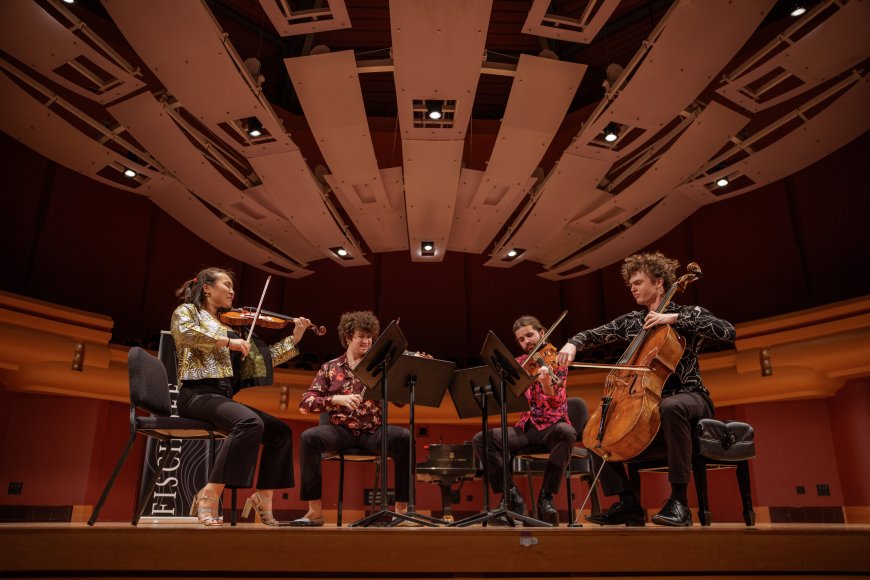
These days, queer people, trans people, and people of color are not yet commonly associated with classical music. But the Poiesis Quartet — with conversations about identity ever-present, and often decked out in crushed velvet, satin and sequins — is all about changing that. Honoring tradition while pushing for greater inclusivity and representation in the art form is a crucial part of that discussion.
“[The classical community is] constantly looking for ways to define what is the canon or what is traditional, when in reality, tradition is everywhere,” Ma said. “A work that we love to play by [the late] Coleridge-Taylor Perkinson [String Quartet No. 1, “Calvary,” 1956, is titled after the spiritual it quotes]. If he’s drawing from African American spirituals, that comes from a tradition that dates all the way back to pre-colonial times and, like a lot of the spiritual and rhythmic structures in jazz and gospel, comes from influences in the African continent.”
Ma firmly believes that Poiesis does indeed represent tradition, while simultaneously working to expand the repertory. She points to the Kronos Quartet and the Attacca Quartet as sources of inspiration for Poiesis. “To view Beethoven and the great Western composers as the emblems of tradition,” she said, “is exactly the type of narrative that we are trying to push away from.”
Though Poiesis Quartet is relatively young, Dansby hopes that they’re “not the same quartet in five years [that they] are now” — evolution is Poiesis’ constant goal.