How did Nicole Paiement’s love of architecture and music guide her to the podium?
“When you’re looking at a score, it’s like you’re looking at a blueprint for an architect,” the conductor said.
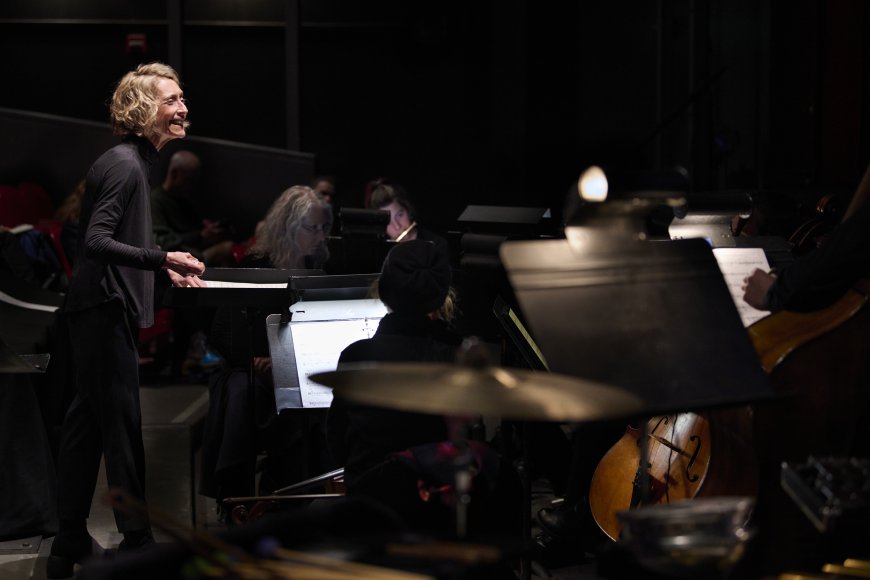
Paiement is the founder and artistic director of San Francisco’s Opera Parallèle, which recently celebrated its 15th anniversary. She will take to the podium at Zellerbach Hall from March 13–14 to lead her company in the classic fairytale, La Belle et la Bête (Beauty and the Beast), presented by Cal Performances. The live performance will feature Jean Cocteau’s film of the same name (1946) accompanied by Philip Glass’s mesmerizing score (1994).
Paiement seems the ideal interpreter of Glass’s works, since she’s been pushing artistic boundaries since Opera Parallèle’s beginnings. The company was the first to produce all three operas that Glass wrote in homage to Cocteau — Orphée in 2011, Les Enfants Terribles in 2017, and La Belle et la Bête in 2022.
Born in Montreal, she went on to study piano and bassoon at McGill University, where she was asked to be an assistant conductor for a performance of Handel’s Julius Caesar. And, voilà, a conductor was born!
Paiement is committed to presenting works that explore relevant social and cultural themes. In addition to her work with Opera Parallèle, Paiement maintains an active career as a guest conductor for orchestras and opera houses around the world, and has gained a reputation as a conductor of contemporary music and opera. Though Paiement earned a doctorate in Baroque opera from the Eastman School of Music, it’s fair to say that she’s rarely met a contemporary opera she didn’t like!
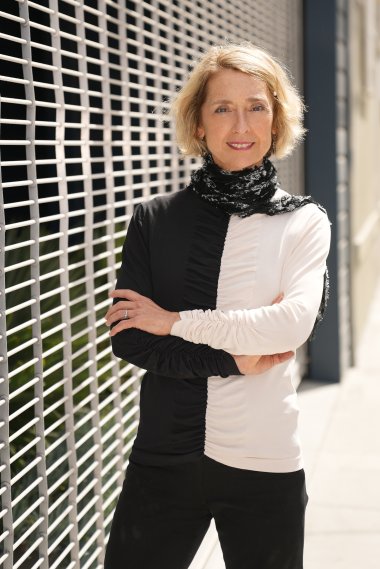
Her 2012 debut with The Dallas Opera, where she conducted Peter Maxwell Davies’s The Lighthouse, led to her appointment as Principal Guest Conductor. Other guest conducting gigs included working at Lyric Opera of Chicago, Seattle Opera, and Washington National Opera — where she led the world premiere of Mohammed Fairouz and Mohammed Hanif’s The Dictator’s Wife.
She’s also served as the Artistic Director of the BluePrint Project at the San Francisco Conservatory of Music (SFCM) where she has commissioned, premiered, and recorded works by many living American composers.
In May, Paiement will lead the West Coast premiere of Douglas J. Cuomo’s Doubt with Opera Parallèle. In October, she’ll debut with Hawaii Opera Theatre by leading Paul Moravec’s The Shining, with a libretto by Mark Campbell.
SF Classical Voice spoke with Paiement about La Belle et la Bête, her repertory choices, and women conductors in opera.
I’d like to begin by asking how music and architecture led you to be a conductor?
I’ve always been surrounded by music through my family life [and] had two great loves as I was developing: one was music, of course, and the other was architecture. At one point, I realized I could maybe combine both of these loves by being a conductor.
You are creating sounds with a full score, [and] when you analyze the score you find pillars, textures, colors – all these things that relate to architecture. I thought that would be a way for me to combine both loves.
Let’s talk Glass and Cocteau. In the New York Times, Allan Kozinn described the work as a “virtually new art form,” since Glass had removed the film’s original soundtrack and replaced it with a live operatic score performed alongside the projected images. What drew you to Glass’s musical language, and what elements define this particular production of La Belle et la Bête?
There has not been one other company that has completed the trilogy. Glass, who came to the 2017 production of Les Enfants Terribles, fell in love with our company and what we were doing, and said, “Oh, you have to finish the trilogy so that there's at least one company that has done it,” [and] I thought it would be a dream.
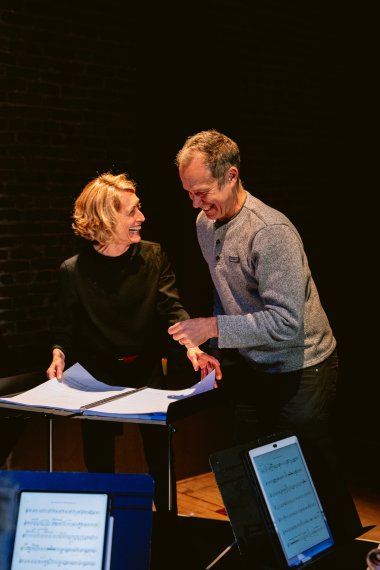
Coming from a French background, I was used to a French style of music that is, perhaps, a little bit more fluid and transparent and flexible. Glass’s music is more structured and measured, but as I got to understand his style, it became clearer to me that not only is it a lot more complex than one can think when they listen, but that it also has that capacity to be elastic and free. But it's done in a very original and unique way.
I think that's why many people who do not know a lot of contemporary composers know Philip Glass. There's something very visceral about rhythm in the human condition — we have a heartbeat, we feel that — and I think that Philip’s [music] has that visceral element that connects people to his music.
Indeed! So, the Glass score reimagines a familiar fairy tale through a hypnotic, yet minimalist lens. What emotions or narrative do you feel most compelled to bring forward in this production?
This piece is meant to be live [with] reverse lip-syncing, where the singers are [in the pit with the musicians] singing the text that the people on the film are saying [while the film is muted].
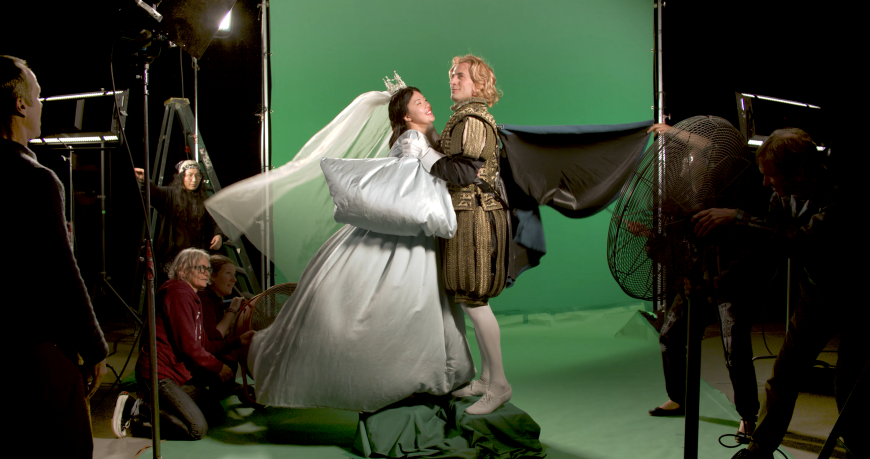
We were given permission to expand on this. [We have] them singing on stage, looking like the people on the film. It takes 3.5 hours to make a mask of the beast, [and] it’s exactly how they did it for the film in the 1940s, with gluing the hair on the face and all of that.
Then, by green-screening our own actors, we put the faces of our singers inside the film of Cocteau. It emphasizes the surreal nature of the film, because it was already eccentric and surreal and magical. But seeing our singers embark and enter that film, makes the story feel timeless.
Having a third film that's playing, which is our version of it with our singers, is very complex. It makes the audience think that they could also be part of that mystical world. It’s a beautiful way of emphasizing the story about how we define beauty, how we define love, the commitment of love. All of these are enlarged by the way we’re producing the piece. It’s a huge, huge undertaking.
Hear, hear! You’ve built a career championing new and adventurous repertory. How has your identity helped shape the kinds of stories you’ve chosen to program?
I don’t think of that so much; I think of myself as a human being who really cares for community. I’m a firm believer that art can transform and bring people together, especially in difficult times. As an artist, I feel compelled to find stories that can bring communities together [and] resonate with people in the hall.
That said, most great stories are relevant because they have a universal theme, and a universal theme can be underlined in a production. Take The Little Prince, which is not a new story, [but] you can find messages relevant today. La Belle et la Bête is another old story you can make relevant.
That’s one of our goals — to experiment. We find these projects that push the boundaries of defining opera. Rather than preserving opera, we’re expanding it.
I love Baroque opera. It was very different than the early Renaissance, because they were pushing boundaries in the world. Period. You don’t think of [Baroque opera that way] nowadays, because it looks pretty simple. But they were pushing all kinds of stagecraft. So, we need to participate in that kind of growth, and that's what we do.
March is Women’s History Month, and Marin Alsop has been calling on a #PurpleBaton campaign to celebrate women conductors in classical music. Where do you see the most meaningful progress for women in opera, and where does the field need to push harder?
We are doing very well in casting and in orchestral players. We’re [also] doing better with production people in terms of directors and set designers. [But] we have to continue to bring women to the podium in the operatic field, which is slightly more complex than conducting a symphonic work, because there are so many more elements to the production.
I think women are great storytellers, and they can really bring a lot to the operatic form. So, I would say, let's continue to encourage women to be on that podium.
Tickets for the March 13-14 performances of La Belle et la Bête are available at calperformances.org, by phone at (510) 642-9988, or in person at the Ticket Office at Zellerbach Hall, Tuesday–Friday, 12–5:30pm and Saturday–Sunday, 1–5pm. Tickets range from $53-$175.