With just four players, a string quartet is more likely to arrive at out-there interpretations than, say, a symphony orchestra. It’s far easier to get things done in a chamber ensemble, but that also means that results may vary. They certainly did at the Feb. 23 concert in Palo Alto by the Aris Quartet.
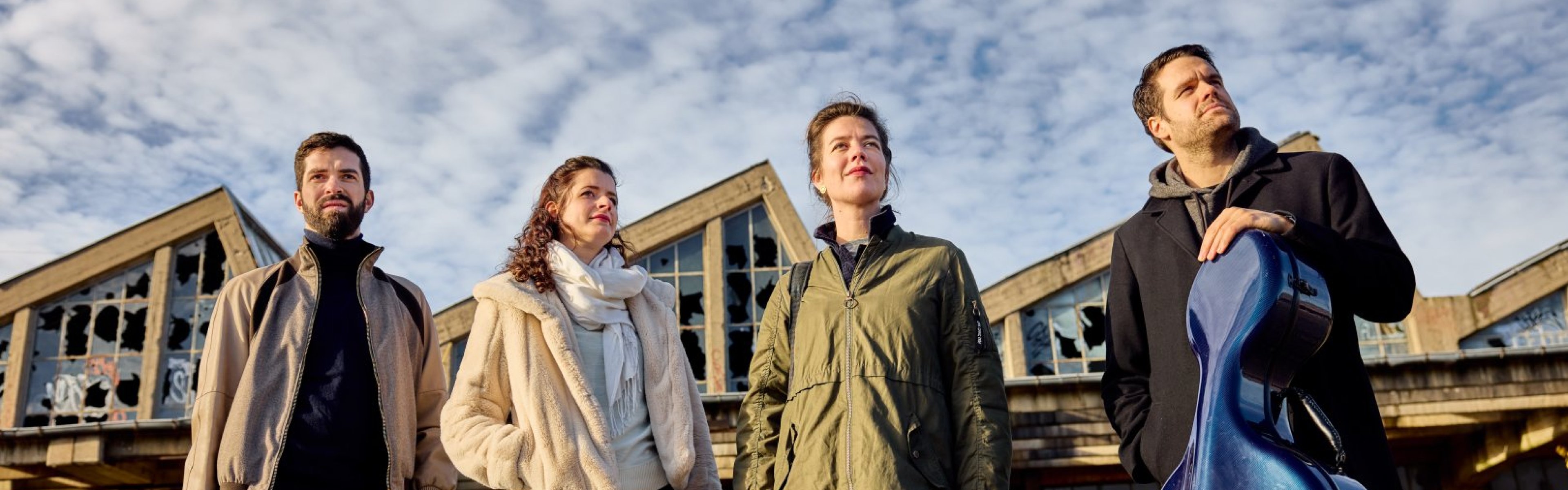
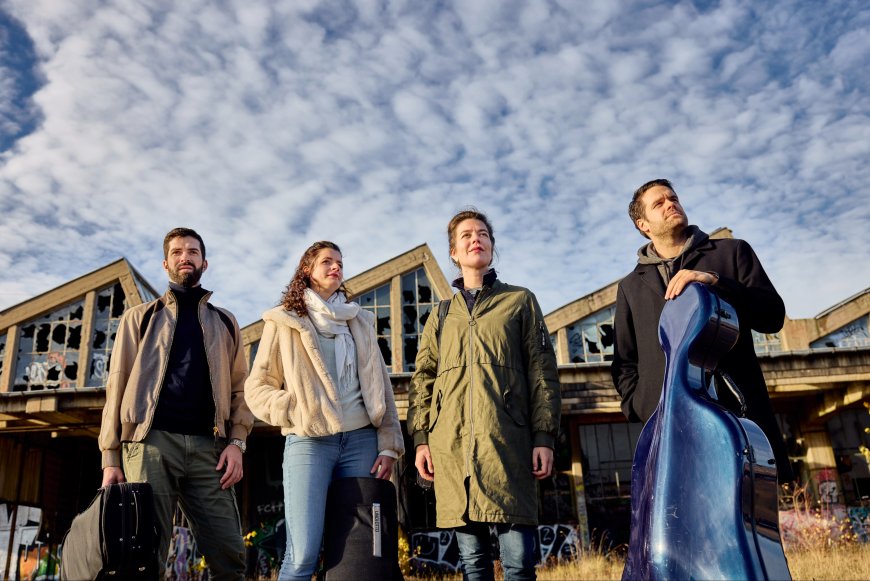
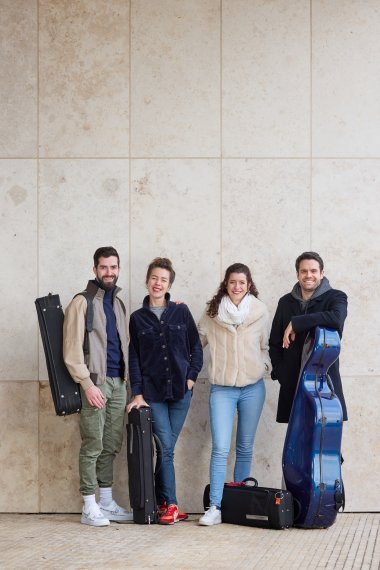
Beethoven’s Op. 18, No. 2 was a felicitous introduction to the German group, whose members (Anna Katharina Wildermuth and Noémi Zipperling, violins; Caspar Vinzens, viola; and Lukas Sieber, cello) are in their 30s and have played together since 2009.
Beethoven was barely 30 himself when his initial set of six string quartets was published. His G Major Quartet, as if introducing itself to musical Vienna, bows and curtseys in dotted rhythms and florid lines, which the Aris Quartet played on Monday with well-considered grace. The interjections were good-natured, the outbursts gentle. The sound was often wispy, the bowing half over the fingerboard. (During the trio section of the Scherzo movement, I saw that Sieber had broken a bow hair — how?)
In the Schultz Cultural Arts Hall at the Oshman Family Jewish Community Center, the blend sounded a tad ascetic. But it wasn’t a bad thing, least of all in the contrapuntal passages, where Beethoven riffs on Bach.
While it’s wonderful that Chamber Music San Francisco brings so many of its programs to Palo Alto, The JCC space is punishingly dry. In the Beethoven piece, even the slightest wobbles were audible. (For what it’s worth, I moved to the back of the room after intermission; the added distance did smooth the edges somewhat.)
The hall’s dry acoustics, on the other hand, did no harm to Shostakovich’s Quartet No. 8. If anything, the fourth movement’s chords rattled all the better.
These fateful knocks and the fugal passages of the Largo movements were the highlights of a performance that otherwise bore frustratingly little resemblance to the group’s fine 2018 recording of the same work.
To be sure, Monday’s situation was complicated by a personnel shakeup: Wildermuth, Aris’s regular first violinist, is pregnant and couldn’t join the tour. Her replacement, Sophia Jaffé, seemed like a natural fit nonetheless.
Indeed, the group was nothing if not consistent in playing the second movement’s Allegro molto — a movement that should evoke high stress, if not terror — with bizarre rubato. One could argue for some wiggle room in the first movement’s recitatives, perhaps. In other passages, however, the broadening emphasized harmonic changes that weren’t there; the music was ponderous for no reason.
Aris’s interpretation of the program’s last piece, Brahms’s String Quartet No. 2 in A Minor, was less ambiguous. Sieber described — or disclaimed — this Romantic-era music as “complex,” requiring “active listening” to hear each of the four voices. In the odd performance that followed, each part sounded atomized, as if each player existed in his own world. The lines were so shaped that even simple textures — two violins playing in thirds — seemed somehow coiled.
Still, beauty glinted practically in every bar. Sieber’s pizzicato was gorgeously languid in the first movement’s intermezzo-like second theme, and the chords of the finale’s coda were stunning in their fragility. These fragments never really coalesced into anything greater, but for the Aris Quartet, maybe they were never meant to. I got the sense that these players accomplished exactly what they set out to do.