Think of a film franchise, and Marvel, James Bond, or Godzilla likely spring to mind. These three series, and many others like them, have been recognized by arbiters of taste while another sprawling cinematic universe has remained largely under the radar. That’s Barbie.
Since 2001, Mattel, Inc. has made 44 movies, most of them animated, starring the titular blonde. But none were as singular and culturally relevant as the live-action Barbie, which finally aired in July, 2023 after years in production.
In the weeks and months before the film’s release, pink was everywhere. In theaters across the world, decked-out fans cheered on the latest Barbie (a flawless Margot Robbie) through her existential crisis about the concept of death and subsequent journey of self-discovery, one that ends up liberating all the dolls – including Ken – from gender stereotypes.
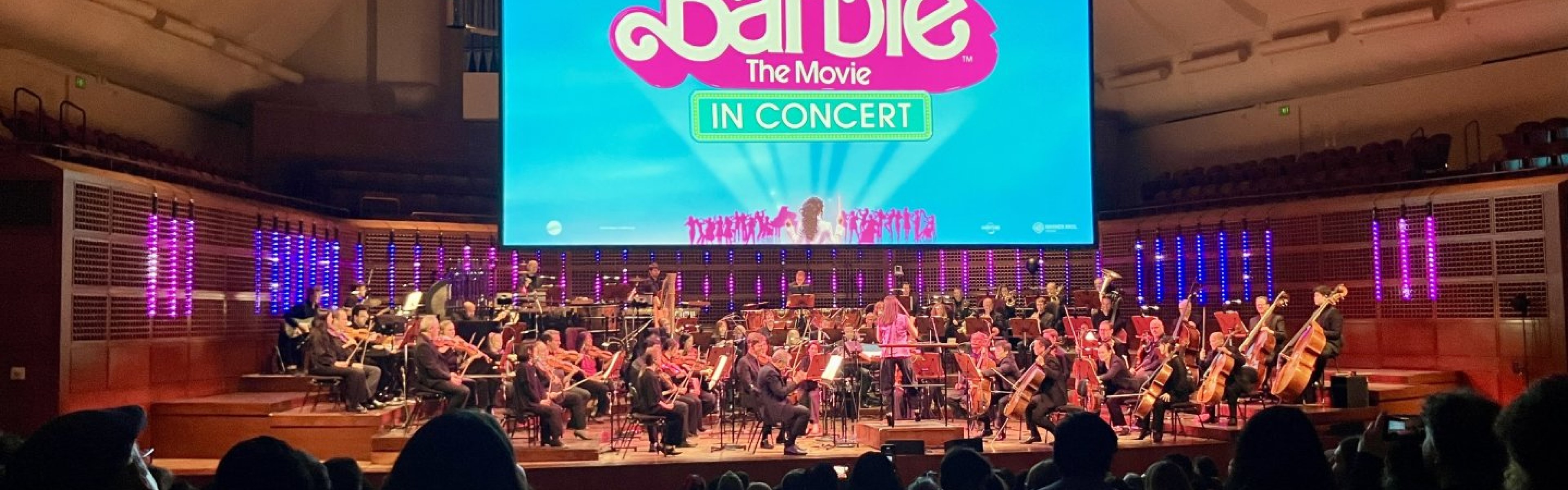
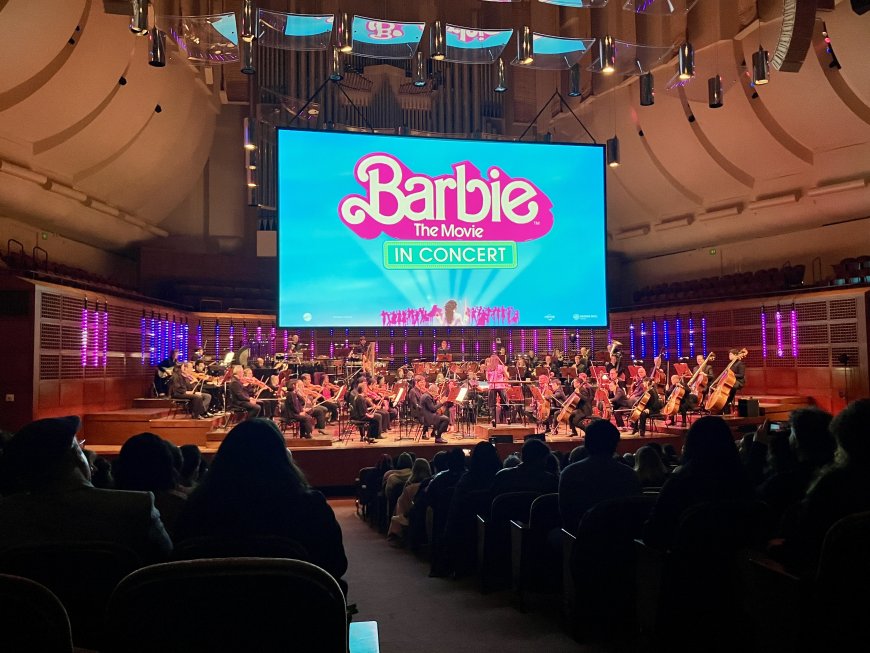
Fast forward to 2025, and the film has mostly faded from view. It wasn’t an obvious choice for a performance by the San Francisco Symphony, especially since the score isn’t particularly symphonic (though Sarah Hicks, a well-regarded film conductor who has often appeared at Davies Hall, is always a natural fit). In concert on Nov. 27, the orchestra often felt superfluous. Still, in moments, the score couldn’t help but sparkle.
A new, majestically orchestrated overture covers all the hits of Mark Ronson and Andrew Wyatt’s score without overstaying its welcome. When a towering Barbie makes her first appearance at the opening of the film, Richard Strauss’s “Also sprach Zarathustra” – well, the same 90 seconds everyone knows from 2001: A Space Odyssey – never sounded so good.
As for the underscore (orchestrated by Matt Dunkley), the brass and lower strings shone on Friday, particularly in the soaring corporate anthem that recurs as a leitmotif. The best music is in the rhythm section, as there’s usually some kind of beat. The SFS percussion section (particularly Jake Nissly on drum set), two contracted guitarists, and John Wilson on keys were working in overdrive.
The wind writing for Barbie is largely unremarkable. The strings fare better — when they’re heard — but they could have used more amplification against such heavy percussion. As for the balance, the movie itself was always too loud.
Ronson and Wyatt’s melodic writing is aesthetically diffuse, taking cues from 70’s rock, 80’s synth pop, and musical theatre. Ronson, a DJ and producer, has said the score’s wide scope reflects a “hodgepodge” of societal messaging “telling the individual who to be.”
Perhaps to gain wider appeal, the duo commissioned 17 original tracks for Barbie, written by younger artists but with references to older songs. Some are forgettable, like GAYLE’s spin on Crazy Town’s “Butterfly.” Other songs are perfectly good like Lizzo’s 80’s-inspired “Pink,” with its wonderfully random second violin licks, and Tame Impala’s “Journey to the Real World,” a psychedelic synth-pop miniature that has just the right amount of cosmic twinkle.
The standout is Billie Eilish’s frankly heartbreaking song “What Was I Made For.” The young singer-songwriter cogently covers Barbie’s loss of identity (“Takin’ a drive, I was an ideal / Looked so alive, turns out I’m not real”), the shackles of masculinity, and the longing for a more equitable future. The song’s melancholy is anticipated in fragments throughout the underscore before it emerges in full bloom. At Davies, this gorgeous orchestral swell evaporated too soon, as well as Eilish’s breathy lyrics.
Director Greta Gerwig (of Lady Bird and Little Women), who also co-wrote the movie with her husband, Noah Baumbach, famously described her work here as "doing the thing and subverting the thing.” The film’s bland but good message — sexism is bad for everyone — must have involved some tightrope walking in order to earn Mattel’s approval and appeal to people across the political spectrum. To the tune of $1.447 billion, it is the highest total gross of any female-directed film. Talk about girl power.
With the Symphony at the fore and under Hicks’s crisp direction, the movie felt lighter, as if relieved of the pressure to perform feminism. At its core, Barbie is a visual feast. But perhaps it would be unrealistic to expect Barbie the movie to measure up to Barbie the doll’s standards. In 2025, it remains a buoyant, upbeat film — one that only occasionally makes the viewer think of death.