
Outside Davies Symphony Hall, a bright green poster promised “A Seasonal Tour.” Its main draw: Antonio Vivaldi’s The Four Seasons, his most famous work and indeed one of the most familiar pieces of Western music, with Bach’s popular “Brandenburg” Concerto No. 5 rounding out the bill.
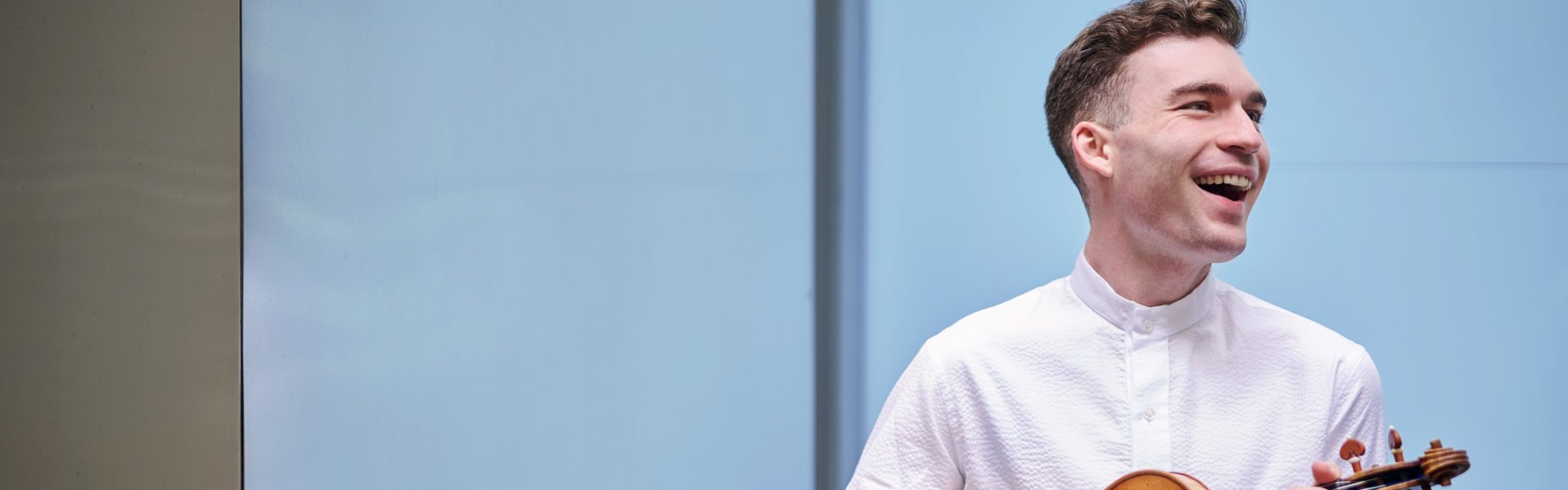
But if audiences expected a comfy, colorful pleasure cruise down an imaginary River Baroque, that’s not what unfolded on Thursday, Nov. 20, for the program’s first of three concerts through Saturday, Nov. 22. With the electrifying and eloquent violinist Alexi Kenney as soloist and ensemble leader, the drama, tension, caressing tenderness, and even violence that can make Vivaldi’s work so gripping came through and then some.
Dressed for the occasion Thursday afternoon in a collarless skin-tight gray shirt, a flowing black skirt over matching pants, and silver boots, the Palo Alto native made his mark right away. He showcased both the softly plush bird sounds and arresting ferocity of his runs and passagework in the opening Allegro of “Spring.” In the Largo that followed, he elaborated several lines with languid ornamentation. He topped off his personal rite of spring with the amusing effect of trading question-and-answer short phrases with himself.
That’s not to suggest the performance was all about the soloist. With little more than nods, head feints, and exchanged glances, Kenney kept the chamber-sized orchestra of about 20 in close accord. Everyone stood, per Baroque practice, with the exception of the cellists and two continuo players.
Listeners no doubt have their own favorite of these Seasons. “Summer” was the one that got to me this time, with its heat-struck sighs, a cuckoo’s natural, off-kilter call, and some harsh, relentless exchanges and powerful unisons of soloist and band.
It was partway through that concerto that I noticed how hard Kenney’s biceps and triceps were working away inside that tight shirt — visceral affirmation of how deeply embodied this performance felt. Never mind the oft-quoted T.S. Eliot line about April; here the summer months were the vividly cruelest ones.
The performance had a few balance issues, with the two cellists’ pedal-point notes repeatedly too loud. Now and then, so was the long-necked theorbo.
The concert opened with two works in their first San Francisco Symphony performances, one a 1644 rarity by a woman composer and the other a Baroque-inflected piece from 2000, by the Finnish composer Olli Mustonen.
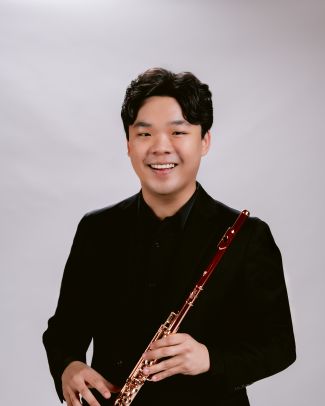
Kenney’s arrangement of Barbara Strozzi’s aria “Che si può fare,” an expression of agonizing love, began with a haze of high harmonics. With flutist Yubeen Kim voicing the melody that would have been sung by a soprano, the aria emerged from its high-pitched cloud in a touching exchange with Kenney’s violin.
Mustonen’s Nonetto II for Strings, a beguiling work in three movements, played a pulsing figure off against a long-lined melody first offered by the cellos and violas. As this dialogue of opposites evolved, a neo-Baroque agreement gradually took hold. The second movement built an affecting pastorale around a simple four-note motif. The piece concluded in a lively scamper, with a few blurry spots on the way to a reprise of the prevailing theme.
The “Brandenburg” Concerto No. 5 was the least successful performance. While the strings played with verve, there was a dutiful, lockstep quality overall. Jonathan Dimmock played the first movement’s long harpischord solo without the driving energy built into its chromatic rise. Kim played the flute part attentively, but his timbre did not pair well with the harpsichord.
Kenney, who had won over the audience with his flashy and sensitive Vivaldi performance, topped off the afternoon with yet another Baroque discovery, in a hypnotizing encore of “Alia Fantasia” by the 17th-century Italian violinist and composer Nicola Mattheis.
Kenney may have had the stage to himself at the end, but from start to finish as soloist, arranger and ensemble leader, he was a dynamic team player.
Correction: Mr. Kim's flute was rosewood not metal, as the review originally stated.