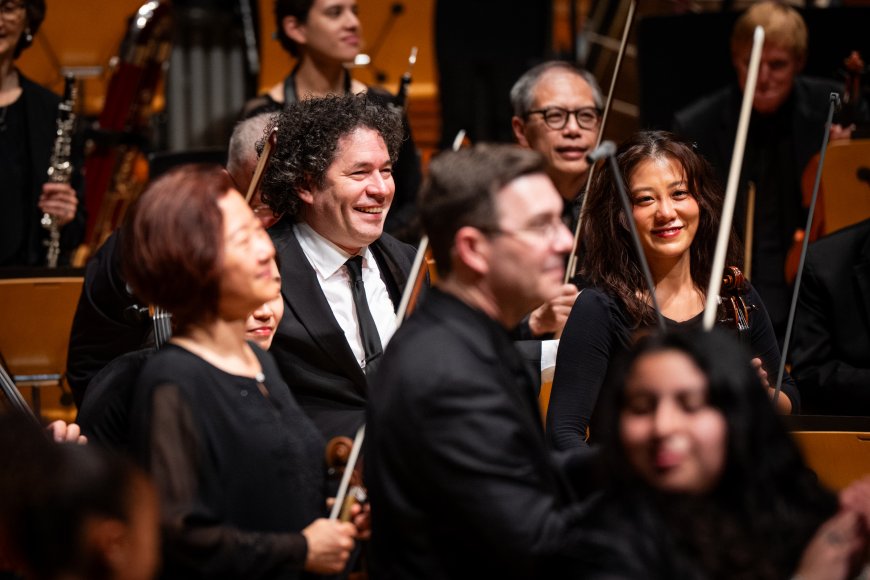
During Gustavo Dudamel’s tenure as music and artistic director for the Los Angeles Philharmonic, the classical recording market as we once knew it dissolved into a confusing mess of incompatible formats.
The now-venerable compact disc received obituaries as the vinyl LP slowly made an improbable comeback. SACDs never achieved critical mass, yet nevertheless hung on as a niche format mainly for orchestral music. Streaming replaced downloads as the prime digital format, and presently generates approximately 80% of the revenue from all recorded music.
It’s a strange new world, reminiscent of the notorious “battle of the speeds” in the late ‘40s and early ‘50s when LPs and 45s were replacing 78s. As a result, Dudamel’s discography (itself a questionable term in these disc-less times) has been doled out in a patchwork of formats that make me wonder whether the decision-makers know what they’re doing.
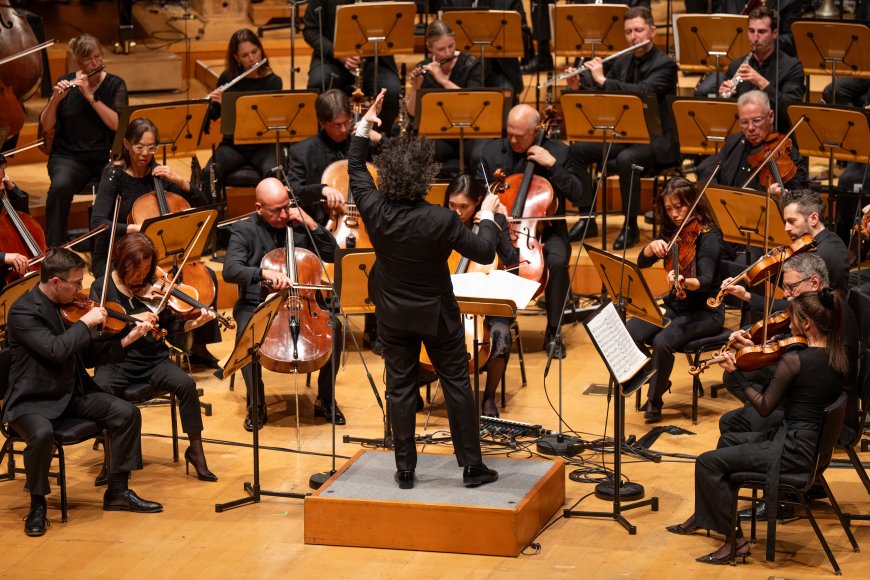
You can’t predict which mediums his recordings will be released in. You also can’t fathom why some recordings are put out almost immediately, while others are held back for years or permanently put on the shelf — a worker at the LA Phil Store in Disney Hall told me that customers are disappointed when they request a certain LA Phil recording and learn it is not available in physical form.
In commemorating the final days of Dudamel’s term with the LA Phil, Deutsche Grammophon — the label to which he is still apparently signed — is rummaging through its ice box for older material. First out is a Dudamel/LA Phil recording of Sergei Prokofiev’s complete Romeo and Juliet ballet that’s been held back for nearly eight years.
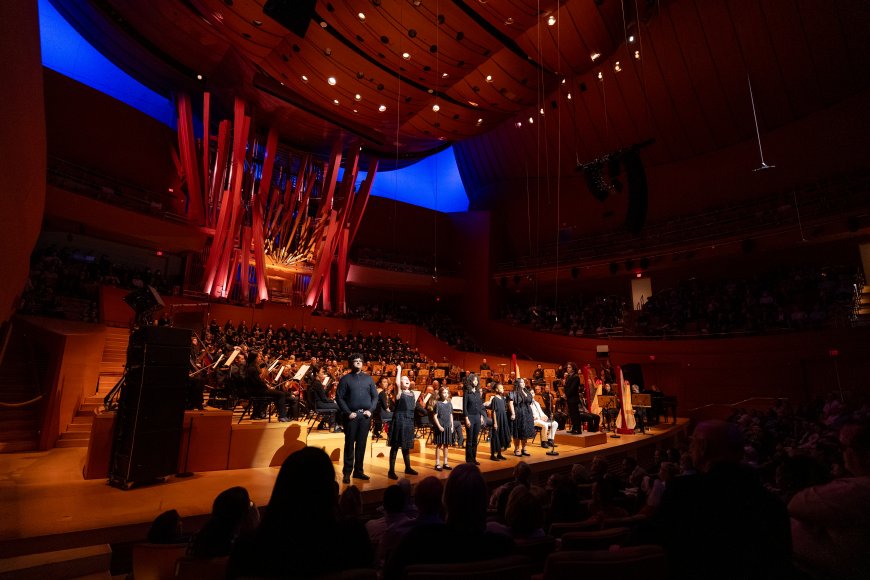
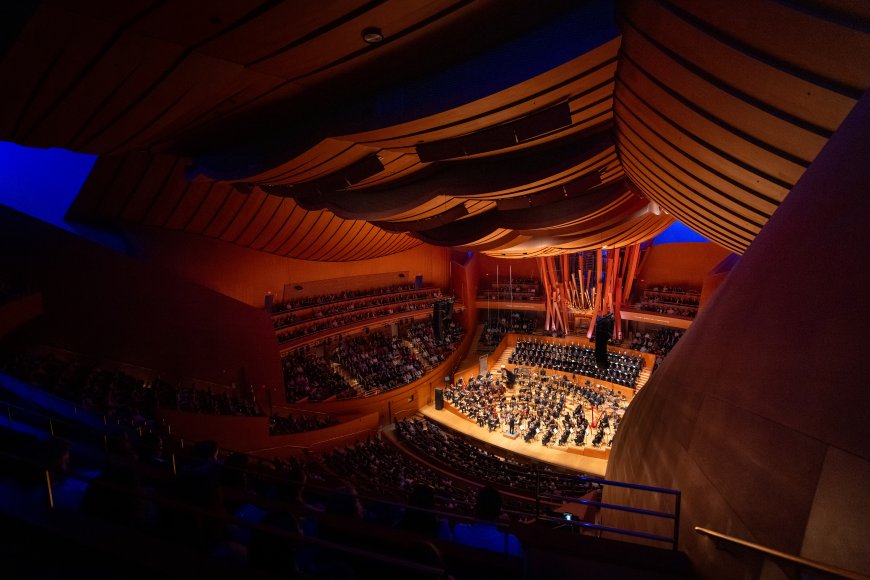
The work was recorded at Disney Hall in October 2018 during live performances in which Benjamin Millepied, artistic director of the LA Dance Project, turned his dancers loose onstage and then, video camera in hand, followed them through backstage corridors and up to the rooftop garden in one continuous shot. I recall that the “Love Dance” was placed right where it should have been — in the idyllic garden, with the stainless-steel exterior walls of the hall symbolizing the never-ending wars between the Montagues and the Capulets hemming the lovers in.
You wouldn’t know any of this, though, from the digital-only format, which has a single uninformative sentence as “liner notes” (another obsolete term for a format with no liners or booklets).
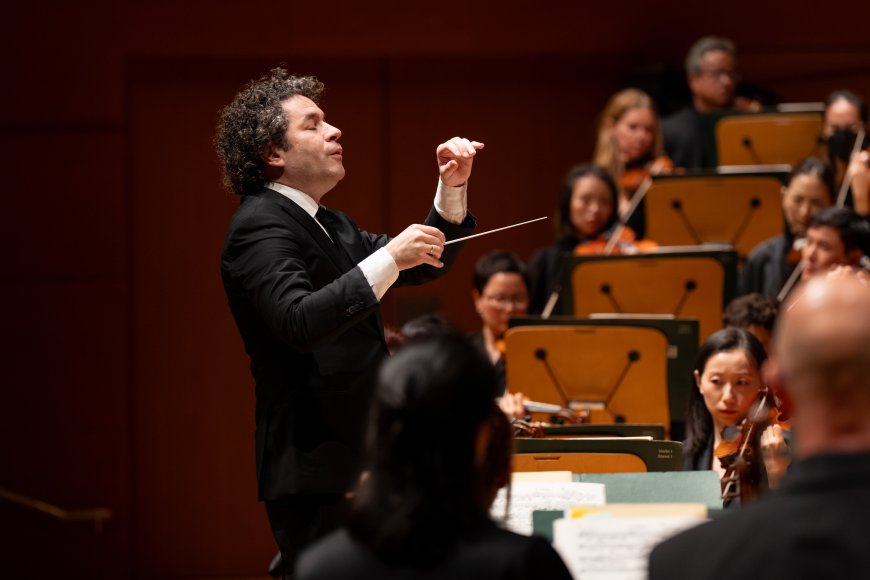
Nevertheless, the audio performance itself is terrific. From the opening bars, Dudamel sets a propulsive pace, cranking it up to warp speed in the fight scenes while bringing tenderness to the lyrical passages. Dudamel is very good with Prokofiev because he identifies with the sharp rhythmic response in this music and pumps up the dynamic contrasts to their extremes. It’s a youthful Romeointerpretation, which was entirely appropriate in the live performance since the dancers were clad in teenagers’ street clothes as if Millepied was referencing the R&J update, West Side Story.
The LA Phil follows right along, sounding like the world-conquering ensemble it has consistently been during the Esa-Pekka Salonen and Dudamel years. Why was this splendid recording sitting on the shelf for so long, and why not issue it in all formats?
More Prokofiev from Dudamel and the LA Phil has also come out via Deutsche Grammophon with the children’s classic Peter and The Wolf, available digitally and on a skimpy, overpriced 12-inch LP with no couplings (it would have made more economic sense as a 10-inch LP). This one dates from the COVID pandemic, recorded at the Hollywood Bowl in July 2021 before a select audience of kids as limited live performances returned.
The sound quality is richly detailed, with little things that you don’t notice very often popping out in the mix. It took a long time, but the Phil’s engineers have learned how to extract excellent results in this problematic outdoor facility.
In this recording, Gustavo takes tempos a little slower than his usual. But he retains a sure grasp of the Prokofiev two-step rhythms that keep things percolating along; you can sense him grinning as he leads. The Philharmonic’s impeccable wind soloists are having grand fun with their solos depicting Prokofiev’s animals and the occasional human. I’m not thrilled about narrator Viola Davis, who overdoes the histrionics in Peter.
Recently, Dudamel and the LA Phil have released their recordings through the digital-only Platoon label — in particular, samples from their Pan-American Music Initiative which will prove to be Gustavo’s most valuable musical legacy from his L.A. period. Their latest Platoon release is a step back from the run of world premiere recordings of new music to the early 20th century, with the idea of magical birds as the theme.
The newest recording is Pájaros Mágicos, extracted from an October 2023 Disney Hall concert containing Heitor Villa-Lobos’s Uirapuru and Igor Stravinsky’s 1919 Firebird Suite. It’s an apt coupling for other reasons besides entertainment for bird watchers; both works originated during the 1910s, both are ballets, and the Villa-Lobos work opens with a splashy flourish that instantly recalls Stravinsky’s Song of the Nightingale.
Uirapuru is a loose-limbed tone poem with indigenous Brazilian effects conjured by delicate touches like a solo flute over xylophone, a piano rumbling in the bass regions, and melodies adapted from aboriginal sources. It has been recorded a number of times before; among them are Leopold Stokowski’s pioneering 1958 stereo recording and Eduardo Mata leading the Simón Bolívar Symphony Orchestra in 1992-93. (People forget that the SBSO was a potent force on recordings well before Dudamel became involved; Latin America Alive, a six-CD box of Latin American classics by the ensemble under Mata, is a benchmark in that field.) Dudamel’s Uirapuru largely echoes the Mata template, but with an extra jolt of energy and urgency.
As for Firebird, this is Dudamel’s third recording of music from the ballet with the LA Phil. Do we need yet another one? Not really, but I would give this one a slight edge for the extra zip in the “Dance of the Firebird” and the most room-rattling “Infernal Dance,” which was already fiery enough.
The Firebird suite has effectively become Dudamel’s signature piece during his time in L.A. Since Stravinsky was an Angeleno for 28 years of his long life, it makes sense as a continuing salute to a former homeboy.