Esa-Pekka Salonen is back again. Conducting.
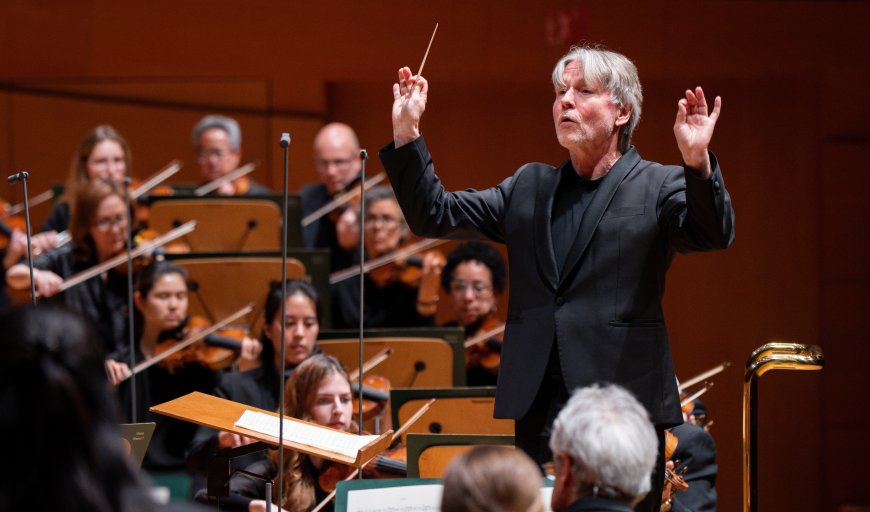
In his first concert as newly appointed Creative Director of the Los Angeles Philharmonic on Jan. 9, Salonen had the audience in the palm of his hand(s) from the moment he stepped onto the podium at Disney Hall. It seemed like only yesterday that he had inaugurated this musical temple at its opening in 2003 as LA Phil’s Music Director, a position he held from 1992 to 2009.
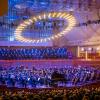
On this occasion, Salonen opened the Body and Sound festival, a feel-good exploration of music’s interaction with our non-aural senses. Alexander Scriabin’s multimedia psychedelic extravaganza, Prometheus: Poem of Fire (1910) anchored the dense and provocative program. As the pyrotechnic finale — with sparkling lighting effects designed by Grimanesa Amarós — Prometheus left audience members gasping in amazement.
What came before (from Jean Sibelius, Gabriella Smith and Claude Debussy) also offered plenty of food for thought — and for hearing and seeing. Except for the new piece from Smith (2025), all the works were composed during the remarkably vibrant artistic period between 1888 and 1913. Under the influence of impressionism and Richard Wagner’s operas, the composers addressed themes of nature and man’s relationship to the environment — both earthly and heavenly.
For an appetizer, Salonen offered an evocative tone poem from his homeland of Finland: Sibelius’s The Oceanides. Composed for a commission from Yale University and first performed in Norfolk, Connecticut, in 1914, it creates a sonic world of frolicking nymphs — the Oceanides, daughters of Oceanus, ruler of the seas.
As in many of Sibelius’s symphonies, the flutes figure prominently in this piece as they depict the nymphs’ graceful antics, set against the deep mellow background of the low brass, with lots of space in between. As usual, principal flutist Denis Bouriakov played with subtle poetic style. Salonen took a leisurely, relaxed approach, allowing the music to float and soar.
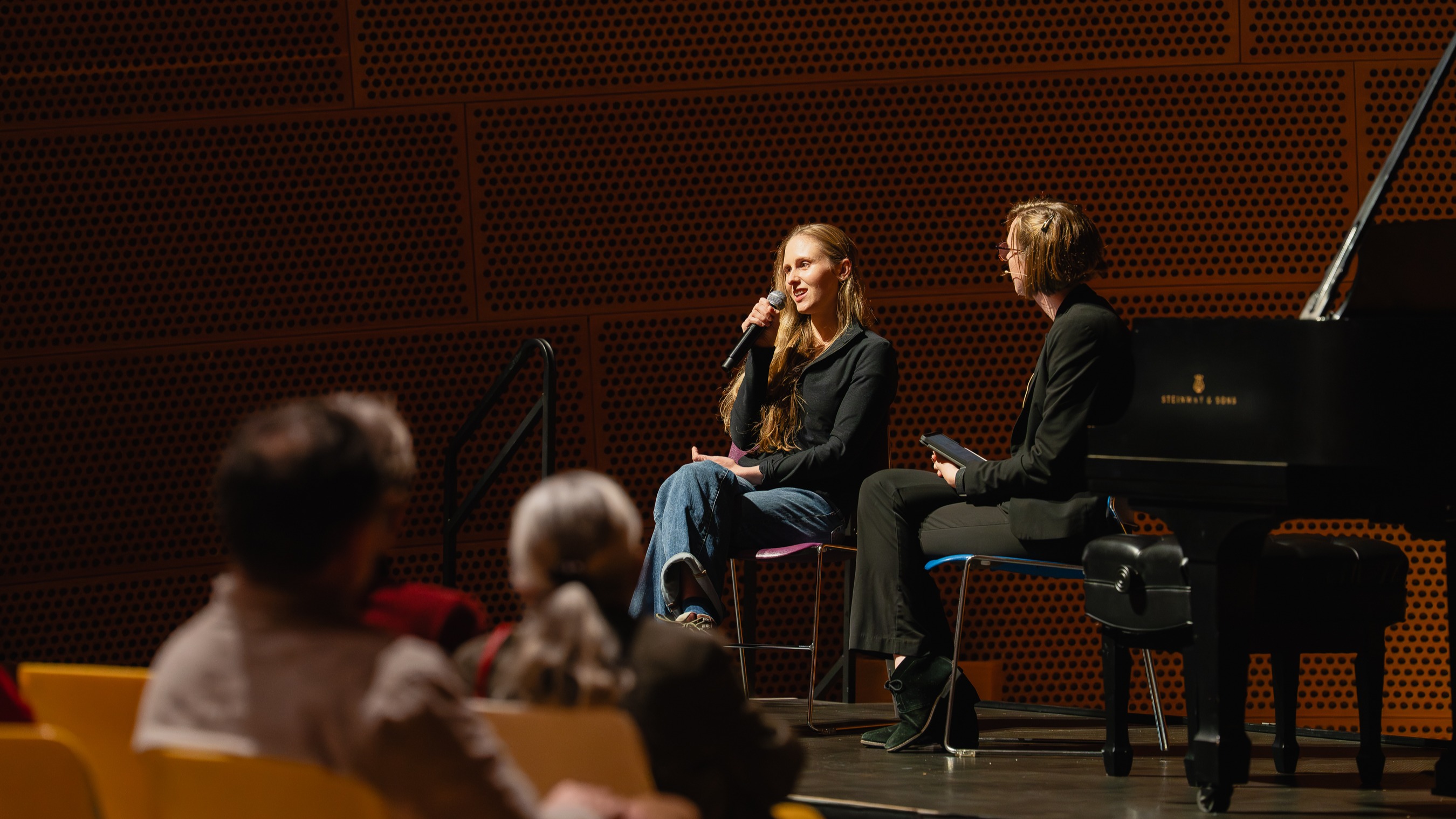
Behind the orchestra, a network of hanging fiber optic tubes (present throughout the evening) glowed a gentle blue. This ocean was gentle, more southern than Nordic.
Gabriella Smith’s Rewilding takes an activist stance toward the natural world. Like other representatives of what has been called “eco-composing,” Smith seeks to heighten awareness of climate change and ecological processes through work that replicates sounds and processes of nature.
Salonen helped to commission the piece, and he conducted its premiere with the San Francisco Symphony last June. Rewilding features some unusual “instruments,” including two used bicycles, metal mixing bowls, walnuts or chickpeas, twigs and branches, and found metal objects. Spinning bicycle wheels open and close the piece, celebrating the joyful use of eco-friendly human energy. Clarinet bird songs, trickling water, crackling, and frog gurgles in the strings set the scene.
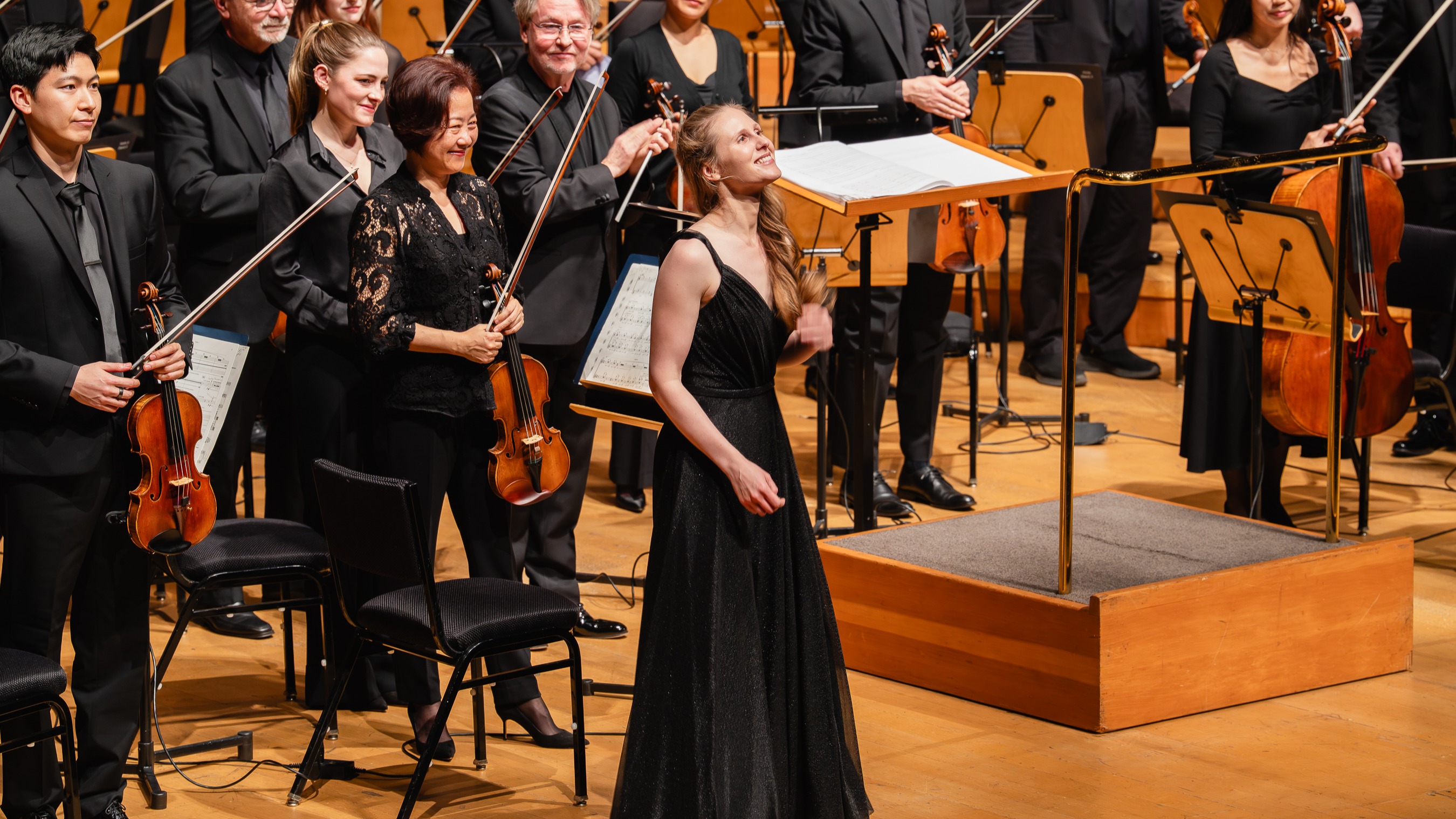
Smith’s radical approach requires an open mind and heart. Plenty of folks were willing to go along, judging by the warm reception Rewilding received from the packed house.
Debussy’s impressionistic La demoiselle élue (The Blessed Damozel, 1888) travels to a different environment: heaven. Set to Dante Gabriel Rossetti’s verses, the cantata dramatizes the suffering of the damsel (in heaven), pining for her earthbound beloved. The vocal writing for a narrator (Chinese mezzo Jingjing Xu, at this performance) and the damsel (soprano Liv Redpath) is rooted in recitative. Both singers brought light and clarity to the poetry, joined by the graceful voices of the women of the Los Angeles Master Chorale.
Hushed and static, La demoiselle élue paints slowly changing orchestral and vocal colors, without much dramatic development — like looking at passing clouds through a window. Salonen elicited a polished, shimmering sound from the orchestra, with eloquent solos by reliable oboist Ryan Roberts.
Prometheus, Poem of Fire, inspired by the Greek myth of the giver of fire to humans, reaches to the cosmos and beyond. When Serge Koussevitzky led the 1911 Moscow premiere, he called it a musical milestone, “a fact of history.” Scored for enormous orchestra with expanded brass and percussion, solo piano part, and chorus, Prometheus produced shock and awe.
But its most innovative feature was the lighting effects reflecting harmonic changes, designed to be executed by a color keyboard (Tastiera per luce). Fascinated by synesthesia or “colored hearing,” Scriabin worked with an electrical engineer to create such an instrument but found the result unsatisfactory.
Scriabin’s futuristic conception — “a spectacular ‘dual symphony’ of light and sound” —exceeded what was technically feasible in 1911, and even for many years afterward. The original published score provided few details, but another score with more precise instructions resurfaced in 1978 and was used for a definitive scholarly edition, first seen at Yale University in 2010.
Other more fanciful attempts have also been made to add multimedia components. Salonen conducted a 2024 San Francisco Symphony performance that added scent — a fragrant collaboration with luxury brand Cartier and perfumer Mathilde Laurent.
These LA Phil performances, however, used Amarós’s new installation Radiance, a “light sculpture inspired by fire.” LEDs and reflective materials created “a visual interpretation of the fire Prometheus brought to humanity and the wisdom it represents,” and drew parallels between Prometheus and Viracocha, the Incan creator god.
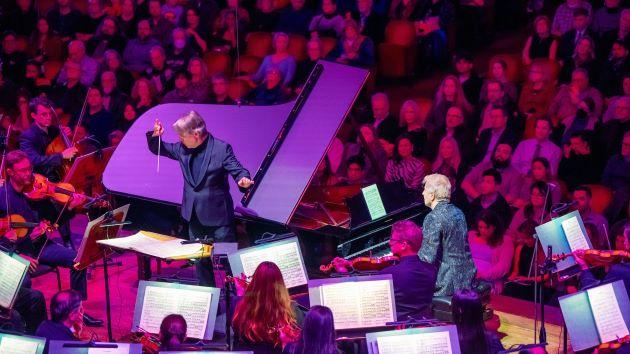
Salonen conducted with fervor and intensity. Disney Hall favorite Jean-Yves Thibaudet executed the fluttering piano trills with his usual élan, and the Master Chorale made the most of their loud three minutes at the end, adding to the stupendous cacophony.
But the lighting failed to coordinate with the musical structure the way Scriabin intended. Shades of yellow and red ebbed and flowed, but without logical connection to the harmony or various themes. Scriabin would likely have been disappointed with the result, because he had something much more specific in mind.
But it was still a spectacular show which augured well for Salonen’s new responsibilities.