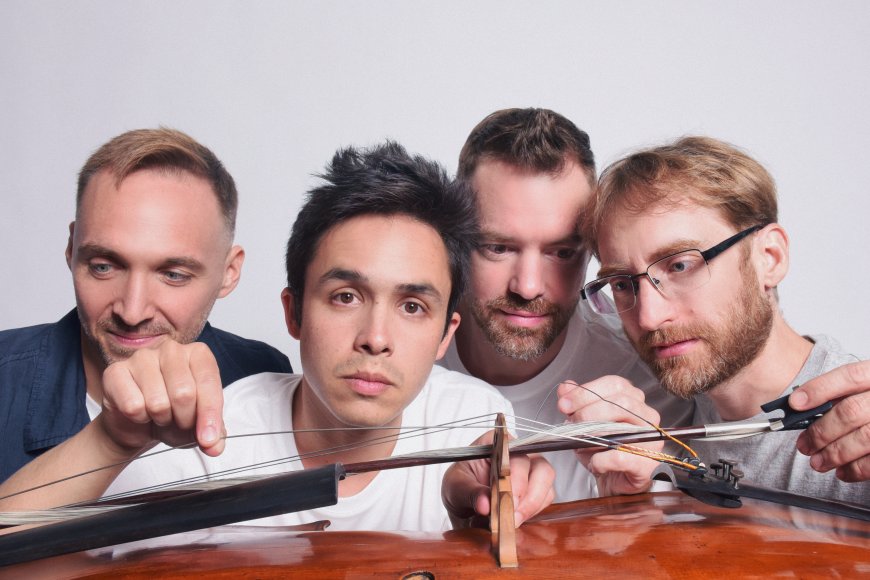
The music of the late composer Wolfgang Rihm — as tender as it is abrasive — is rarely heard in Bay Area concert halls. For those lucky enough to experience it at the JACK Quartet’s Cal Performances debut this past Sunday, March 15 in Hertz Hall, the encounter was nothing short of electrifying.
Dwarfing the other works on the program in scope, Rihm’s String Quartet No. 3, “Im Innersten,” asks a great deal of the quartet. Its volatile moods shift from romantic espressivo one moment to acerbic scrapes the next. But the JACK Quartet rose to the task brilliantly. The dense polyphony that characterizes the piece was rendered strikingly transparent in this performance. Emerging from this chaos are bursts of gasping and sighing in rhythmic unison between the players. The musicians gave great care to these moments, fluently switching on a dime from soloistic virtuosity to palpable cooperation.
Even among the best quartets specializing in avant-garde repertoire, the keen ear for phrasing required to shape Rihm’s sinuous melodies can atrophy — this is definitively not the case for the JACK Quartet, whose nuanced delivery of transitional passages was particularly notable. The extreme pianissimo slow sections sounded with a chilly hollowness that kept them from simple nostalgia, imbuing them with a sense of longing.
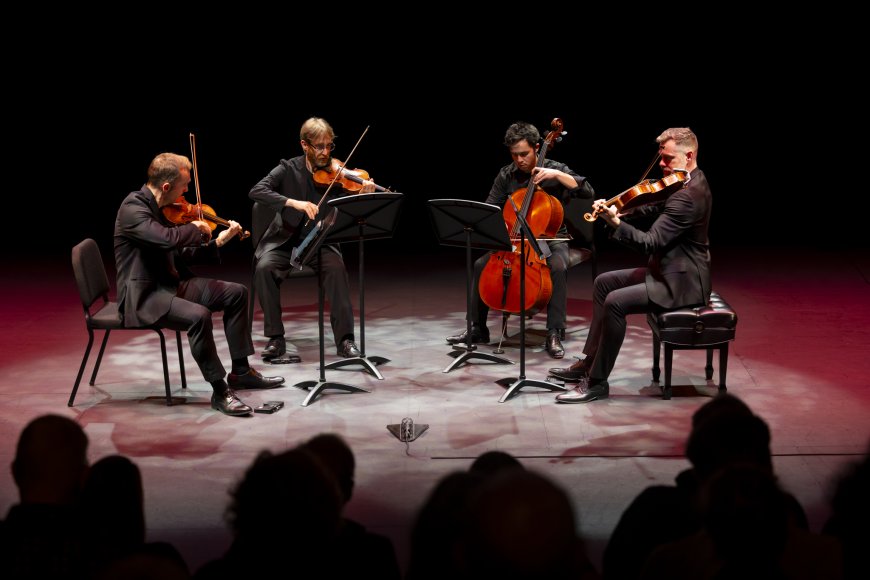
Speaking to the audience, violinist Austin Wulliman linked all five pieces on the program together as “capturing a moment.” If there is a moment that “Im Innersten” captures, it is clearest in its final bars: underneath crunching bow noises reminiscent of vocal fry, the viola hovers alone oscillating between two notes — the interval of a minor third. Already a haunting gesture in Rihm’s quartet, it was exceptionally chilling in the context of this concert, because it eerily echoed the main melodic idea shared by two preceding works on the program.
Wulliman himself composed the first piece of the afternoon, “The Late Edition,” which weaves a vivid tapestry from the motive of a minor third (the same interval as in the opening words to “Hey Jude.”) The motive is bounced around the quartet, which keeps a rhythmic drive of persistent pulsing notes before culminating in rich spectral chords inspired by Wulliman hearing a close-miked snare drum. What for Rihm was an agony at the gulf between “new music” and “old music” becomes, in The Late Edition, a welcome ambivalence to historical divides between the avant-garde and minimalism.
The penultimate work on the program, Gabriella Smith’s “Aegolius,” similarly concerned itself with this oscillating minor third, though here it was insistent and pressingly fast, mimicking the calls of owls. Even before Rihm’s quartet had slowly recalled this shared melodic figure, the pulsing textures of “Aegolius” immediately stood out as being distinctly in dialogue with Wulliman’s piece.
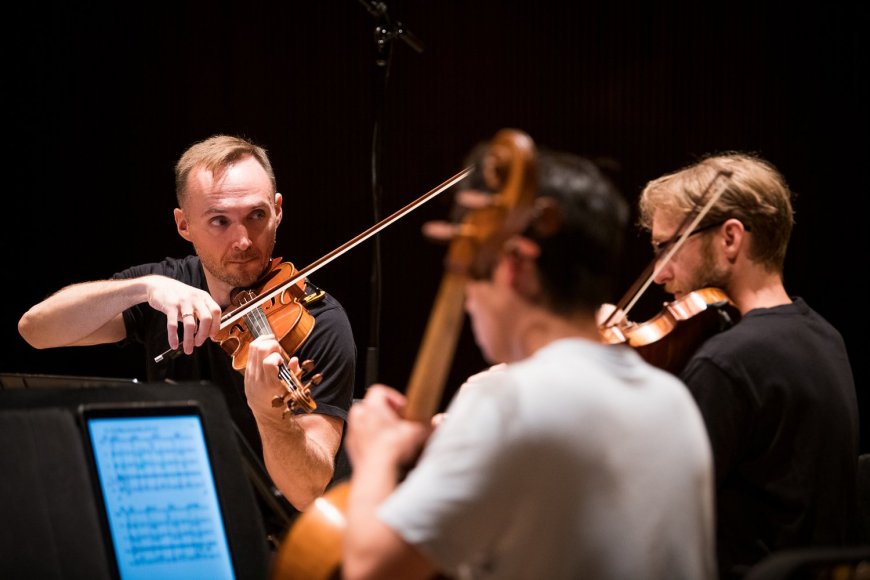
In this lively performance, Smith’s writing felt incredibly natural to the quartet, each part contributing to a unified but layered ensemble sound. The energy eventually congeals into long tones in simple harmonies passed around the ensemble, like the crossfading of a stereo. The harmonies seemed to physically dance around the room, with no clear breaks in sound between the players. Then, subtly, the bow changes sustaining the long notes grow quicker, building in intensity until they become the very insistent pulsation with which the piece began. Where the two-note motive was germinal in Wulliman and somber in Rihm, in Smith’s hands it was exuberant.
If Sunday’s program had a weak link, it was the quartet’s performance of Hans Abrahamsen’s String Quartet No. 4. For audiences familiar with the composer through his lush orchestral song cycle let me tell you or his enigmatic album Schnee, Abrahamsen’s Fourth Quartet could easily read as austere to a fault. Rarely is his rigorously intricate music so baldly structured.
The first movement adds the instruments one by one to an interlocking pattern of high whistling harmonics — first violin alone, repeated with second violin, this duo repeated with viola. Just when it seems that the cello may enter, the trio drops out and the cello alone plays a stratospherically high note. Then this whole orderly process repeats in variation. For the third movement, this whole procedure (repetitions and all) occurs again from the bottom up, starting with solo pizzicato cello, culminating in the first violin playing its low croaking vocal fry sound.
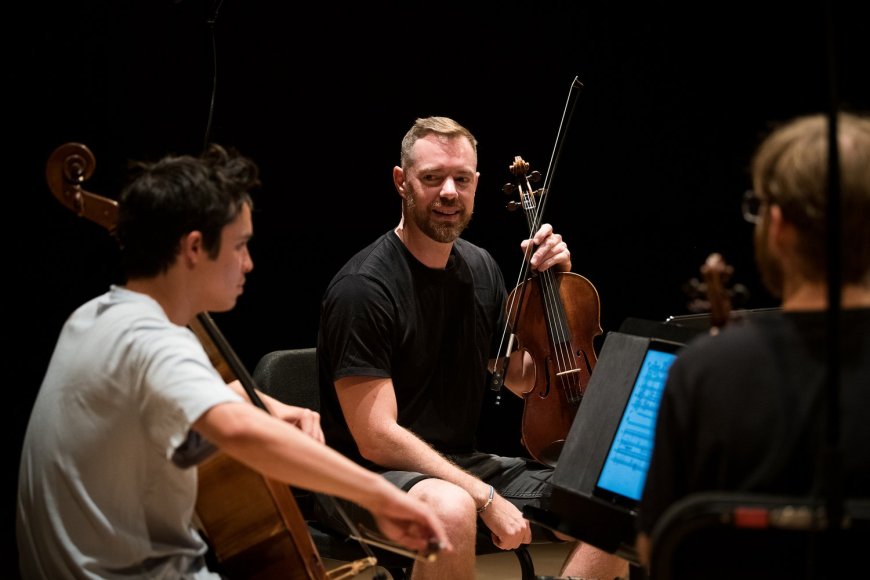
Granting that Abrahamsen’s rhythms are maddeningly difficult to play, the quartet nevertheless sounded under-rehearsed. The complex canons between the parts failed to congeal into the promised “groove.” The result was not the intended accumulation of contrapuntal density but music that simply started and stopped too frequently and predictably.
Still, the afternoon was incredibly polished overall, with masterful intonation throughout on all the microtonal inflections. Perhaps the strongest aspect, however, was the curation. Each piece on the program seemed to comment on and refract the ideas of the others in ways entirely unforeseen by the composers. It was this insightful programming and interpretation that made the JACK Quartet’s impressive performance truly convincing.