The same year Theodore Roosevelt was first elected president and Antonín Dvořák died, Alice Coleman Concerts celebrated its inaugural performance at the Elks Club Lodge in Pasadena — January 25, 1904.
It featured the Krauss Quartet made up of members drawn from the newly established Los Angeles Symphony Orchestra with Coleman (a classically trained musician) as the ensemble’s featured pianist, a role she filled for the next 35 years.
Coleman later became a major proponent of new music. In 1964, she gathered a coalition to create “Encounters,” a series of musical gatherings focused on connecting composers and listeners and moderated by pianist Leonard Stein. The series’ remarkable roster of composers included Milton Babbitt, Luciano Berio, John Cage, Ingolf Dahl, Morton Feldman, William Kraft, Ernst Krenek, Harry Partch, Mel Powell, Karlheinz Stockhausen, and Morton Subotnick. Between 1971 and 1973, “Encounters” premiered Lou Harrison’s opera with puppets, Young Caesar, presented a dual recital by Olivier Messiaen and his wife, Yvonne Loriod, as well as performances by Leon Kirchner, György Ligeti, Terry Riley, and Toru Takemitsu.
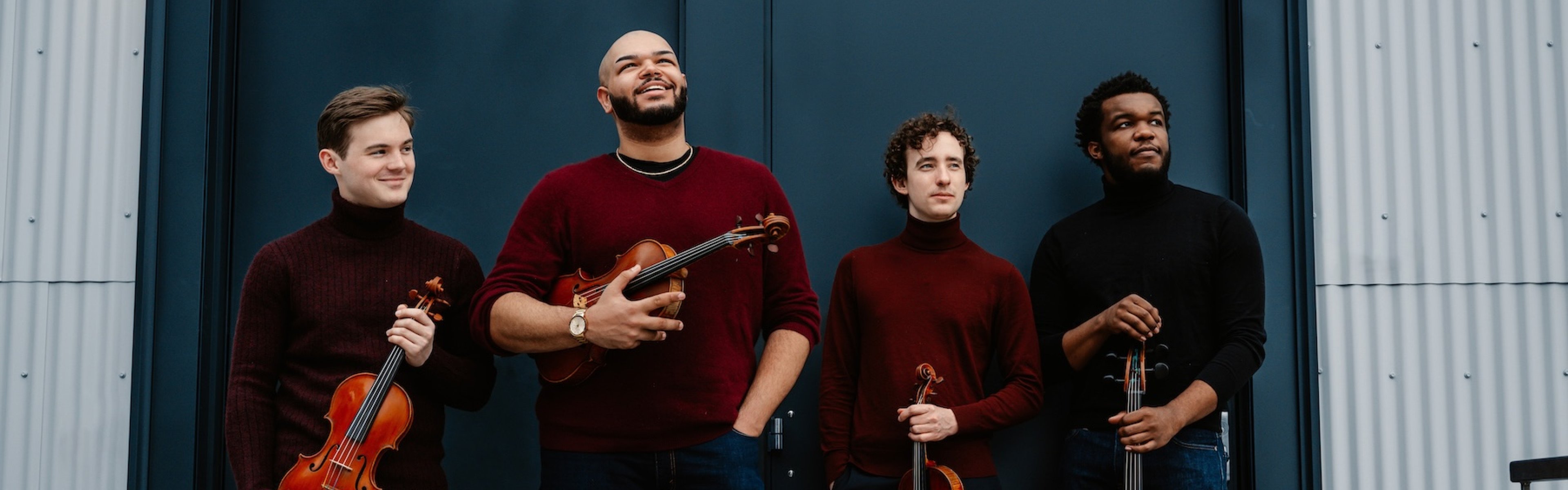
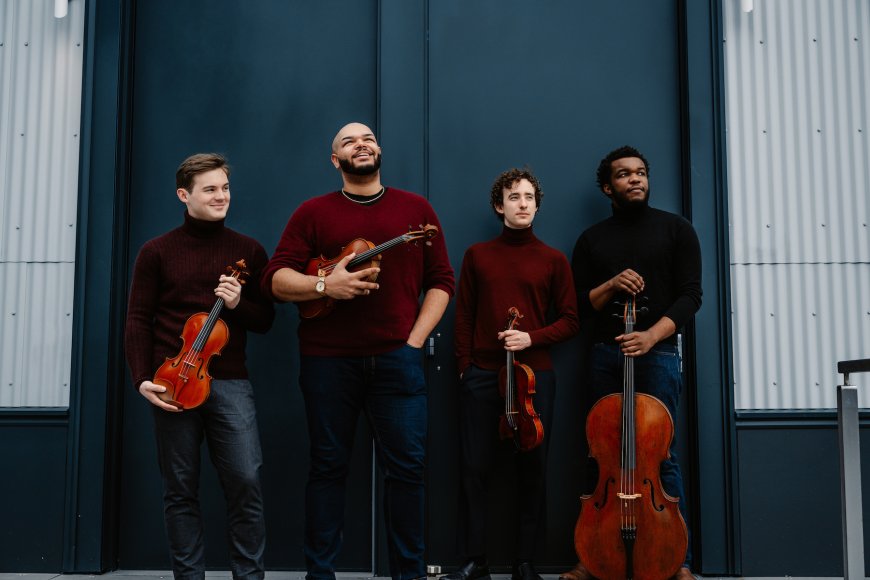
At 122 years and counting, the series, now called “Sundays with Coleman,” is thus the oldest independent chamber music series in the U.S. Its Feb. 15 presentation was interesting, though more on the traditional side — a concert of Bach, Brahms, and Beethoven performed by the Isidore Quartet: Adrian Steele and Phoenix Avalon (violin), Devin Moore (viola) and Joshua McClendon (cello) at Beckman Auditorium on the campus of Caltech.
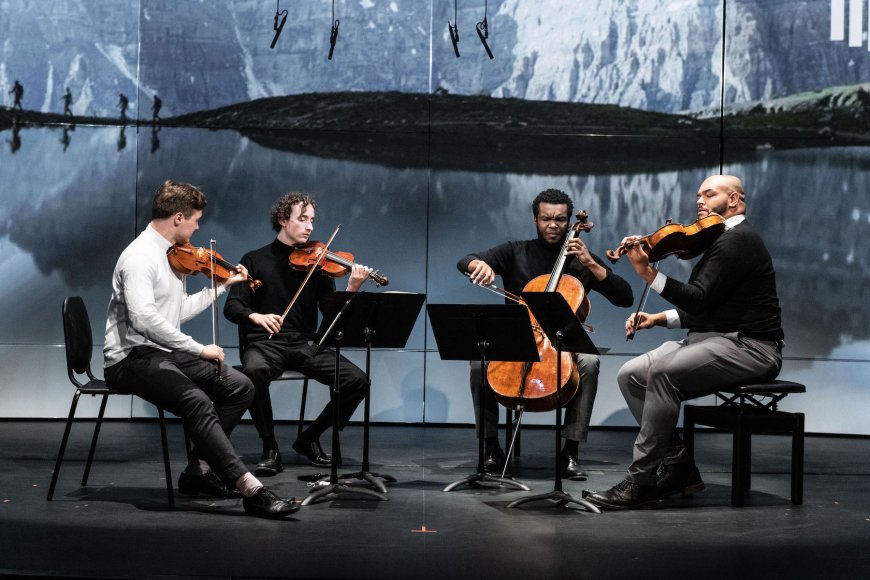
Winners of the 2022 Banff International String Quartet Competition, the ensemble has been praised for its “polished sonorities, instrumental balance and faultless intonation.” Those qualities were for the most part apparent Sunday. In the spirit of Olympic judging, however, I would have given the group far lower marks for energy, bravado, or any sense of risk-taking.
The program was designed to draw connective threads: first, between the Gregorian chant basis of some chorales of J.S. Bach and their interpretation by Brahms (in string arrangements by Moore), and then between Beethoven’s innovative String Quartet in B-flat Major, Op. 18, No. 6 with a Brahms’s String Quartet No. 3 in B-flat Major.
Beckman Auditorium (a campus relic of midcentury modern architecture) is hampered by an exceedingly dry, distant acoustic. It’s hard to know what the performances sounded like to the musicians versus the way they sounded in the hall. Delicacy became prissiness. Fortes faded like mist. Caltech deserves a contemporary concert venue.
Bach’s chorales and Brahms’s ruminations on them in his Geistliches Lied are almost monastic in the rigidly confined arrangements by Moore. The exception was the richly flowing arrangement of the “Agnus Dei” from Bach’s Mass in B Minor.
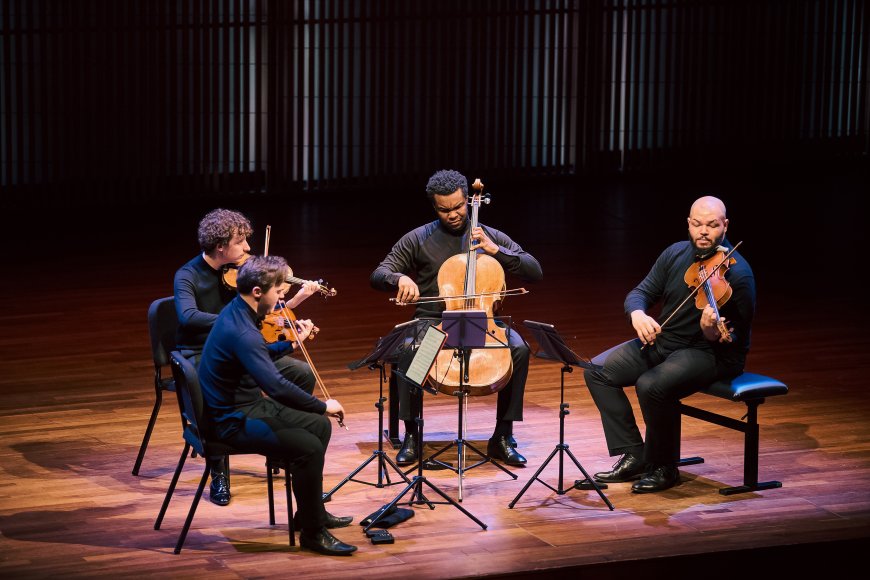
The Isidore Quartet’s most impressive playing came in the third-movement scherzo and the finale of Beethoven’s quartet, which clearly had an influence on Brahms. The concert-ending performance of Brahms’s quartet offered the musicians the chance for more dynamic instrumental interplay, which they executed with exactitude if not ebullience.
The Isidore should get credit for thinking through the music on their concert program and presenting it well. Looking back on Alice Coleman’s innovative approach to new music, I’d like to see the adventurous spirit that defined the “Encounters” era incorporated into the contemporary programming. That said, this year’s schedule has plenty to recommend and keeping this SoCal treasure going is important work.